
What if the funnel that works for an online store is the wrong fit for your service business? The best Sales Funnels examples don’t follow one template. They reflect how your customers research, decide and get in touch.
If it’s unclear what should happen between someone finding your business and becoming a customer, you’re not alone. Picture a homeowner searching online for a tradie: they land on a clear service page, send an enquiry, then receive a useful follow-up. Each step has a purpose, without adding needless complexity.
This guide explores practical funnel models for different buying journeys, from attracting potential customers with helpful content to turning high-intent enquiries into sales conversations. You’ll see which website, advertising, email and follow-up touchpoints may suit each stage, and what to measure so you can improve the journey over time.
Start with the path your customers already take, not a complicated diagram. Consider where people discover your business, what helps them choose you and what happens after they enquire. PurpleCow Digital can help connect those steps through website design, search engine optimisation (SEO), advertising, content and follow-up.
Key Takeaways
- Sales Funnels examples work best when they match how customers make decisions, not when they follow a one-size-fits-all template.
- Compare funnel models by purchase complexity, decision time, repeat buying and whether a sales conversation is needed.
- Keep your first funnel focused: map the key decisions, choose only useful touchpoints and assign responsibility for follow-up.
- Track whether prospects move to the next meaningful step, then refine the journey using what you learn.
- Connect your website, SEO, advertising, content and email to support a clear path from discovery to enquiry.
What Is a Sales Funnel, and Where Do Prospects Get Stuck?
An interested prospect can disappear simply because the next step isn’t clear. They find your business, compare their options, then reach a page that doesn’t explain how to enquire or what happens next. A sales funnel helps you identify those gaps and plan a more useful customer journey.
A sales funnel is a planning model for the stages people move through as they discover your business, consider a purchase, become customers and decide whether to return. It’s not a fixed, linear script. People may skip a stage, revisit an earlier one or take a different route before they’re ready to act.
The purchase funnel is a familiar way to describe this journey, but stage names and boundaries vary between businesses. Treat the model as a practical way to ask what someone needs next, not a rulebook for how every buyer behaves. That’s a useful starting point for adapting Sales Funnels examples to your customers.
What are the main sales funnel stages?
Awareness is when someone discovers your business or recognises a need. Consideration is when they explore options and assess fit. Decision is when they take a meaningful next step, such as making an enquiry, booking a consultation or purchasing.
Some businesses also plan for retention after the sale. This stage covers the experience that encourages a customer to return, continue using a service or recommend the business. It may matter more for ongoing services or repeat purchases than for a one-off job.
These labels are prompts, not universal categories. A prospect might see a social media post, search for your business later and enquire without a long comparison period. Another may read several pages, leave, then return when their need becomes more urgent. Make each relevant next step clear, and measure where people stall.
How is a sales funnel different from a sales pipeline?
A sales funnel maps the customer’s journey, including the information and experience that help someone move towards a decision. A sales pipeline tracks sales opportunities and the actions your team takes to progress them, such as responding to an enquiry, preparing a proposal or following up.
For example, imagine a business offering regular pest inspections. Its funnel might begin when a property manager finds an educational page, compares service options and submits an enquiry. Once the enquiry arrives, the pipeline could track whether the team has contacted the prospect, discussed their needs and sent a proposal.
The two models connect, but they answer different questions: what is the customer experiencing, and what is happening with the sales opportunity? Marketing and sales teams may use different labels for the same stage. Agree on clear definitions, such as what counts as an enquiry worth following up, so handovers and reporting stay useful.
5 Sales Funnel Examples for Different Customer Journeys
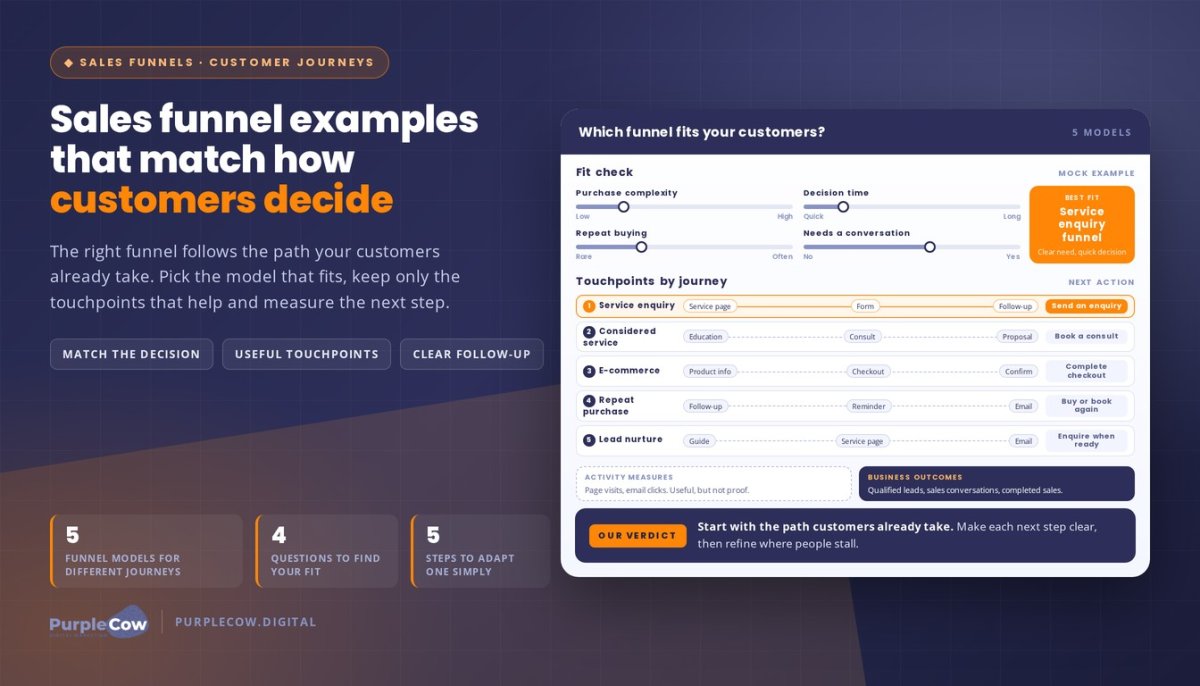
These illustrative examples show how a funnel can change with the customer’s decision, from a straightforward service enquiry to a repeat purchase. They’re planning models, not client case studies or promised results. For each one, focus on the customer’s need, the touchpoints that help and the next useful action.
1. Service enquiry funnel
Suitable business: trades and professional services. Customer need: find a provider who can address a clear problem. A need-led search or referral leads to a focused service page with relevant information, a clear enquiry form and an explanation of what happens next. The business responds, holds a discovery conversation and follows up to answer questions and assess fit. Next action: submit an enquiry or arrange a conversation.
2. Considered-service funnel
Suitable business: consultants or providers of more involved services. Customer need: understand the approach before committing. Helpful educational content leads to a consultation, then a proposal that sets out the recommended work and supports a considered decision. Follow-up can clarify the scope or answer questions, rather than simply repeating the pitch. Next action: book a consultation or decide on the proposal.
3. E-commerce first-purchase funnel
Suitable business: an online retailer. Customer need: choose a product and feel confident completing the purchase. Product discovery leads to useful product information, a clear checkout and a purchase confirmation. Post-purchase communication can explain what happens next and provide relevant support. Next action: complete checkout, then engage with the follow-up information.
4. Repeat-purchase funnel
Suitable business: a retailer or service with customers who may buy again. Customer need: know what to do after the first purchase and when another purchase may be relevant. Helpful post-purchase content, a service reminder or a relevant email can guide the next step without sending unrelated messages. Next action: return to purchase, book a service or respond to a relevant offer.
5. Educational lead-nurture funnel
Suitable business: a business with a service that prospects research before making an enquiry. Customer need: build understanding and compare options at their own pace. A useful article or guide leads to related content and, where appropriate, an email follow-up with more detail. Next action: explore the service page or enquire when ready.
Quick comparison: The useful signal is whether customers take the next intended step, not whether every journey follows the same route.
Service enquiry: clear need | service page, useful information, form | completed enquiry.
Considered service: more questions before commitment | education, consultation, proposal | consultation booked or proposal decision.
E-commerce: product choice and checkout | product details, checkout, confirmation | completed purchase.
Repeat purchase: ongoing or recurring need | helpful follow-up, reminder, email | return booking or purchase.
Lead nurture: research before contact | educational content, service page, email | relevant enquiry.
Use the model that matches how your customers decide, then keep only the touchpoints that help them move forward. If you’re mapping a website journey, our team can discuss your sales funnel and how its steps could support your business goals.
Which Sales Funnel Example Fits Your Business Best?
The right funnel depends on how your customers make decisions, not on how many tools your business uses. A straightforward, clearly scoped service may need a direct enquiry path. A complex purchase may need education and a conversation before a prospect feels ready to decide.
Choose stages around the customer’s next decision, not the features of your software. Use four questions to narrow your options: how complex is the purchase, how long do customers take to decide, how often might they buy, and does a good decision depend on a conversation?
- Low complexity, quick decision: make the service details and enquiry or purchase step easy to find.
- Higher complexity, longer decision: offer useful education and a clear way to discuss individual needs.
- Online product sale: prioritise product information, a straightforward checkout and relevant post-purchase communication.
- Frequent or repeat buying: plan relevant reminders and follow-up that support the next purchase without adding unnecessary messages.
For example, a customer who knows what service they need may be ready to enquire after checking the scope and seeing relevant information. Someone considering a larger or less familiar service may first need to understand the approach, compare options and talk through their situation. The most useful Sales Funnels examples reflect those differences.
Does your customer need information, reassurance, or a conversation?
Start with the questions that could hold someone back: What does the service include? Is it right for their situation? What happens after they enquire? Match each question to useful content, such as a clear service explanation, relevant proof or a simple outline of the next step. If the answer depends on a customer’s individual needs, make a human conversation easy to start.
Don’t add touchpoints just to make the funnel look complete. If one page answers the main questions and gives a clear next action, extra steps may create friction rather than confidence.
What should you measure at each funnel stage?
Track actions that show progress: relevant visits to a service page, completed enquiries, sales conversations and purchases. Then compare how people move from one stage to the next over consistent periods. This can help you find where the journey needs attention without assuming every business should meet the same benchmark.
Separate activity measures, such as page visits or email clicks, from business outcomes, such as qualified leads and completed sales. A rise in activity doesn’t automatically mean the funnel is producing better-fit opportunities. Check what happens after each action, too: are enquiries suitable, are conversations progressing, and are customers completing the next step?
Keep the first measurement plan focused. Choose a small set of signals tied to decisions your team can act on, then review them together. If visits are happening but relevant enquiries aren’t, revisit the page information and next step. If enquiries arrive but don’t progress, look at the handover and follow-up.
How to Adapt a Sales Funnel Example Without Overcomplicating It
A useful funnel doesn’t need a long list of stages or a new platform. Start with the decisions your customer needs to make, then build only the touchpoints that help them move forward. Use these five steps to turn Sales Funnels examples into a practical plan for your business.
- Define your audience. Be specific about who you want to reach and what they’re trying to achieve. For example, a plumbing business might focus on homeowners who need a leaking tap repaired, rather than trying to speak to every possible customer on one page.
- Map the customer’s decisions. Write down what prompts them to look for help, what they need to know and what might make them hesitate. In the plumbing example, they may want to know which services are offered, how to describe the issue and what happens after sending an enquiry.
- Choose touchpoints that answer those questions. A service page could explain the offering and provide a clear enquiry option. A confirmation message can set expectations for what happens next. Add an email or conversation only if it gives the customer useful information at that point.
- Set ownership for each handover. Decide who receives enquiries, who follows up and how the team records the outcome. Even a simple shared process can make responsibility clearer and reduce the chance that a prospect is left without a response.
- Review the journey and refine it. Check whether customers are taking the next intended step, then use their questions and your team’s experience to identify friction. Keep the first version focused on the few stages that change what the customer does next.
Map the customer decision before choosing tools
Start with the customer’s trigger, key questions, likely concerns and decision point. Match each concern to a useful page, email or conversation instead of adding touchpoints by default. If you’re coordinating several channels, our digital marketing services can connect activity such as content, advertising and email to a shared customer journey.
The aim is a clear path, not a complicated diagram. If a prospect’s main concern is understanding the service, make that information easy to find. If their decision depends on their circumstances, make it straightforward to start a conversation.
Review, learn and improve the journey
Look for where prospects stop progressing, then investigate the experience behind the numbers. A drop between a service page and enquiry could point to unclear information, a hard-to-find next step or a mismatch between the page and the customer’s need. Treat each as a question to explore, not proof of a single cause.
Change one clear element at a time so you can understand what may have influenced the result. Ask what enquiries and sales conversations reveal about customer questions, then update your stage definitions when they no longer reflect what people actually do. Keep the process manageable enough to review and maintain.
Want a clearer customer journey? Talk with PurpleCow Digital about your sales funnel.
How PurpleCow Digital Connects Sales Funnels to Real Business Goals
A funnel only helps if it connects what your customer sees with what your business does next. We work with you to align your website journey, marketing activity and follow-up around practical business goals, such as relevant enquiries and sales conversations.
For example, a potential customer might find your business through a search result or advert, land on a page that addresses their need, then submit an enquiry. A clear path makes the next step easier to understand. A considered follow-up helps your team respond with context instead of treating every enquiry the same way.
The Sales Funnels examples in this article are starting points, not fixed templates. We help you shape a journey around your customers, services and the outcomes you want to track, then use what you learn to refine it.
Connect website content, campaigns, and follow-up
Each campaign should lead somewhere that continues its promise. If an advert promotes a particular service, its landing page should explain that service and make the relevant next step clear. The same principle applies to organic search: a page should answer the need that brought the visitor there, not leave them to work out where to go.
Strategic website design connects useful content with clear enquiry paths. SEO can support discovery over time, while paid advertising, social media, content and email can help people at different stages. When an enquiry arrives, a useful acknowledgement and relevant follow-up can reduce uncertainty about what happens next.
The goal isn’t to add every channel. It’s to coordinate the touchpoints that suit your customers and give each one a job. A landing page might answer key questions, an email might share relevant information, and a conversation might help clarify whether the service fits.
Build an integrated system that can evolve
As enquiries come in, your team needs a practical way to record details, see progress and manage agreed follow-up. Customer relationship management (CRM) keeps lead information organised, while automation can help manage routine tasks. PurpleCow supports businesses with GoHighLevel setup, chatbots, lead management and CRM, connecting customer-facing activity to a workable internal process.
GoHighLevel CRM and automation can support lead management. The right setup depends on your workflow: a small team may need a straightforward record of enquiries and follow-up, while a more involved journey may need additional handovers. Start with what helps your team respond consistently, then expand only when there’s a clear reason.
Measure meaningful actions, review where prospects pause, and use feedback from enquiries and sales conversations to improve the journey. We can help connect your website, marketing and follow-up to business goals, then measure and refine performance over time.
Make Your Next Funnel Improvement Count
You don’t need to rebuild everything to make a customer journey easier to follow. Choose one moment where a prospect has to pause, guess or wait, then make the next action clearer. That might mean sharpening an enquiry prompt, explaining what happens after someone submits a form, or making a useful answer easier to find.
Use Sales Funnels examples as inspiration, not templates. Your customers’ questions and behaviour should guide what you change. Try one focused improvement, observe how people respond, and use what you learn to decide what to refine next.
A funnel is working when it helps both your customer and your team take the next useful step. Keep that standard in view as your business grows. Small, considered improvements can build a clearer journey over time, without adding complexity for its own sake.
Frequently Asked Questions
Can prospects skip stages in a sales funnel?
Yes. If someone is ready to act, don’t send them through introductory material they don’t need. Make the relevant action easy to find, while keeping useful background information available for people who want it. A returning prospect may also pick up at a different point after time away. A flexible process lets your team respond to the customer’s current needs instead of repeating steps that add no value.
How long does it take to build a sales funnel?
There’s no fixed timeframe. The work can depend on how many pages, messages and handovers are involved, whether useful content already exists, and how much review the team needs. Existing forms, customer records or email processes may also need to be considered. Before setting a schedule, identify who will approve content and who will test the enquiry path. Those practical dependencies often shape the work as much as the funnel diagram.
What happens if leads stop responding during a funnel?
First, check whether there’s an operational issue, such as an incorrect contact detail, a missed internal handover or a message that didn’t reach its destination. If the process worked as intended, update the opportunity status so the team doesn’t treat silence as an active conversation indefinitely. You can also note a suitable point to revisit it if the prospect re-engages. Keep any contact respectful and honour a request to stop.
Can one business use more than one sales funnel?
Yes, but manage them as one joined-up system. Use consistent names for stages and shared records where appropriate, so staff can understand a customer’s history if they move between paths. Assign responsibility for each enquiry and check that separate communications won’t reach the same person with conflicting messages. This keeps reporting easier to interpret and reduces duplicated work as you add or adjust journeys.
Is a sales funnel useful for a referral-led business?
Yes. To make a referral path more effective, record who made the introduction and any context they’ve shared, then acknowledge the connection naturally in your first interaction. This helps preserve the personal trust behind the referral instead of treating the person like an anonymous lead. Sales Funnels examples can offer ideas, but a referral process should feel like a thoughtful continuation of the introduction.
How do you know when a sales funnel needs improving?
Check for a mismatch between what brings someone to a page and what they find there. For example, an advert may promise information about one service, while the landing page focuses on something broader. Review the journey on a mobile device, too, and test that forms and links work as intended. These checks can reveal friction that totals alone won’t explain. Prioritise fixes that make the experience clearer for the customer.
Ready to make your customer journey clearer? Let’s Chat with PurpleCow Digital about a sales funnel that fits your business.

Article by
Angie Neal
Angie Neal is the founder and CEO of PurpleCow Digital, a full-service digital marketing agency based on Queensland's Redcliffe Peninsula. With deep expertise in SEO and web design, as well as a certification as a GoHighLevel Admin. Angie helps small-to-medium businesses build scalable growth systems through AI-powered automations, CRM workflows, and smart digital strategy. She's also passionate about building a community of like-minded agency owners at the After Party — sharing insights, solving real problems, and helping others grow. Whether it's search visibility, lead management, or end-to-end automation — Angie's focus is always on helping businesses scale sustainably.
Disclaimer
This page may contain affiliate links. If you sign up for software through our links, we may earn a commission at no extra cost to you. We only recommend tools we use and trust – software that is the backbone of our agency.