
What’s one missed call worth when you’re halfway through a job and a potential customer is ready to book? An AI Answering Service could capture that enquiry, but only if it handles the caller’s needs well and gives your team a clear next step.
You can’t always step away to answer the phone. And it’s fair to be cautious: a clumsy automated conversation can frustrate callers just as quickly as voicemail can lose them. The answer isn’t to automate every interaction. It’s to match each call with the right response.
In this guide, you’ll learn what AI can handle reliably, when a person is the better choice, and how a hybrid approach can help. For example, if someone calls about a leaking tap while you’re on site, an AI service might collect their details and reason for calling, so you can follow up with useful context. We’ll compare AI-only, human, and hybrid options, then map a practical path from call to recorded enquiry and follow-up. At PurpleCow Digital, we help businesses connect enquiry handling with organised lead-management workflows, so technology supports the way your team works.
Key Takeaways
- Assess which calls involve routine questions and which need a person’s judgement before choosing how to answer them.
- An AI Answering Service is most useful when its tasks, business information, and handover steps are clearly defined.
- Compare AI-only, human-only, and hybrid call handling against your callers’ needs and your team’s capacity.
- Map common enquiry scenarios before setup, including what should happen when a request is unclear or needs escalation.
- Connect each recorded enquiry to an owner and a suitable follow-up action so calls move into your lead-management workflow.
What is an AI answering service, and when does it suit your business?
A phone ringing while you’re under a sink, on a roof, or helping another customer can mean an enquiry goes unanswered. Before choosing an answering approach, work out what callers need, what information you want to capture, and what should happen next.
An AI Answering Service is software that responds to business calls and carries out tasks set by the business. Those tasks might include greeting a caller, collecting details, or sharing approved information. The system’s scope depends on its setup and instructions. The broader idea of a virtual assistant helps explain how software can take on routine interactions, but a phone-answering service is only useful when its specific role is clear.
Keep four outcomes distinct. Answering means responding to the call; capturing means recording useful details; routing means directing the enquiry to the right person or channel; and follow-up means taking action after the call. A system may be configured for some of these tasks, but answering a call alone doesn’t mean your team has what it needs to act.
What can an AI answering service do on a business call?
Common configured tasks can include:
- Greeting the caller and asking what they need.
- Collecting details such as their name, contact number, and a brief description of the job.
- Sharing approved information, such as the types of services your business provides.
- Passing the enquiry to a person or prompting an agreed next step.
Hypothetical trades enquiry: A caller contacts an electrician about a faulty power point. The service could ask for the caller’s suburb, contact details, and a short description, then record that information for the business to review. Whether it can answer questions beyond approved information depends on its instructions and task boundaries.
Which businesses may benefit from AI call answering?
It may suit an owner-operated trade or service business when calls regularly arrive while the owner is on a job, speaking with a customer, or handling other work. Repeat enquiries can also make it easier to define routine tasks, such as collecting the same initial details before a team member follows up.
Look at your own call patterns, not the appeal of automation alone. Which calls do you miss? What do callers commonly ask? Which enquiries need your judgement straight away? If calls are occasional or mostly involve nuanced advice, a person may be better placed to handle them. If there’s a mix, answering support can complement your team rather than replace its customer service. A captured enquiry is a starting point, not proof that the caller received the help they needed.
How an AI answering service turns a call into an actionable enquiry
A call is only useful if the information reaches someone who can act on it. Design the process from the caller’s first words to the next task, so details don’t end up in an inbox without an owner.
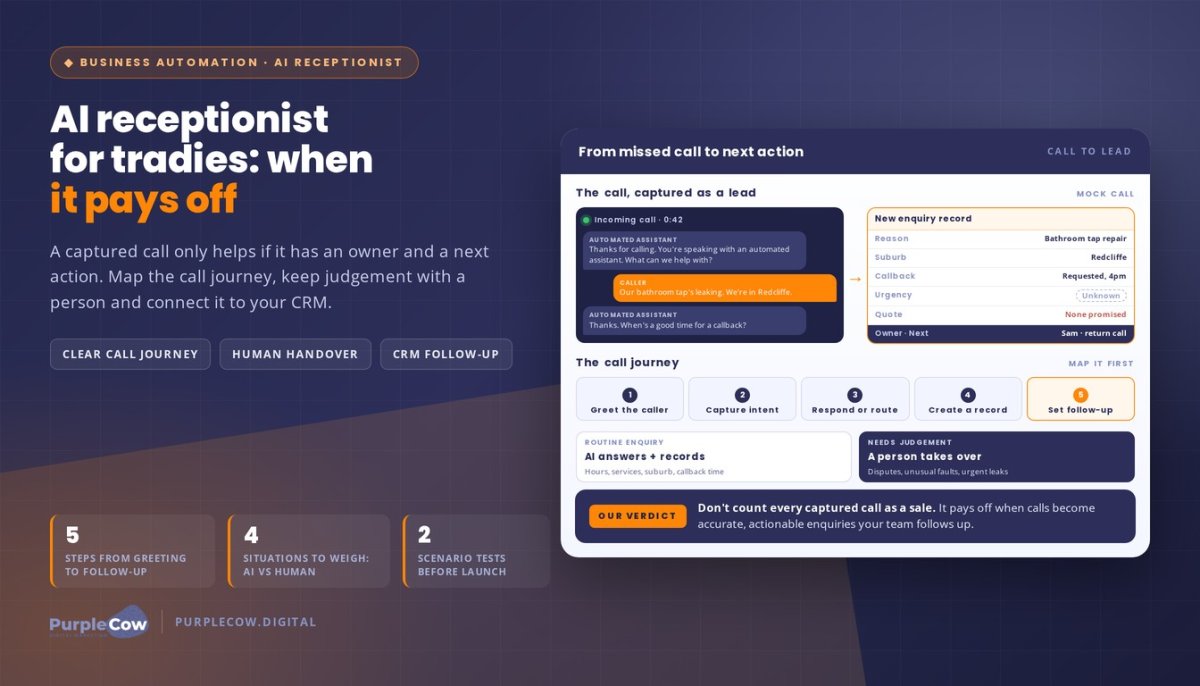
A practical call journey has five stages:
- Greet: Give the caller a clear, courteous opening and establish what they’re calling about.
- Capture: Ask only for the details needed to understand and respond to the enquiry.
- Classify: Record the enquiry type, such as a new job request, an existing booking, or a general question.
- Route: Send the record to the appropriate person or workflow, based on your business rules.
- Follow up: Assign a next action, such as returning the call or reviewing the request, and record when it’s due.
A successful handover gives the enquiry a clear owner and a defined next step.
This is where an AI Answering Service becomes part of lead management, rather than just a response to a ringing phone. Your greeting, approved business information, and task instructions shape what callers hear and what your team receives. Vague instructions can lead to incomplete records or requests being sent down the wrong path, so define what the system should ask, record, and do when a caller’s request falls outside its scope.
What information should the service capture?
Start with the details your team needs to understand the request and respond. Depending on the enquiry type, that might include the caller’s name, preferred contact method, reason for calling, and job details needed for initial triage. A booking enquiry may need different details from a new service request.
Keep the conversation focused. Decide which details are necessary for each enquiry type, and avoid collecting information just because a field is available. If calls are recorded or caller details are stored, have your privacy and consent approach reviewed against current Australian requirements before putting the workflow into practice.
How should call details reach the right person?
A captured enquiry might be added to a customer relationship management (CRM) record or sent to a designated team member, depending on your workflow. The record should make it easy to see what the caller needs, who owns the follow-up, and when it’s due. For example, a request for a hot water system repair could go to the person responsible for service enquiries, with a follow-up task and due time recorded.
CRM processes work best when they reflect how your team already handles leads. PurpleCow Digital can help plan connected enquiry and follow-up workflows, including through GoHighLevel setup and support. If you’re shaping a process around your team’s real call types, talk with us about your workflow.
AI answering service vs human receptionist: choose the right call model
The right call model depends on what callers need, not on whether automation sounds impressive. An AI Answering Service can support defined, repeatable tasks, while a human receptionist can respond to context and nuance. A hybrid approach combines the two, but only when the handover is clear and callers know what to expect.
AI can handle defined tasks consistently; people bring judgement to conversations that depend on context, empathy, or interpretation. Neither option guarantees a good customer experience on its own. A quick automated response can still frustrate someone if it can’t address their request or offer a clear way forward.
| Call situation | AI-only | Human-only | Hybrid |
|---|---|---|---|
| Routine enquiries | Can suit predictable questions and structured information capture. | A person can answer and clarify details as needed. | AI can handle initial details; a person follows up when needed. |
| Complex or unusual requests | May be limited by its configured tasks and approved answers. | A person can ask follow-up questions and use judgement. | Route unclear or sensitive requests to a person. |
| Caller preference | Some callers may prefer speaking with a person. | Offers direct human interaction. | Can provide an automated first step and a human path. |
| Human judgement | Follows set instructions rather than personal judgement. | Can assess context and respond with discretion. | Reserves human attention for calls that need it. |
When can AI handle routine enquiries?
Consider automation for questions with stable, business-approved answers, such as your service categories or the details needed to start an enquiry. It may also help collect structured information, provided callers are asked only for details relevant to their request. Set clear boundaries: what can be answered, what must be recorded, and when the system should stop and pass the call on. Don’t assume every caller will describe a familiar situation in a predictable way.
When should a person take over?
A person may be better placed to handle a complaint, sensitive situation, unusual request, or conversation where the caller’s meaning is unclear. Build an escalation path that explains what happens next, who will respond, and how the caller can request a person. Avoid implying an immediate transfer or a specific response time unless your process can support it.
AI-only may suit businesses prioritising defined, repeatable call tasks. Human-only may fit teams whose enquiries regularly need conversation and judgement. Hybrid handling can make sense when calls include both routine requests and cases that benefit from human attention. Test the approach against real enquiry scenarios, then review where callers get stuck and adjust the tasks or handover. The goal isn’t to automate every call. It’s to give each caller a useful next step.
How to evaluate and prepare an AI answering service for your business
A smooth setup starts before you switch on an AI Answering Service. First decide which calls it should handle, what a useful outcome looks like, and when a person needs to step in. That gives you a practical way to assess whether the workflow fits your business, instead of judging it by answered calls alone.
Test the plan against real enquiry scenarios before configuring the service. For example, imagine a caller asking for a quote, someone following up on an existing job, and a caller with a request your team doesn’t usually receive. Each scenario should have a clear response, record, and next step.
What should you define before setup?
Map the common reasons people call and the information your team needs to respond appropriately. Then document the instructions and boundaries that will guide each conversation:
- Call types: List frequent intents, such as a new service enquiry, an existing job question, or a general request.
- Desired outcomes: Decide whether each call should result in information captured, a message passed on, or another defined action.
- Approved wording: Prepare accurate answers to routine questions, using language that sounds clear and helpful to your customers.
- Escalation rules: Identify requests the system should route rather than answer, including unclear, unusual, or sensitive enquiries.
- Ownership: Document who receives each type of enquiry, who follows up, and how the team knows the next action is due.
Keep the boundaries specific. If a caller asks for advice outside the approved information, the system should have a clear instruction for what to do next, rather than guessing. Review the scenarios with the people who handle those calls so the process reflects how your business actually works.
How can you tell whether the workflow is working?
Look beyond the number of calls answered. Review call records to see whether useful enquiries were captured, whether the details were sufficient for the team to act, and whether assigned follow-up was completed. A call can be answered yet still fail to create a clear next step.
Use caller feedback and day-to-day outcomes to spot friction. For instance, if callers repeatedly ask for clarification about a service or your team often receives incomplete quote requests, adjust the approved wording or questions. Keep a record of what changed and why, so improvements are based on patterns rather than one confusing call.
Set a regular review process that suits your call volume. Check representative calls, note misunderstandings, confirm that enquiries reached the right owner, and look for follow-up that stalled. Avoid relying on generic industry benchmarks; compare results with your own goals and customer experience.
Connect AI answering with a smarter lead-management workflow
An AI Answering Service shouldn’t sit apart from the rest of your enquiry process. Its value depends on what happens after the conversation: where the details are recorded, who takes responsibility, and how your team decides what to do next.
Start with the journey, not a shopping list of tools. A phone enquiry and a website form might arrive through different channels, but both can follow a shared process: record the request, identify its type, assign an owner, and define a next action. That gives your team a practical view of incoming opportunities, rather than scattered messages that are difficult to track.
Design the lead journey beyond the phone call
Map each stage from first contact to follow-up. For example, a caller asking about a maintenance job could be recorded as a new service enquiry, assigned to the team member who handles that work, and given a follow-up task. A website enquiry about the same service can enter the process with its source recorded, so your team can respond consistently while keeping useful context.
Decide what information matters at each stage and what status tells you the enquiry is moving forward. A record might show that a request is new, assigned, awaiting a response, or resolved. Keep the process simple enough for your team to use and clear enough to show where an enquiry has stalled. Phone and website enquiries can share the same ownership and follow-up rules without needing identical questions.
That joined-up view can also help you assess how enquiry channels support your wider growth plan. PurpleCow’s digital marketing services bring channels into a broader strategy, while a defined lead process helps your team manage the enquiries those channels generate.
Make automation support real business outcomes
Useful automation starts with the steps your business needs to manage, not with adding disconnected tools. PurpleCow’s Business Automation work includes GoHighLevel setup, chatbots, lead management, and customer relationship management (CRM). We plan workflows around your existing process and goals, with the focus on making enquiry ownership, follow-up, and reporting easier to understand.
For example, you might want to see how many enquiries are waiting for a response, which team member owns each one, and whether the next action has been completed. A clear record can support that visibility, but the process still needs sensible rules and people responsible for acting on the information. Automation can organise the handover; it can’t replace a well-defined business process.
Build around the outcome you need: a traceable enquiry, a responsible owner, and a useful next step. Then review whether the workflow helps your team follow through and spot gaps. PurpleCow can help you plan that process across lead management and CRM, without treating phone answering as a standalone fix.
Make your next enquiry easier to manage
The next step isn’t necessarily adding more technology. Start by identifying where enquiries most often lose momentum: a call that isn’t recorded, a follow-up without an owner, or information your team has to chase down. Fixing that process gives any future AI Answering Service a clearer role and gives your team a more useful way to assess its results.
Choose one recurring enquiry type and map what should happen from first contact to the next action. Then consider what your team needs to see, who should take responsibility, and how you’ll know the process is working. A focused workflow is easier to test, review, and improve than a collection of disconnected tasks.
We work with Australian businesses on practical digital systems shaped around their goals. When you’re ready, build a clearer process for the enquiries your business receives.
With a clear process behind every call, you can give your team a stronger foundation to grow from.
Frequently Asked Questions
What is an AI answering service?
An AI answering service uses conversational software to handle parts of a business phone interaction. Unlike a recorded menu that directs callers through fixed options, it can respond to spoken requests within the limits of its setup. It isn’t a staff member, so decide how callers will be told they’re speaking with an automated system and what information it can provide about your business.
Can an AI answering service book appointments?
Some services can support appointment booking if they’re configured to do so and have access to the relevant booking process. Define which appointment types are in scope, what details are needed, and how conflicting requests are handled. For example, decide whether a caller receives a confirmed time or whether the team reviews the requested slot first. Make that distinction clear in the wording.
Can callers speak to a human when they need one?
That depends on the call-handling setup. If a caller is transferred, the receiving person should have enough context to continue without making them repeat the whole enquiry. If the team can’t take the call, explain what the caller can do next, such as leaving a message. Test the process from a caller’s perspective, including what happens when the intended contact isn’t available.
Is an AI answering service suitable for a small business?
It may suit a small business if the expected call-handling tasks fit the team’s capacity and budget. Before deciding, review your call logs for unanswered calls, recurring questions, and the time your team can set aside to respond to captured enquiries. A small plumbing business, for instance, could assess whether quote requests are a manageable starting point instead of automating every call at once.
How much does an AI answering service cost?
Pricing varies by provider and charging model. Australian services may use a monthly subscription, metered usage, or a per-call fee, and some arrangements include setup or monitoring. Compare the expected total cost with the calls or minutes included, possible overage charges, and any costs for features you need. Estimate your likely call volume from your own records before comparing plans, and check how each pricing model treats usage above its allowance.
What happens if an AI answering service does not understand a caller?
Build in a way for callers to correct important details before the interaction ends. For instance, the system could repeat back a name or contact number and invite the caller to correct it. Your team can then review records for misheard details or incomplete summaries and adjust the questions or wording. This helps you spot where the call process needs refinement without assuming every conversation will be captured perfectly.
Is caller information safe when using an AI answering service?
No system should be treated as automatically safe. Before using one, understand what caller information is collected, where it’s stored, who can access it, and how long it’s retained. Keep questions limited to details needed to handle the enquiry, and review the provider’s privacy and security information as part of your assessment. For Australian privacy obligations, get advice suited to your business and the information you collect.

Article by
Angie Neal
Angie Neal is the founder and CEO of PurpleCow Digital, a full-service digital marketing agency based on Queensland's Redcliffe Peninsula. With deep expertise in SEO and web design, as well as a certification as a GoHighLevel Admin. Angie helps small-to-medium businesses build scalable growth systems through AI-powered automations, CRM workflows, and smart digital strategy. She's also passionate about building a community of like-minded agency owners at the After Party — sharing insights, solving real problems, and helping others grow. Whether it's search visibility, lead management, or end-to-end automation — Angie's focus is always on helping businesses scale sustainably.
Disclaimer
This page may contain affiliate links. If you sign up for software through our links, we may earn a commission at no extra cost to you. We only recommend tools we use and trust – software that is the backbone of our agency.