
A low cost per lead can hide an expensive customer acquisition. When calculating customer acquisition cost in Australia, divide your total marketing and sales spend by the number of new customers acquired over the same period.
That figure is useful only when it captures the full cost of winning a paying customer, not just advertising spend. You’ll learn which marketing, sales, and support costs to include, how to compare CAC with customer lifetime value, and why cost per acquisition can measure something different.
We’ll also look at assessing CAC by channel and keeping calculations practical for an Australian business. The goal is to understand what it takes to turn marketing spend into customers, and whether those customers justify the investment.
Key Takeaways
- Calculate CAC by dividing your sales and marketing costs by the new paying customers acquired over the same period.
- Include the costs that support customer acquisition, not just campaign spend, and keep retention expenses separate.
- Compare CAC with customer lifetime value to understand whether customer relationships can support sustainable growth.
- Track CAC by channel and customer segment to see where your acquisition budget is working hardest.
- Cost per acquisition may count a lead or sign-up, while CAC measures the full cost of gaining a paying customer.
What is Customer Acquisition Cost (CAC)?
CAC measures the spend required to turn prospects into new paying customers. Divide marketing and sales costs by the number of new customers acquired in the same period.
Customer Acquisition Cost Definition
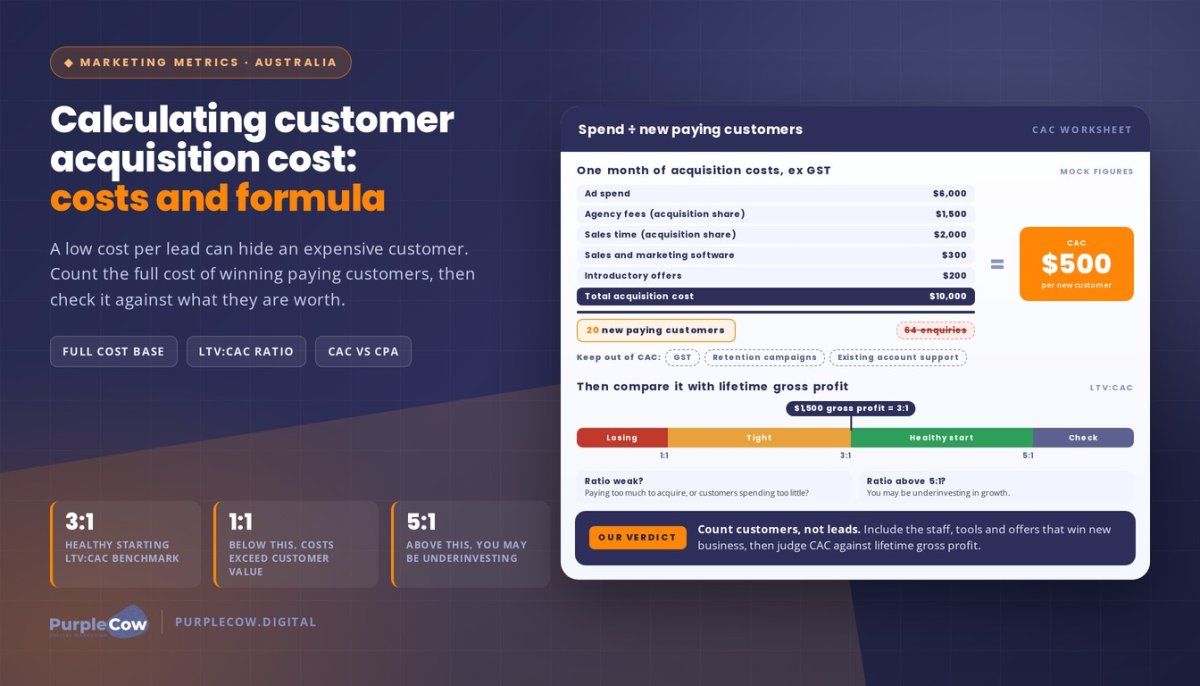
Customer acquisition cost is the average amount your business spends to gain one new paying customer. This metric connects marketing and sales activity with customer growth, giving you a practical way to assess acquisition efficiency. For example, a CAC of A$500 means your business spent A$500 on average for each new customer counted in that period.
Basic and Comprehensive CAC Formulas
The basic formula divides marketing spend by new customers; the comprehensive formula also includes sales costs and overhead that directly support acquisition. An ad-only calculation can look lower because it leaves out staff time, sales tools, commissions, and other acquisition support. Choose the formula that fits the decision you need to make.
When calculating customer acquisition cost in Australia, match the spend and customer count to the same period. Monthly tracking suits many growing businesses, while quarterly figures can smooth short-term fluctuations. Keep the period consistent: don’t divide quarterly spend by monthly customers.
For registered Australian businesses, calculate CAC excluding GST, as GST is typically recoverable as an input tax credit. Separate acquisition spending from retention costs, and count new paying customers, not enquiries or leads. This keeps the metric focused on customers won, rather than people who haven’t purchased.
For 2024, Australian retail and e-commerce CAC benchmarks are A$25-A$85; food and beverage benchmarks are A$35-A$120. Professional services range from A$300-A$1,200, while software and SaaS range from A$800-A$2,500. Treat these industry figures as context, not targets: business models and acquisition economics differ.
Divide CAC by the customer’s gross profit per period to estimate the CAC payback time. For repeat purchases or subscriptions, use gross profit earned in each period rather than total lifetime revenue. This indicates how long it takes to recover acquisition spending through customer purchases.
Attribution can distort results when customers are assigned to the wrong channel or when spend and conversions cover different periods. A 62-customer total across channels can mislead if every customer is credited to one campaign. Mixing lead counts with paying customers also skews CAC. Keep source labels consistent; businesses tracking enquiries through a CRM can refer to the GoHighLevel Australia overview for related operational context.
How does CAC relate to Customer Lifetime Value (CLV)?
CAC shows what you spend to win a customer; customer lifetime value (CLV) estimates what that customer contributes over the relationship. Comparing them helps you judge whether acquisition supports profitable growth, rather than treating new-customer numbers alone as success.
Estimate CLV by multiplying average purchase value by purchase frequency and average customer lifespan. This estimates revenue, so account for gross margin before comparing it with acquisition costs.
The LTV:CAC ratio compares lifetime gross profit with the cost of acquiring a customer. Divide lifetime gross profit by CAC, using the same basis for both figures.
For example, if a customer’s lifetime value is A$500 and CAC is A$50, the revenue-to-cost ratio is 10:1. That looks strong, but it doesn’t show gross profit by itself. If delivery, product or service costs consume much of that A$500, the gross-profit ratio will be lower. Make the comparison using consistent periods and gross-profit figures.
A ratio below 1:1 means acquisition spending exceeds the customer value being measured. A ratio above 5:1 may point to underinvestment in growth, rather than an automatic reason to cut acquisition. Read the figure alongside cash flow, capacity and the time required to earn customer revenue.
Retention affects the equation because customers who keep buying can generate value beyond their first transaction. For a subscription business, recurring purchases contribute to lifetime value while a customer remains active; for a trades or service business, repeat bookings and follow-on work can play a similar role. Track retention and purchase frequency alongside the ratio.
Conversion rate matters because it affects how efficiently prospects become customers, while retention affects the value those customers generate afterwards. If your ratio is weak, ask two separate questions: are you paying too much to acquire customers, or are customers spending too little over time? The answers can help you decide whether to improve marketing conversion or strengthen the customer experience.
Use the LTV:CAC ratio as a decision tool, not a standalone verdict. Compare customer groups and acquisition periods consistently, then assess whether gross profit, repeat purchases, and retention support the growth you’re funding.
What Costs are Included in CAC?
A useful CAC calculation includes costs that directly support customer acquisition, not just advertising spend. Include attributable agency fees, staff salaries, and software; Australian businesses registered for GST should calculate CAC excluding GST, as GST is typically recoverable as an input tax credit.
Marketing and Sales Expenses
Marketing and sales expenses are the direct costs of reaching prospects and converting them into customers. Include campaign spend, sales commissions, acquisition-related salaries, and agency fees tied to customer generation. Including both marketing and sales gives you a clearer cost base than counting advertising alone.
Allocate shared staff time and agency work to acquisition only when they support winning new customers. For example, exclude time spent servicing existing accounts. This helps you measure acquisition costs without blending them with retention or general business activity.
Overhead and Promotional Costs
Include overhead in CAC when it directly supports customer acquisition. This can include sales software, marketing tools, subscriptions, and campaign-related production costs. Counting advertising but omitting the tools and people supporting it may understate actual acquisition spend.
Promotional incentives can count too. Include discounts or introductory offers when they’re used to bring in new customers, and apply the same rule across channels.
GST, Agency, Staffing, and Software Costs
For a GST-registered Australian business, calculate CAC excluding GST, as GST is typically recoverable as an input tax credit. Include the share of agency fees, salaries, and software costs attributable to acquisition, rather than every business expense. This keeps the metric focused on spending that supports new-customer growth.
For example, allocate only the relevant share of a staff member’s time if their role also covers retention. Apply the same approach to software used across marketing, sales, and customer support. Consistent allocation makes results more useful for comparing periods and assessing whether acquisition remains profitable.
Keep customer retention costs separate from acquisition costs. Support for existing customers and retention campaigns serve a different purpose from spending to win new customers. Mixing them can make CAC harder to interpret and obscure whether acquisition campaigns efficiently generate paying customers.
Use one consistent rule for each cost category and period. If a referral discount, agency fee, or sales salary supports new-customer acquisition, include the attributable amount; if it supports existing customers, leave it out of CAC. This gives you a more complete picture than an advertising-only figure.
CAC analysis by channel and customer segment
Channel-level CAC shows what each source costs to acquire paying customers. Compare channels and customer segments using the same period, cost rules, and customer definition.
CAC by Acquisition Channel
Calculate channel CAC by dividing that channel’s acquisition spending by the new customers it generated. This helps reveal which sources bring in customers at a lower acquisition cost.
These figures are useful only when each channel’s costs and conversions are attributed consistently. Include relevant campaign and sales costs, then count paying customers assigned to that channel. If a customer interacts with several channels, use a clear attribution rule instead of crediting the full conversion to each one.
Customer Targeting and Channel Efficiency
Channel efficiency depends on whether it reaches a customer segment your business can serve profitably. A low-cost lead source may still produce a high CAC if few leads become paying customers. Compare conversion and CAC by segment, such as new residential clients versus commercial accounts, rather than relying only on a blended average.
Use the results to guide spending, not to make automatic cuts. A channel with higher CAC may attract customers who return more often or buy higher-value services. Compare acquisition cost with customer value and capacity before shifting budget, and keep existing customers separate from new-customer results.
Advertising Costs and Channel Benchmarks
These broad benchmarks provide context, not guaranteed costs for Google, Meta, or another channel. Platform costs, audience, offer, and conversion rates all affect the spending needed to generate a paying customer.
These figures don’t establish one fixed Australian benchmark for Google Ads or Meta Ads. The difference shows why channel-level measurement matters more than assuming one source always costs less.
To reallocate spending, compare channel CAC with customer value, then shift spending gradually towards channels producing suitable customers. Review conversion quality alongside those figures before changing your strategy.
CAC and cost per acquisition differences
Cost per acquisition (CPA) measures what you spend to produce a chosen action; customer acquisition cost (CAC) measures the cost of gaining a paying customer. You might track CPA for a completed booking request, then track whether that request becomes a customer. This distinction prevents campaign results from being confused with business growth. Name the action in your reporting so your team knows exactly what each CPA represents.
CPA can focus on one campaign and one outcome, such as a new subscription sign-up. CAC takes a wider view of the effort behind customer acquisition, including relevant marketing and sales activity. If your campaign budget generates sign-ups but your sales process converts only some into customers, CPA and CAC will differ. The gap can show where prospects drop out.
Revenue adds another layer, but it’s not the same as either metric. A campaign can bring in customers who generate different revenue over time, while CAC records the cost of acquiring them. Compare CAC with customer value separately; a low CPA doesn’t prove the resulting customers are profitable. When calculating customer acquisition cost in Australia, consistent cost and customer definitions make the comparison more useful.
Staff salaries also affect the distinction. A campaign report might show media spend and a CPA for enquiries, while CAC can include the sales team’s acquisition work. If a staff member splits their time between winning new accounts and supporting existing ones, allocate the acquisition share consistently. This gives you a clearer comparison between campaign efficiency and the broader cost of gaining customers.
Referral activity needs the same clarity. You could measure CPA by a referred enquiry, a completed sign-up, or a new paying customer. Each answers a different question. For CAC, focus on the customers gained and the attributable work or incentive used to acquire them. For CPA, report the specific referral action you’re measuring, rather than presenting it as the average cost of a customer.
Use CPA to diagnose a campaign’s chosen action, then use CAC to assess the wider acquisition picture. When calculating customer acquisition cost in Australia, connect campaign budgets, attributable salaries, and new paying customers using the same measurement approach. This helps you identify whether a campaign attracts attention, generates meaningful actions, or contributes customers. The measures work together, but they aren’t interchangeable.
PurpleCow Digital
PurpleCow Digital can help connect CAC figures with the marketing and website activity behind new customer enquiries. If your numbers are hard to interpret, or you’re unsure which digital activity contributes to customer growth, we can help bring the relevant parts into a clearer strategy.
The useful question isn’t simply whether a channel produced clicks. It’s whether your marketing helps the right people find you, understand your offer, and take the next step. For example, if Google Search brings visitors but few suitable enquiries, reviewing the website journey alongside search visibility can help identify where prospects drop away.
Our services can support different parts of that journey:
- Website Design can shape how clearly your business explains its services and guides potential customers towards an enquiry.
- Search Engine Optimisation can help your business become more visible when people search for relevant services.
- Website Maintenance supports the ongoing upkeep of your site, which is part of the experience prospects encounter before enquiring.
- Meta Ads can support paid campaigns, giving you another channel to assess against customer enquiries and acquisition results.
These services work best as connected parts of your growth plan, not isolated tasks. A website may need clearer messaging before more traffic is useful. Assess search activity and Meta Ads alongside the enquiries and paying customers they generate. Maintenance helps support the website side of that journey as your business changes.
For an Australian small business, the next step is to connect marketing activity with the outcomes that matter: suitable enquiries, new customers, and the costs of acquiring them. We can help you understand where your digital presence fits into that picture and which areas deserve attention. The right focus depends on your goals, customers, and current marketing activity, so the conversation starts with your business rather than a preset package.
If you’d like to discuss how your website and digital marketing relate to customer acquisition, contact PurpleCow Digital.
Frequently Asked Questions
How do I calculate CAC if I don’t have perfect data?
Use the most consistent records available, and label estimates clearly. For example, match invoices and campaign reports with new-customer records in your CRM, and use a consistent rule for customers who encountered several channels. If you estimate staff time, document the allocation method and apply it to each period. Improve tracking over time; an estimate measured consistently is more useful than changing methods between reports.
Should I include salaries in my CAC calculation?
Yes, include the share of salaries spent acquiring new customers. If a salesperson also manages existing accounts, allocate only the acquisition-related time rather than their entire salary. Apply the same principle to marketing staff who divide their work across campaigns, retention, and general brand activity. This better represents the labour behind acquisition, rather than treating paid media as the only cost.
What is a healthy LTV to CAC ratio?
A 3:1 LTV:CAC ratio is a healthy starting benchmark, measured using lifetime gross profit against acquisition cost. It isn’t a universal target: a long payback period can strain cash flow even when the ratio looks favourable. Check the margin behind customer revenue, how quickly it arrives, and whether retention supports the expected lifetime value. A ratio above 5:1 may also suggest room to invest more in growth.
What is the difference between CAC and CPA?
CPA measures the cost of a specified action, while CAC measures the broader cost of acquiring a paying customer. For example, a campaign’s CPA could track a completed enquiry form, even if that person never buys. Use CPA to assess the action the campaign is designed to generate; use CAC to understand the cost of winning customers after considering marketing and sales activity.
Does customer retention affect my CAC?
Retention doesn’t change the historical cost of acquiring a customer, but it affects the value your business gets from that cost. For example, a customer who books recurring service visits can contribute more lifetime gross profit than someone who purchases once. Track repeat purchases and customer lifespan alongside CAC. This context helps you assess acquisition economics without treating retention spending as a new-customer cost.
How do you reduce CAC?
Find where acquisition is becoming inefficient, then improve that part of the journey. For example, raising a website conversion rate from 1% to 2% doubles leads generated without increasing advertising spend, though it doesn’t automatically double paying customers. Review lead quality and sales follow-up too. You can also focus spending on channels with proven returns and remove campaign activity that attracts enquiries but few customers.
What are common CAC mistakes?
Common errors include counting leads instead of paying customers, mismatching spend and customer periods, and crediting one customer to multiple channels. For example, a customer who clicks an ad and later responds to a referral should follow one consistent attribution rule. Excluding acquisition-related staff time can also understate costs. Keep definitions, period boundaries, and channel rules stable so comparisons remain meaningful.
What is customer acquisition cost (CAC) and how is it calculated?
CAC is the average cost of gaining a new paying customer during a chosen period. Add the marketing and sales expenses attributable to acquisition, then divide by the new customers acquired in that period. For instance, if your business reviews a month, match that month’s eligible costs with customers who became paying customers during the same month. Use one consistent method to compare results over time.

Article by
Angie Neal
Angie Neal is the founder and CEO of PurpleCow Digital, a full-service digital marketing agency based on Queensland's Redcliffe Peninsula. With deep expertise in SEO and web design, as well as a certification as a GoHighLevel Admin. Angie helps small-to-medium businesses build scalable growth systems through AI-powered automations, CRM workflows, and smart digital strategy. She's also passionate about building a community of like-minded agency owners at the After Party — sharing insights, solving real problems, and helping others grow. Whether it's search visibility, lead management, or end-to-end automation — Angie's focus is always on helping businesses scale sustainably.
Disclaimer
This page may contain affiliate links. If you sign up for software through our links, we may earn a commission at no extra cost to you. We only recommend tools we use and trust – software that is the backbone of our agency.