
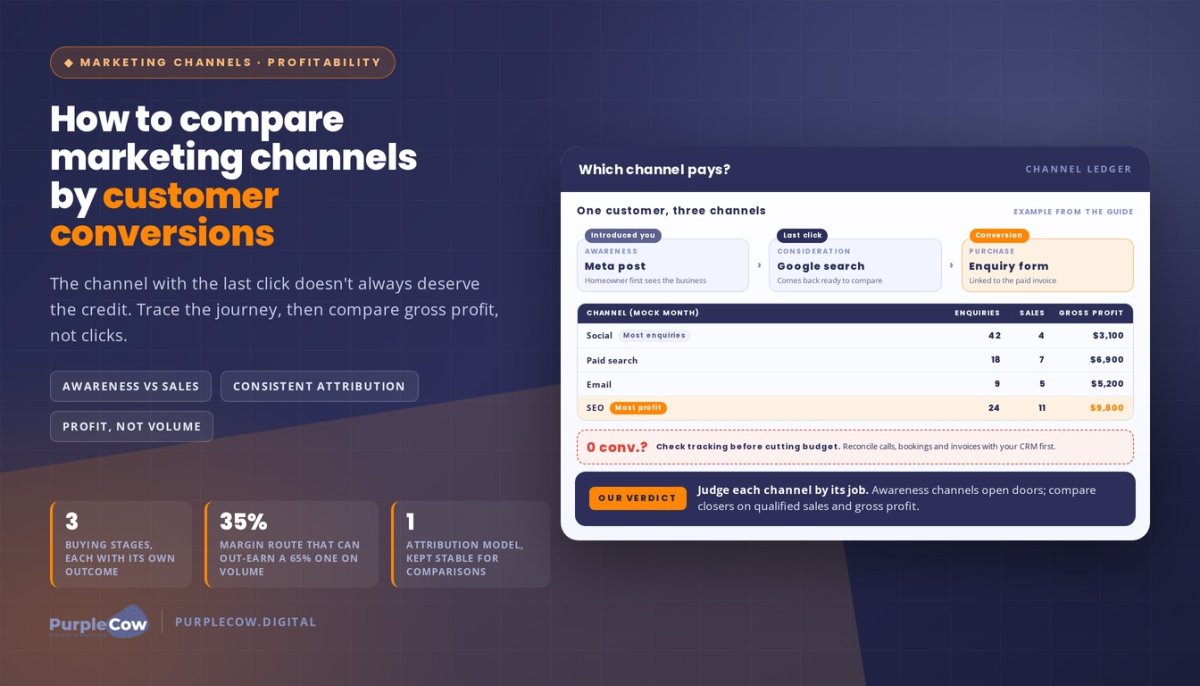
The channel that gets the last click doesn’t always deserve the credit. A local tradie might first get noticed through a Meta post, then receive an enquiry after a customer searches Google for the service. Learning how to find out which marketing channels are most profitable means tracing that journey, not just counting clicks or leads.
It’s understandable to favour the channel that appears to bring in the most enquiries. But awareness and sales do different jobs, and a busy channel can still struggle to turn attention into paying customers. The aim is to see which channels attract the right people, contribute to conversions and deliver worthwhile returns.
This guide shows you how to separate awareness from direct sales, track channel conversions and assess ROI using results that matter to your business. You’ll also learn how to test channels, spot gaps in the evidence and adjust your marketing based on what customers actually do. No guesswork, just a practical way to make your next marketing decision with more confidence.
Key Takeaways
- Separate channels that build awareness from those that generate direct enquiries or sales, so each is judged by the right outcome.
- Match your marketing activity to the customer’s buying stage, from first discovery through to making a purchase.
- Track meaningful conversions by acquisition channel, not just clicks or website visits, to see which sources bring potential customers closer to action.
- Compare channel costs with the value of the customers they bring in, then use regular ROI reviews to guide your next decisions.
- Test channels and refine your approach over time; the strongest mix comes from evidence, not assumptions.
Distinguishing brand awareness from direct sales
- Separate attention from transactions. Record awareness signals, such as branded searches or social engagement, separately from enquiries, bookings and completed sales. A Meta post may introduce your business, while a later Google search leads to an enquiry. Treat both as possible steps towards a sale, but don’t count attention as revenue. This distinction shows whether a channel supports growth early in the customer journey or helps close the sale.
- Compare gross profit, not sales volume alone. Apply each channel’s margin to the sales it contributes. In a hypothetical comparison, direct sales at a 65% margin can generate less gross profit than another route selling at a 35% margin, if the second route moves substantially more volume. The useful question is not simply which channel sells more, but which combination of volume and margin creates more gross profit.
- Account for sales that may have happened anyway. Compare campaign results with the existing organic sales trend before crediting a campaign for growth. If sales were already rising before a promotion, the full increase may not have come from that activity. Compare similar periods and note other changes, such as seasonality, pricing or availability. This gives you a more realistic view of whether the campaign added sales or coincided with existing demand.
- Review the full sales funnel at least once a month. Track movement from awareness to consideration, enquiry and purchase. If awareness rises but enquiries stay flat, examine the next step: the message, offer or landing page may not give people a clear reason to act. If enquiries grow but sales don’t, review follow-up and the sales process. A monthly funnel review shows where progress slows, rather than blaming the channel that first introduced your business.
- Include repeat orders in channel comparisons. A first purchase is only part of a channel’s contribution. Compare new customers, repeat orders and the gross profit associated with each source. For example, a channel bringing fewer first-time buyers may still contribute meaningful sales if those customers return. Track the original source alongside later purchases, then use those patterns to refine your small business marketing strategy and distinguish lasting customer growth from a short-lived sales spike.
Matching channels to stages in the customer buying cycle
Attribution is a way to analyse channel influence, not necessarily a complete record of an identifiable person’s journey. For privacy-conscious reporting, focus on channel-level patterns. Don’t assume a report shows every interaction or identifies who made it.
- Map the buying cycle before choosing channels. Group customer actions into awareness, consideration and purchase. A homeowner might first see a social post, later compare service options, then search Google when ready to book. This journey shows why judging every channel by immediate sales can miss its role. Give each stage a useful outcome, such as relevant reach, a service-page visit or a qualified enquiry.
- Use CRM records to find meaningful customer segments. A CRM, or customer relationship management system, organises information such as enquiry source, service requested and sales status. Compare patterns across groups: past customers may respond to email, while new prospects may discover you through search. Build segments around recorded behaviour and needs, rather than assumptions based on broad labels like age or suburb alone.
- Describe your target customers through practical personas. A persona is a concise profile of a customer type, built from evidence such as common questions, purchase triggers and objections. For example, a busy property manager may prioritise clear communication, while a homeowner may need to understand the service first. Match the channel and message to those needs, then assess whether each attracts the intended audience.
- Choose channels that fit the customer’s next action. Social content can introduce a business to people who aren’t actively searching; a detailed service page can help someone compare options. Email can support existing customers with useful follow-up, while a direct-to-customer website gives buyers a place to explore and enquire without an intermediary. Give each channel a defined job, then connect its result to the next stage.
- Coordinate touchpoints instead of treating them as silos. Consistent details across social profiles, email and your website make it easier for customers to move between channels. For instance, keep the service description and enquiry route consistent when a campaign sends people from a post to a landing page. Compare channel-level contributions without assuming every interaction belongs to one identifiable customer journey.
Treat attribution as a way to analyse channel influence, not a complete record of an identifiable person’s journey. For privacy-conscious reporting, compare channel-level patterns and contributions without assuming every interaction can be linked to a person or a single customer journey.
Measuring acquisition channel conversions
Conversion tracking connects marketing activity with actions such as calls, bookings and paid invoices. Choose an attribution approach, then apply it consistently across channels and reporting periods.
-
Choose an Attribution Approach
Choose first-touch, last-touch or multi-touch attribution to decide how your reporting credits channel interactions. First-touch credits the first recorded interaction; last-touch credits the final one before conversion. Multi-touch shares credit across selected interactions. Each model answers a different question, so document your choice and avoid switching models mid-comparison.
For example, a customer might discover a service through social media, return through organic search, then enquire after an email. First-touch highlights social media’s role in discovery; last-touch emphasises email. Multi-touch recognises more of the journey. Compare the models when results seem counterintuitive, and choose the one that best fits your decision or marketing strategy.
-
Attribute Sales and Revenue to Channels
Connect each tracked enquiry with its eventual sale using consistent campaign tags and customer records. Record the original source, conversion action, sale status and revenue against the same enquiry or customer identifier. For example, link a tracked website form to the resulting invoice, rather than treating every form submission as a completed sale.
Check that tracking covers the actions that matter, including phone calls and bookings where your systems can record them. Keep lead volume, qualified enquiries and completed sales as separate measures. A reported example records 38 goal completions overall, while Paid Search shows zero conversions. That contrast makes it important to inspect channel-level data, not just the total.
Compare analytics records with your sales or CRM records before assigning revenue. Note gaps such as untracked calls, repeat customers or sales completed after an offline conversation. If a customer’s path includes several channels, apply your chosen attribution model consistently and avoid crediting the full sale to every touchpoint. This keeps channel comparisons useful without overstating each channel’s contribution.
Use channel-level results to decide what to investigate next, rather than treating a single figure as a verdict. In the article’s example, Paid Search had 0 conversions, while SEO generates a 14.6% conversion rate. Check whether the channels were measured over the same period and whether each conversion action was recorded consistently. Then compare enquiries, qualified leads and completed sales to see where the difference appears. If tracking is incomplete, resolve that gap before shifting budget or concluding that a channel has no value.
External benchmarks can offer context, but they do not replace your own attribution records. Financial services firms’ incremental customer sign-ups were 7 times higher on LinkedIn. Consider whether the comparison applies to your audience, goal and measurement approach before using it to guide channel decisions. Keep the attribution model and conversion definitions stable when reviewing performance, and note any change in tracking. This makes it easier to distinguish a genuine change in results from a change in how those results are counted. Tie any action to the business outcome you are measuring, and revisit the channel’s contribution after the same checks have been applied across the customer journey.
Measuring return on investment by channel
Compare each channel’s costs with the profit it contributes, not just its reported revenue. Review results monthly, then use consistent tracking to decide where to invest next. If you’re working out how to find out which marketing channels are most profitable, start with comparable data and clear cost records.
-
Measure Lifetime Value and Profit by Channel
Group customers by their original marketing channel, then track their purchases over time. Customer lifetime value estimates the revenue a customer generates across their relationship with your business. To assess profit, subtract the associated delivery and acquisition costs from that revenue. For example, compare customers acquired through email with those from paid search, including repeat purchases rather than only the first transaction. In appointment-based sectors such as allied health, strategic consultancies like The Clinic Project focus on these long-term metrics so clinic owners can pinpoint which marketing channels drive sustainable, profitable patient relationships.
Keep the calculation consistent across channels. If one source includes repeat sales while another counts only initial orders, the comparison misleads. Also separate revenue from profit: a channel can bring in more sales yet leave less after fulfilment and marketing costs. This distinction makes it easier to judge where further investment may support profitable growth.
-
Set the Data Volume and Comparison Period
Choose a comparison period that reflects how long customers take to enquire, decide and buy. A short window may suit frequent, low-consideration purchases, while a longer sales cycle needs more time for outcomes to appear. Compare equivalent periods and include enough completed customer journeys to make the pattern useful, rather than treating a few conversions as a reliable verdict.
How much data is enough depends on sales volume, purchase frequency and the length of your sales cycle. Review channel ROI monthly, but avoid major budget changes based on a brief spike or dip. Keep the measurement window consistent so seasonal demand and delayed sales don’t distort which channel appears more effective. This gives you a more grounded answer to how to find out which marketing channels are most profitable.
-
Set Up Analytics Tools and Tracking
Connect website analytics, campaign tags and your CRM so you can compare channel activity with sales outcomes. Add consistent campaign labels to links, and record enquiry source and sale status in customer records. For phone or in-person enquiries, capture the source through your normal sales process where practical. Use one agreed naming convention across campaigns.
Which tools help measure profitability? Use an analytics platform for website activity, campaign tracking to identify traffic sources, and a CRM or sales record to connect enquiries with outcomes. Check that tags, forms and sales records use matching channel labels. Then reconcile reported conversions with completed sales before comparing ROI, and document any gaps in tracking.
Testing and optimising marketing channels
- Turn one uncertainty into a test. If you’re asking how to find out which marketing channels are most profitable, start with a specific question your marketing strategy needs to answer, such as whether a service page or social post brings more qualified enquiries. Define the audience, channel, message and outcome before launching. Keep the test focused: changing the offer, audience and creative together makes the result harder to interpret.
- Set a baseline and success measure. Record the current result for the action you want, such as completed booking enquiries from organic search. Include campaign dates and the service promoted so you can compare like with like. Choose a measure tied to business value, not just visibility. For instance, track qualified enquiries rather than treating every page visit as a win.
- Run the test long enough to observe customer behaviour. Allow time for people to see the message, consider the offer and take action. A short burst can miss customers who compare options before enquiring. Keep other major marketing changes stable where practical. If you also change pricing or a landing page, record that change because it can affect the outcome.
- Read the result in context. Compare conversions and lead quality with the baseline, then check whether sales followed. One channel may produce more enquiries but fewer suitable customers; another may bring fewer enquiries that progress further. Review the audience reached, offer shown and steps between click and conversion. This helps identify whether the issue lies with the channel, message or website journey.
- Decide what to adjust, continue or stop. If a test improves qualified enquiries, repeat the approach and see whether the pattern holds. If results are weak, change one element, such as the message or audience, before dismissing the channel. Don’t expect to choose the right channels perfectly on the first attempt. Treat each result as evidence, not a permanent verdict.
- Carry learning into the next review. Keep a simple record of the test question, change, audience, dates and outcome. For example, note that a local service campaign brought visits but few booking enquiries, then test a clearer call to action. For a practical answer to how to find out which marketing channels are most profitable, use those findings to refine your next test instead of relying on assumptions or one-off results.
PurpleCow Digital
PurpleCow Digital can help turn channel data into practical decisions when reports show activity but don’t clarify what brings qualified enquiries. We connect the customer journey, website experience and marketing activity, so your next step is based on business goals rather than clicks alone.
That work may involve different parts of your digital presence. If people discover your business but struggle to enquire, the website journey may need attention. If your site works well but relevant customers aren’t finding it, search visibility may be the priority. The right focus depends on where the path from discovery to sale is breaking down.
- Website Design: Consider it when your website makes services difficult to understand or the next step is unclear. A clearer structure can help visitors find relevant information and take action.
- Search Engine Optimisation: Consider it when customers use search to find services like yours, but your business isn’t appearing for relevant searches. It focuses on building visibility for those discovery moments.
- Website Maintenance: Consider it when your website needs ongoing care to keep its content and functionality current. A maintained site gives customers a more dependable place to learn about your services and enquire.
- Meta Ads: Consider them when you want to promote a specific service or offer to a defined audience. Campaign performance can then be assessed against the actions that matter to your business.
These options aren’t competing answers to every marketing challenge. A business with steady website enquiries but low search visibility may prioritise Search Engine Optimisation. A business attracting visitors who don’t submit forms may first need to review its website journey. Match the work to the evidence, then measure whether it supports stronger customer outcomes.
We can help you interpret channel performance and identify a practical next step across your website and marketing. That might mean improving how your site guides visitors, strengthening search visibility, maintaining the website or using Meta Ads to reach a relevant audience. Connect each decision to the enquiry or sale you’re trying to grow.
If you’d like a partner to help make sense of your marketing and website priorities, you can contact PurpleCow Digital for a conversation about your goals.
Frequently Asked Questions
How do you calculate marketing channel profitability using ROI, ROAS, and customer acquisition cost?
Calculate ROI by comparing a channel’s attributable profit with its total cost: (profit minus cost) divided by cost, multiplied by 100. ROAS compares revenue with advertising spend, so it doesn’t show whether those sales were profitable after other expenses. Customer acquisition cost (CAC) is the channel’s acquisition costs divided by the new customers it brings in. Use the same profit definition and attribution approach across channels.
How do you include channel costs such as ad spend, agency fees, and staff time?
Include every cost directly connected to running and measuring the channel. Add media spend, agency fees, creative production, software and staff time spent planning, managing or following up campaign enquiries. For staff time, use a consistent method to allocate labour costs across channels. For example, if a team member handles leads from several sources, divide their time using recorded tasks rather than assigning all their time to one channel.
How do you compare profitability across paid search, social media, email, SEO, and referrals?
Use the same reporting window, attribution model and profit measure for each source, then account for how each channel works. Paid search and social media may have direct campaign spend; SEO also requires ongoing work, while email and referrals have different operating costs. Compare qualified customers, completed sales and profit, not just clicks. A channel that assists discovery may contribute value even if another gets the final conversion credit.
How do you run experiments to validate which marketing channels are most profitable?
Start with a testable question, such as whether a revised paid search landing page produces more qualified enquiries. Keep the audience, offer and measurement method consistent, and change one major element at a time. Record the test period, costs and resulting sales in your reporting system. Compare outcomes with a suitable baseline, then repeat or refine the test before changing your broader channel mix.

Article by
Angie Neal
Angie Neal is the founder and CEO of PurpleCow Digital, a full-service digital marketing agency based on Queensland's Redcliffe Peninsula. With deep expertise in SEO and web design, as well as a certification as a GoHighLevel Admin. Angie helps small-to-medium businesses build scalable growth systems through AI-powered automations, CRM workflows, and smart digital strategy. She's also passionate about building a community of like-minded agency owners at the After Party — sharing insights, solving real problems, and helping others grow. Whether it's search visibility, lead management, or end-to-end automation — Angie's focus is always on helping businesses scale sustainably.
Disclaimer
This page may contain affiliate links. If you sign up for software through our links, we may earn a commission at no extra cost to you. We only recommend tools we use and trust – software that is the backbone of our agency.