
The fastest way to lose credibility in a marketing meeting is to bury a clear point under jargon. If you’ve ever worried about being caught out by a question, learning how to look like a marketing expert in meetings starts with a simple goal: connect marketing activity to what the business needs.
You don’t need to know every platform update or have an instant answer to every question. You do need to explain your thinking in practical terms. Instead of reporting that a campaign earned clicks, for example, explain how you’re checking whether those clicks led to calls, enquiries or booked jobs.
This guide covers how to prepare useful talking points, choose relevant metrics and discuss marketing in terms of leads, sales and business goals. You’ll also learn how to respond when you don’t know something, without bluffing or undermining your credibility. Clear evidence beats impressive-sounding jargon, every time.
Key Takeaways
- Learn how to look like a marketing expert in meetings by explaining your reasoning, evidence and next steps in plain language.
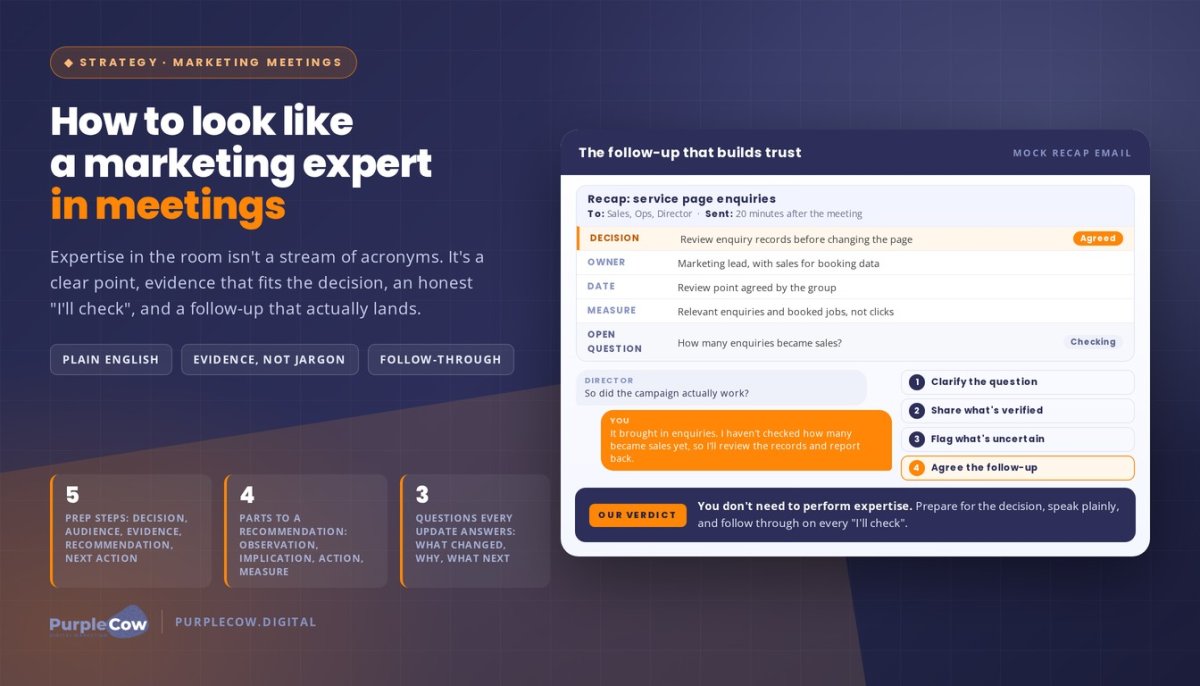
- Prepare by clarifying the decision, audience, evidence, recommendation and next action.
- Choose measures that show decision-makers what changed and what it means, not just what activity took place.
- Handle a tough question with confidence: clarify what’s being asked, share what you know and agree to follow up on anything uncertain.
- Build trust after the meeting by recording decisions, owners, dates and measures for review.
Why marketing expertise in meetings is about clarity, not jargon
Worried someone will ask a question you can’t answer? You don’t need to bluff or fill the silence with marketing jargon. Confidence comes from preparing your thinking, explaining what you know and being clear about what still needs checking.
Meeting-ready marketing expertise means explaining your choices, the evidence behind them and the next step in plain language. That’s the practical answer to how to look like a marketing expert in meetings: help the room make a better decision, rather than trying to prove you know the most.
For a quick perspective on clear, confident communication, watch this short video:
What people mean when they say someone sounds like a marketing expert
People are usually responding to useful behaviours, not a stream of acronyms. A credible marketing colleague asks who a campaign needs to reach, what action matters and what evidence would help assess the result. They explain trade-offs too: a message designed to reach more people may attract a different mix of enquiries from one aimed at a narrower audience.
That clarity helps colleagues make informed decisions. You might say, “I’ve checked the campaign results, but I need to confirm how many enquiries became booked jobs.” That’s more trustworthy than presenting an unverified assumption as fact. Strong expertise includes knowing when to check.
Why business outcomes matter more than marketing jargon
Marketing activity tells only part of the story. A post published, an advert served or a website visit is not automatically a qualified lead or a sale. Connect the activity to the outcome you’re trying to improve, such as relevant enquiries, sales conversations or completed jobs.
An activity-only update might be: “We ran Meta Ads and reached more people.” An outcome-led version adds context: “The campaign brought visitors to the service page. We’re checking how many made an enquiry before deciding whether to adjust the message.” The second gives the team a reason to act without claiming more than the evidence supports.
Marketing includes different marketing communication channels, from advertising to direct communication. Name a channel or term when it helps the discussion, then explain it simply. The goal is shared understanding, not a vocabulary test.
How to prepare for a marketing meeting in five practical steps
You don’t need a slide deck packed with every available metric. A focused point, backed by relevant evidence and a clear next step, is easier for others to act on. Use this five-step checklist to prepare.
Start with the decision the meeting needs to make
Before gathering information, work out whether the meeting needs to approve a plan, diagnose a problem, agree on a priority or make another decision. Identify who that decision affects and which business outcome matters. If the purpose isn’t clear, ask: “What do we need to decide by the end of this meeting?”
- Clarify the decision. Write down the choice the group needs to make.
- Identify the audience. Be specific about which customers or prospects the marketing activity is meant to reach.
- Select relevant evidence. Choose information that helps answer the decision, such as enquiry quality or a change in conversion trends.
- Prepare a recommendation. Explain what the evidence suggests and what action you propose.
- Agree on the next action. Know what needs to happen after the meeting and who should own it.
Choose evidence and prepare a simple recommendation
Bring one example that makes the decision easier, not a string of disconnected metrics. If you present figures, name their source and the date range they cover. Keep confirmed results separate from estimates, assumptions and open questions. This helps everyone see what the evidence supports and what still needs checking.
Illustrative example, not a client result: A small Australian trade business is considering changes to a service page. The confirmed information is that the page receives enquiries, but the team hasn’t checked which enquiries became booked work. A useful recommendation might be to review enquiry records for an agreed period before changing the page. The booking outcome remains an open question, not a proven result.
Frame your recommendation in four parts: observation (what the evidence shows), implication (why it matters), proposed action (what you suggest) and measure (how the team will assess what happens next). For example: “We’ve received enquiries through this page. We need to check which ones were relevant, so I recommend reviewing them before revising the content. We can then compare enquiry quality after the change.”
This preparation helps you learn how to look like a marketing expert in meetings without pretending to have every answer. If you’d like a thinking partner to help with marketing strategy and reporting, talk with PurpleCow Digital.
How to explain marketing results so decision-makers understand them
A useful marketing update answers three questions: What changed? Why does it matter? What should happen next? Those answers turn a list of activities into information people can use to make business decisions.
Turn a metric into a business-relevant explanation
Start with the outcome, then add the metric that helps explain it. Search engine optimisation (SEO), for example, aims to improve a website’s visibility in search results. Visibility alone, though, doesn’t show whether the right people are enquiring. Enquiry volume, lead quality, sales and customer value can each inform a different decision.
Use measures that fit the question in front of you:
| Activity or vanity metric | Decision-useful measure | What it helps you assess |
|---|---|---|
| Social media reach | Relevant enquiries associated with the activity | Whether attention is reaching potential customers |
| Website visits | Enquiry rate and enquiry quality | Whether visitors are taking a useful next step |
| Ad clicks | Qualified leads or sales, where tracking allows | Whether the clicks are contributing to business outcomes |
Return on investment (ROI) compares the return from an activity with its cost. Choose a timeframe that reflects the sales cycle, and check how results are attributed before claiming a channel drove them. Seasonality, changes to the offer or other marketing activity could also affect performance.
“An observed result tells you what changed; it doesn’t prove what caused the change.” That distinction is central to how to look like a marketing expert in meetings: be clear about the evidence and careful about what it can establish.
Use a concrete example without overstating what the data proves
Illustrative hypothetical, not a client result: A service business compares website enquiries before and after updating a service page. If the periods are comparable and its records show more relevant enquiries afterwards, it can report that enquiries increased following the update. It shouldn’t claim the page change caused the increase unless the evidence supports that conclusion.
A clear update might be: “We saw more relevant enquiries in the later period. The comparison uses the same tracking method, but we haven’t isolated the page change from other possible influences. Let’s review lead quality and sales outcomes before deciding whether to extend the approach.” For more ideas on connecting marketing activity to business priorities, explore marketing strategies for small businesses.
How to answer tough marketing questions without bluffing
A tough question doesn’t require an instant, perfect answer. Credible experts earn trust by staying calm, separating facts from assumptions and being clear about what they’ll check. That’s stronger than guessing to protect your image.
Use this sequence when a question catches you off guard:
- Clarify: “Are you asking about the number of enquiries or how many became customers?”
- Share what’s verified: State the information you can support and where it comes from.
- Flag what’s uncertain: Say what you haven’t confirmed instead of filling the gap with a guess.
- Agree on follow-up: Name what you’ll check and when you’ll report back, if you can commit to a timeframe.
What to say when you do not know the answer
Try: “I can confirm the campaign brought in enquiries, but I haven’t checked how many became sales. I’ll review the available records and share what they show.” This names both the known result and the gap without promising what the evidence will say.
Guessing can damage trust if later information contradicts your answer. A calm, specific follow-up shows care for accuracy, not a lack of expertise. Keep your first response concise, then invite a useful question: “Would it help to look at lead quality or sales outcomes first?”
How to handle disagreement, budget questions, and competing priorities
Bring disagreement back to the agreed business objective and the evidence available. You might say, “I see why that option appeals. I’m concerned we haven’t confirmed it reaches the customers we want. Could we compare it against the enquiry quality we’re aiming for?” This challenges an unsupported assumption without dismissing the person who raised it.
For a budget question, explain the options and trade-offs rather than declaring one channel universally best. One approach may aim to build visibility over time, while another may focus on generating enquiries through paid promotion. The right fit depends on the goal, timeframe, evidence and available budget. If priorities compete, ask which outcome matters most now and what can wait.
Clear, measured answers are a practical part of how to look like a marketing expert in meetings. If you need a broader view of how marketing disciplines can work together, explore digital marketing services.
Build lasting marketing credibility with clear follow-through
A polished presentation can make a strong first impression. Lasting trust comes from doing what you said you’d do, sharing accurate updates and making it easy for others to see what was decided. That’s how you build credibility beyond the meeting room.
Create a simple record of decisions and next steps
After the meeting, send a concise summary in plain language. Separate decisions from questions that still need answers, so no one mistakes a discussion point for an agreed action.
- Decision: What did the group agree to do?
- Action and owner: What needs to happen, and who is responsible?
- Date: When is the action due or ready for review?
- Measure: What evidence will help assess progress?
- Open question: What still needs checking, and who will follow it up?
Set the review point to suit the work. A short campaign test and a longer-term search engine optimisation (SEO) plan may need different review dates. Agree on a sensible checkpoint with the people involved instead of applying the same reporting schedule to every project.
Then follow through. If you agreed to check which enquiries became sales, bring that information back when it’s available. If the data isn’t ready, explain what’s missing and when you’ll update the team. Consistent follow-through earns trust more reliably than performing certainty.
Know when a marketing partner can help
Sometimes the challenge isn’t presenting the update. It’s deciding which audience to prioritise, how to measure progress or which channels fit the business goal. A marketing partner can help examine those questions, connect activity across areas such as website design, SEO, Meta Ads, content and automation, and report against business outcomes. The aim is clearer decisions, not a shortcut to expertise or a promise of specific results.
If audience and positioning are part of the challenge, explore attracting high-paying clients. You can also bring your marketing questions to PurpleCow Digital, which works with Australian businesses to connect marketing activity with leads, sales and broader goals.
Take your next marketing meeting with confidence
Knowing how to look like a marketing expert in meetings isn’t about having every answer ready. It’s about preparing for the decision at hand, choosing evidence that matters to the business and explaining what it does, and doesn’t, tell you.
Keep your updates focused on enquiries, lead quality and sales rather than activity alone. If a question catches you off guard, be clear about what you know, what needs checking and how you’ll follow up. Then record decisions, owners and measures so the conversation leads to action.
When you need another perspective, PurpleCow Digital can work with you as a strategic marketing partner. Its integrated services include website design, search engine optimisation, paid advertising, content and automation. The focus is on clear reporting and business outcomes, without promising specific rankings.
You don’t need to perform expertise. Prepare well, speak plainly and follow through. Each clear, honest conversation is a chance to build trust and move your business forward.
Frequently Asked Questions
How can I sound confident in a marketing meeting?
Sound confident by preparing a clear point, relevant evidence and a practical next step. You don’t need to have every answer memorised. Explain what you know, be upfront about what you need to check, and connect your recommendation to a business goal. If you’re wondering how to look like a marketing expert in meetings, focus on helping the group make an informed decision rather than trying to impress them with jargon.
What should I prepare before a marketing meeting?
First, clarify what the meeting needs to decide. Then identify the audience and business outcome, choose evidence that helps answer the question, prepare a recommendation and know what action should follow. Bring one relevant example rather than a long list of unrelated metrics. Note where any figures came from and the period they cover, and separate confirmed results from estimates, assumptions and questions that still need checking.
How do I explain marketing metrics to non-marketers?
Translate each metric into what it means for the business. Rather than saying website visits increased, explain whether more relevant visitors made enquiries and what you know about their quality. For example, “The service page received more visits, but we haven’t checked how many led to suitable enquiries.” Use plain language, explain technical terms only when useful, and avoid presenting a possible explanation as a proven cause.
What should I say if I do not know the answer in a meeting?
Say what you can confirm, name what needs checking and agree on a follow-up. For example: “I can confirm we received enquiries through the campaign, but I haven’t checked how many became sales. I’ll review the available records and report back.” Don’t guess to fill the silence. A clear boundary around what you know protects trust, while a specific next step shows that you’re taking the question seriously.
Do I need marketing jargon to sound like an expert?
No. Use a marketing term when it makes a point more precise, then explain it in everyday language if your audience may not know it. For instance, you could describe a conversion rate as the proportion of visitors who take a chosen action, such as making an enquiry. Clear explanations help colleagues understand the options and decide what to do. Unexplained jargon can get in the way.
Which marketing metrics should I mention in a business meeting?
Choose metrics that match the decision being discussed. If the goal is to generate work, relevant enquiries, lead quality and sales may matter more than reach or clicks alone. For a website discussion, visits can provide context, while enquiry actions show whether people are taking a next step. Name the source and date range for figures, and be clear if tracking doesn’t show what caused a change.
How can I challenge a marketing idea without sounding difficult?
Show that you understand the idea, then raise your concern in relation to the agreed goal and available evidence. Try: “I can see why that option appeals. Could we check whether it’s likely to reach the customers we want before choosing it?” You can also present alternatives and their trade-offs. Keep the discussion focused on the decision, not the person who suggested the idea, and invite others to weigh in.

Article by
Angie Neal
Angie Neal is the founder and CEO of PurpleCow Digital, a full-service digital marketing agency based on Queensland's Redcliffe Peninsula. With deep expertise in SEO and web design, as well as a certification as a GoHighLevel Admin. Angie helps small-to-medium businesses build scalable growth systems through AI-powered automations, CRM workflows, and smart digital strategy. She's also passionate about building a community of like-minded agency owners at the After Party — sharing insights, solving real problems, and helping others grow. Whether it's search visibility, lead management, or end-to-end automation — Angie's focus is always on helping businesses scale sustainably.
Disclaimer
This page may contain affiliate links. If you sign up for software through our links, we may earn a commission at no extra cost to you. We only recommend tools we use and trust – software that is the backbone of our agency.