
A marketing report can be packed with numbers and still leave you wondering what to do next. The difference with marketing reporting that a CEO will actually read is simple: it connects marketing activity to business results, not just clicks and charts. If you’re reviewing channel updates but can’t see which efforts are bringing in enquiries or sales, the report isn’t doing its job.
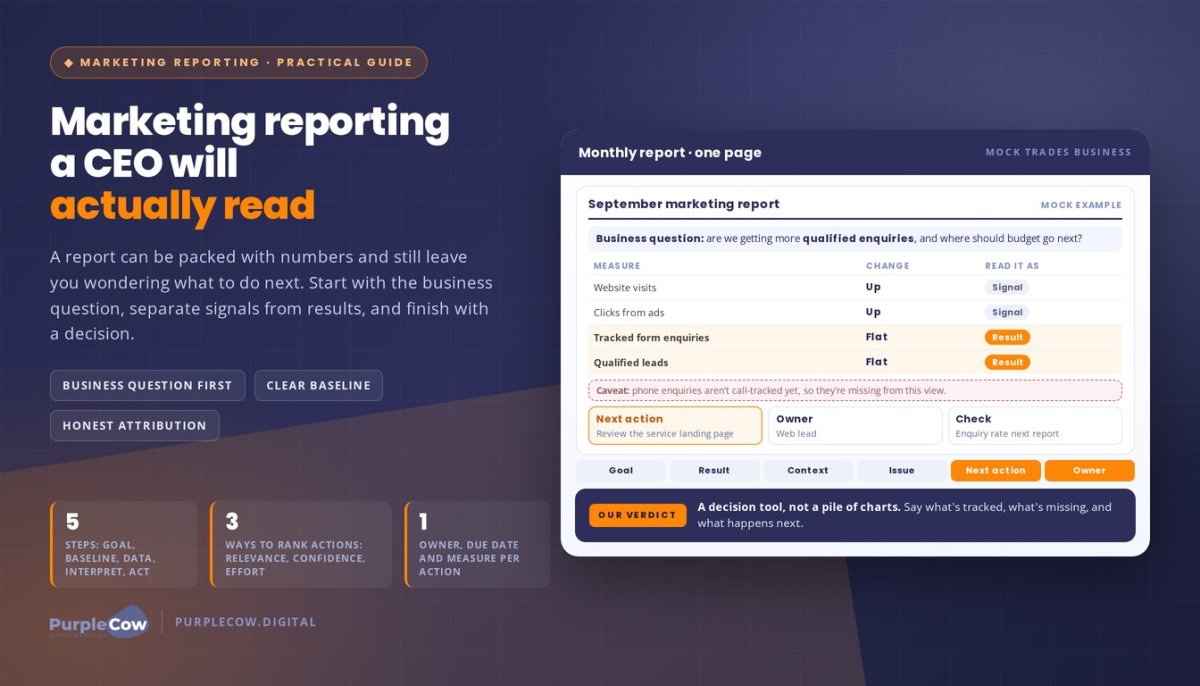
You need a clear view of what’s working, what needs attention, and where to focus your budget. For example, a trades business might see website visits rise while enquiries stay flat. A useful report would flag that gap, show which channels are contributing enquiries where tracking allows, and recommend a practical next step, such as reviewing the relevant landing page.
This guide will help you build a concise reporting rhythm around your business priorities. You’ll learn which measures to include, how to explain attribution clearly, and how to turn the numbers into decisions. At PurpleCow Digital, we believe reporting should support a strategic partnership, not add another pile of charts to your week.
Key Takeaways
- Shape marketing reporting that a CEO will actually read around a business question, not a catalogue of completed tasks.
- Set a clear goal and baseline before comparing results, then choose a reporting period that fits your sales cycle.
- Separate visibility and engagement signals from enquiries, qualified leads, sales, and revenue so each measure is read in context.
- Turn findings into a short action plan by weighing business relevance, evidence confidence, and effort.
- Ask your marketing partner to clarify data sources, metric definitions, reporting frequency, and agreed next steps.
Marketing reporting a CEO will actually read starts with business questions
A report can be full of charts and still leave you asking the same thing: what changed, and what should we do about it? Marketing reporting that a CEO will actually read starts with the decision the business needs to make, not a list of every campaign task completed.
A CEO-ready report is a concise decision aid. It connects relevant marketing activity to business goals, explains what the evidence can and can’t show, and makes the next decision clearer. Let the company’s priorities determine what belongs. If the focus is better-quality enquiries, impressions may provide context, but enquiry quality and follow-up deserve more attention.
For a quick perspective on what marketing can report to a CEO, watch this video:
Start with the decision the CEO needs to make
Ask what the report needs to guide: budget allocation, channel focus, lead quality, or sales follow-up. One clear question gives the report a job and stops useful information from getting buried under unrelated charts.
Separate immediate operational questions, such as whether enquiries are being followed up, from longer-term growth questions, such as which channels are contributing to sales over time. They may need different measures and reporting periods. Trying to answer both with a single snapshot can blur the message.
Connect marketing activity to the business goal
Trace the customer path where your systems allow: marketing activity may lead to an enquiry, then a qualified lead, then a sale. Be precise about what you can measure reliably. Website forms may be trackable, while a later phone enquiry or a sale influenced by several channels may not be clearly attributed. State that uncertainty rather than presenting an estimate as fact.
Hypothetical example: A small Australian plumbing business wants to improve the quality of incoming enquiries. Its report could connect marketing activity to tracked form enquiries, note which enquiries became qualified leads if that information is recorded, and flag any gaps in call tracking. Leave unrelated engagement figures out unless they help explain the result.
A decision-focused marketing report is a concise account of progress against a business goal, the evidence behind that assessment, its limitations, and the action it supports. A Key Performance Indicator (KPI) is a measure selected to assess progress, but the right KPI depends on the decision at hand.
How to build a CEO-ready marketing report from a clear baseline
A clear report doesn’t need more data. It needs a reliable starting point, a few relevant measures, and a next step your team can act on. Use this workflow to make marketing reporting that a CEO will actually read practical to prepare and easier to discuss.
- Set the goal. Name the business outcome the report should help assess, such as generating qualified enquiries or supporting sales follow-up.
- Confirm the baseline. Record the starting point, the dates covered, and any changes to tracking or campaign activity.
- Gather relevant data. Use sources that answer the agreed question, not every platform available.
- Interpret the change. Compare like with like and explain known factors that may have affected results.
- Recommend an action. State what to continue, investigate, or change, and who will own the next step.
Set a baseline before judging performance
A result only means something beside a fair comparison. Note the reporting period and starting figures, then compare equivalent periods where possible. If a seasonal pattern, promotion, or campaign change affected performance, add that context instead of treating the difference as a marketing result alone.
Also record measurement changes. If a form, tracking setup, or lead definition changed, comparisons may no longer be consistent. Flag missing or unreliable data clearly, and don’t fill gaps with assumptions.
Choose a small set of metrics for the report
Select measures that answer the business question. For a lead-generation goal, a concise set might include enquiries, qualified leads, conversion rate, and cost per lead. An enquiry is someone contacting your business; a qualified lead meets the criteria your team uses to identify a potential customer. Conversion rate is the share of people who complete a chosen action, while cost per lead is marketing spend divided by the leads counted under your stated definition.
Revenue may be useful when sales can be reliably connected to marketing activity. If attribution is incomplete, say so and avoid presenting an uncertain connection as proven. Understanding marketing analytics can help frame how performance data supports decisions, but your report still needs clear measures and sources.
For example, Google Analytics 4 may help report website activity and tracked actions, Google Search Console can show search performance, and channel platforms can provide their own campaign data. Add a brief source note beside each measure and explain any tracking limits.
Keep the report layout compact: goal, result, context, issue, next action, and owner. You can also build a broader plan with our marketing strategies for small business. If you’d like to clarify goals and reporting responsibilities with us, talk with PurpleCow Digital.
Which marketing metrics matter, and what should CEOs treat with caution?
A metric earns its place in marketing reporting that a CEO will actually read when it helps answer a business question. Impressions, clicks, and engagement can show whether people are seeing or responding to marketing, but they don’t automatically show that the activity generated enquiries, sales, or revenue.
That doesn’t make attention metrics useless. Read them as signals, then connect them to a later step in the customer journey where reliable data is available.
Separate useful signals from vanity metrics
“Vanity metric” is an unhelpful label if it dismisses a measure without asking what it tells you. Use this comparison to separate a metric’s useful signal from what it cannot establish:
| Metric | What it can help answer | What it can’t answer on its own | Pair it with, if trackable |
|---|---|---|---|
| Impressions or reach | Was the content or ad shown to people? | Did they enquire or become customers? | Clicks, then enquiries or qualified leads |
| Clicks | Did people visit the page or offer? | Were those visitors suitable prospects, or did they buy? | Enquiry rate and lead quality |
| Engagement | Did people interact with the content? | Did that interaction contribute to a sale? | Tracked enquiries or sales, where available |
For example, a rise in clicks alongside unchanged enquiries may prompt you to check the landing page or the relevance of the traffic. The clicks help identify where to investigate, but they don’t explain the cause by themselves.
Report leads and ROI without overstating certainty
Agree what counts as an enquiry and a qualified lead for your business. An enquiry might be a form submission or phone call; a qualified lead should meet criteria you define, such as the service required or fit with your offering. Consistent definitions make reports easier to compare.
A customer relationship management (CRM) system can record enquiry sources and outcomes. Urchin Tracking Module (UTM) parameters are tracking labels added to campaign URLs; when they’re applied consistently and recorded correctly, they can help identify which link brought a visit. Neither method will necessarily capture every touchpoint or connect every sale to one channel.
Attribution models assign credit to marketing touchpoints according to different rules, so they may report the same customer journey differently. Tracked attribution is evidence of a recorded connection, not automatic proof that a channel caused a sale. Imperfect attribution doesn’t make reporting useless. State what’s tracked, what’s missing, and how confident you are, so you can make decisions without claiming more than the data supports.
Turn marketing report findings into a short action plan
A report should finish with a decision, not a stack of observations. Turn each important finding into an agreed action, with someone responsible and a way to check whether it helped. That’s how marketing reporting that a CEO will actually read becomes part of running the business, not just a monthly admin task.
Write recommendations a CEO can act on
Use a repeatable review sequence: summarise the result, explain the context, identify a constraint, then agree an action. Lead with why the finding matters to the business. Keep supporting channel detail available, but don’t make the CEO hunt for the point.
For example, if a landing page receives visits but fewer visitors submit an enquiry than expected, the finding is the gap between visits and enquiries. Context might include a recent page change; a possible constraint could be unclear service information. A proportionate next step is to review the page and test one focused change, rather than overhaul every campaign at once.
Rank proposed actions by three factors:
- Business relevance: Could this action support a current priority, such as improving suitable enquiries?
- Evidence confidence: Is the finding based on consistent, reliable data, or does it need checking first?
- Effort required: Can your team take the step with available time and resources?
For every agreed action, record an owner, due date, and progress measure. That could be the person reviewing a page, the date the review is due, and the enquiry measure you’ll check in the next report. If the evidence is uncertain, make the action a measurement check before committing to a bigger change.
Keep the reporting meeting focused
A concise monthly review is a practical starting point for many businesses, but match the rhythm to your campaigns, sales cycle, and the time it takes for useful data to come through. A longer sales cycle may call for reviewing trends over a longer period instead of treating each month as a complete verdict.
Keep the agenda tight:
- Review outcomes against the business goal.
- Note what changed and the context behind it.
- Discuss the main risk or constraint.
- Agree decisions, actions, owners, and check-in dates.
Save detailed channel troubleshooting for a separate discussion unless it affects a decision. If your findings point to a wider planning question, PurpleCow Digital’s guide to practical small business marketing strategies can help connect next steps to your broader priorities.
Choose a marketing reporting partner who makes results clear
A marketing partner should do more than send charts. They should help you understand what the data says, where its limits are, and what decisions it can support. That’s central to marketing reporting that a CEO will actually read: clarity, honest context, and an agreed way forward.
Questions to ask before agreeing to a reporting process
Before you start working together, ask how the reporting will connect to your business goals. Get clear answers on definitions, data sources, and responsibilities, so you know what each result means and who will act on it.
- Goals: Which business outcomes will the reporting focus on, and how will we know whether progress is being made?
- Definitions: How will we define and track enquiries, qualified leads, and other agreed outcomes?
- Sources and limitations: Which platforms will supply the data? How will missing information, tracking gaps, or attribution limits be identified?
- Frequency and decisions: How often will reports arrive, and how will the findings guide priorities, follow-up, and next steps?
- Access: Which accounts and data can you access, and how will you review the underlying information if you need to?
Look for reporting that explains the whole picture
Transparent reporting should show outcomes, context, measurement limitations, recommendations, and agreed next steps. A result without context can mislead; a limitation without a proposed response leaves you stuck. You should be able to see what changed, how confidently it can be interpreted, and what action is being considered.
PurpleCow Digital’s search engine optimisation (SEO) and social media retainers include regular reporting. We focus measurement on leads, sales, and revenue where they can be tracked, and we don’t promise specific rankings or other outcomes. The reporting process should make clear what’s measurable for your business and what remains uncertain.
To make an initial conversation practical, bring your current reports, business goals, and the measurement questions you haven’t been able to resolve. You can also review our digital marketing services to see which areas may relate to your reporting needs. The aim is to agree what matters, how it will be measured, and how the findings can inform decisions.
Make your next marketing report a decision tool
Marketing reporting that a CEO will actually read starts with a business question, not a dashboard. Set a clear goal and baseline, choose measures that help answer it, and explain what the data can and can’t tell you. Visibility metrics provide context, while enquiries, qualified leads, sales, and revenue represent different stages of business impact.
Then make the findings useful: summarise what changed, add context, identify a constraint, and agree on a next action. Give each action an owner and a way to check progress. Even when attribution isn’t complete, transparent caveats help you make informed decisions without overstating what a channel contributed.
At PurpleCow Digital, we focus reporting on leads, sales, and revenue rather than vanity metrics. We aim to make reporting clear and transparent, and we don’t guarantee specific search rankings. The goal is a practical partnership that helps you understand results and decide what to do next.
Start with one business priority and build from there. A clearer report can help you focus your team’s time and make your next marketing decision with greater confidence.
Frequently Asked Questions
What should a CEO marketing report include?
A CEO marketing report should show progress against a business goal, the results that matter, relevant context, data limitations, and recommended next steps. Keep it focused rather than listing every task or platform metric. If the priority is better-quality enquiries, for example, report tracked enquiries and qualified leads, explain how those terms are defined, and note any gaps in connecting enquiries to sales. This makes marketing reporting that a CEO will actually read easier to use.
How often should marketing be reported to a CEO?
A monthly report is a practical starting point, but choose a rhythm that fits your campaign activity, sales cycle, and how quickly useful data becomes available. A short sales cycle may allow you to review enquiries regularly, while a longer one may need a wider view to understand progress towards sales. Keep the reporting dates consistent where possible, and make clear when a result is too early to assess confidently.
Which marketing metrics matter most to a CEO?
The most useful metrics depend on your business goal. For lead generation, track enquiries, qualified leads, and, where the data supports it, sales and revenue. Conversion rate can show what share of visitors complete a chosen action, while cost per lead compares marketing spend with the leads counted. Impressions, clicks, and engagement can add context, but they don’t prove that marketing produced a customer. Define each measure clearly before comparing results.
Can marketing reports prove which channel caused a sale?
Usually, a report can show which channel was recorded along a customer’s journey, but that doesn’t prove the channel caused the sale. Attribution models assign credit according to different rules, and a buyer may interact with several channels before purchasing. Customer relationship management records and campaign tracking labels can help connect enquiries to sources when maintained consistently. Treat attribution as evidence of a recorded connection, explain gaps, and avoid presenting uncertain credit as fact.
How do you report marketing results when there are few leads?
Report the lead count honestly, then add context rather than stretching a small sample into a firm conclusion. You can show relevant earlier-stage signals, such as website visits or completed enquiry forms, while labelling them as indicators, not sales outcomes. Check whether tracking is working, whether leads meet your agreed quality criteria, and whether the reporting period suits your sales cycle. Record what you’ll monitor next so future reports can build on the evidence.
What is the difference between marketing activity and marketing results?
Marketing activity describes what was done or observed, such as publishing content, running a campaign, earning impressions, or receiving clicks. Marketing results describe outcomes for the business, such as enquiries, qualified leads, sales, or revenue. Activity measures can help explain visibility and engagement, but they don’t automatically show commercial impact. A useful report connects the two where tracking allows, then states what’s known, what remains unclear, and what action the finding supports.
Do marketing agencies guarantee specific SEO results?
Don’t assume an agency can guarantee a particular search ranking or business result. Ask how it will measure progress, what factors are within its control, and how it will explain changes or limitations in the data. PurpleCow Digital focuses on transparent reporting around leads, sales, and revenue where they can be tracked, and does not guarantee specific search rankings. Clear expectations help you assess progress without treating a promise as proof of future performance.

Article by
Angie Neal
Angie Neal is the founder and CEO of PurpleCow Digital, a full-service digital marketing agency based on Queensland's Redcliffe Peninsula. With deep expertise in SEO and web design, as well as a certification as a GoHighLevel Admin. Angie helps small-to-medium businesses build scalable growth systems through AI-powered automations, CRM workflows, and smart digital strategy. She's also passionate about building a community of like-minded agency owners at the After Party — sharing insights, solving real problems, and helping others grow. Whether it's search visibility, lead management, or end-to-end automation — Angie's focus is always on helping businesses scale sustainably.
Disclaimer
This page may contain affiliate links. If you sign up for software through our links, we may earn a commission at no extra cost to you. We only recommend tools we use and trust – software that is the backbone of our agency.