
What if the biggest risk in your Meta Ads budget isn’t spending too little, but paying for activity that never becomes an enquiry or sale? Meta ads costs can be hard to judge when platform spend and campaign management fees are mixed together, and clicks alone don’t show whether your investment is working.
It’s sensible to be cautious. A small budget without a clear goal may not produce useful learning, while spending more won’t fix an offer, website or tracking setup that isn’t ready to convert. Connect your budget to the outcomes your business needs, then measure what happens after someone sees or clicks an ad.
In this guide, you’ll learn what shapes Meta Ads costs, how audience, campaign objective, competition and creative influence spend, and how to plan around your goals and capacity. We’ll also explain the difference between ad spend and management fees, and how to look beyond impressions and clicks to enquiries and sales. At PurpleCow Digital, we focus on clear reporting and practical campaign improvements, so you can make decisions based on results, not guesswork.
Key Takeaways
- Understand what Meta ads costs include, and separate platform spend from management and creative work.
- See how your campaign goal, audience, competition, placement and ad creative can shape costs and the work needed to maintain performance.
- Compare managing campaigns yourself with agency support by weighing your time, skills, creative capacity and measurement needs.
- Build a budget plan around a clear business goal, your capacity to follow up enquiries, reliable tracking and regular reviews.
- Learn how PurpleCow Digital can connect campaign planning and reporting to the outcomes that matter to your business.
Meta Ads costs: what your budget actually covers
There isn’t one universal rate for running Meta Ads. Your total campaign investment may include the money spent to show ads, campaign management, creative production and changes to the page people land on. Which parts you need depends on your goals, resources and what’s already in place.
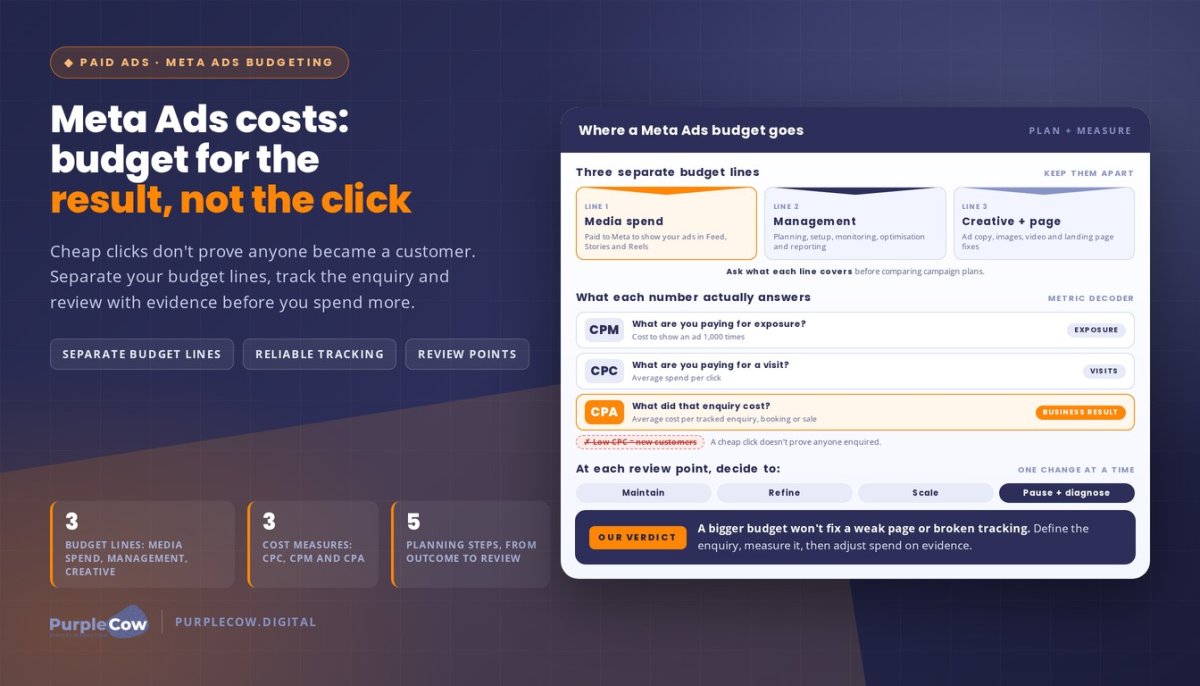
In brief: Meta ads costs include platform media spend and the work needed to plan, create, manage and measure a campaign. Keep these as separate budget lines. That makes it easier to see what your budget is funding and where adjustments may be needed.
Media spend, management, and creative are different budget lines
Media spend is the amount allocated to distribute ads through Meta’s advertising system. It’s separate from professional support, which may cover campaign planning, setup, monitoring, reporting and optimisation. Meta Platforms, the parent company of Meta Ads, provides an overview of the company and its platforms.
Creative work, such as writing ad copy, designing images or producing video, may also need its own budget. So might improvements to the landing page, the page visitors reach after clicking. For example, a trade business with useful service information and existing photos may have different creative and website needs from a business starting without either. Our web design support can help improve the page experience, but not every campaign needs the same mix of services.
When comparing campaign plans, ask what each budget line covers. This keeps platform spend separate from the time and creative work needed to run the campaign.
What CPC, CPM, and CPA tell you
These three measures describe different outcomes. They can help you assess delivery, but none tells the whole story on its own:
- Cost per click (CPC) is the average amount spent for a click. It helps answer: what are you paying to bring someone to your website or another destination?
- Cost per thousand impressions (CPM) is the cost to show an ad one thousand times. It helps answer: what are you paying for exposure?
- Cost per acquisition (CPA) is the average cost for a defined result, such as a tracked enquiry, booking or sale. It helps answer: what did it cost to generate that result?
A low CPC can look appealing, but it doesn’t prove that visitors became customers. If your campaign objective is traffic, the platform is optimising towards visits, which isn’t the same as achieving a business outcome. A useful CPA depends on defining the action that matters and tracking it reliably. For a service business, that could mean counting completed enquiry forms and checking which enquiries progress to bookings. Choose the measure that reflects your goal, not just the one that looks cheapest.
What drives Meta Ads costs for Australian small businesses?
Your campaign settings shape who sees an ad, what Meta is trying to achieve, where your budget is delivered and what you need to measure. For Australian small businesses, understanding these factors makes Meta ads costs easier to assess without relying on a one-size-fits-all estimate.
In short, Meta Ads costs are shaped by your objective, audience, competition, placements, creative, tracking and the readiness of the page you send people to. These factors work together, so a change in one area can affect how useful the campaign is to your business.
Audience, objective, and campaign setup
Start with the action you want people to take. An awareness campaign introduces your business to an audience; a lead-generation campaign aims to prompt an enquiry; and a sales campaign supports purchases. Each objective gives the campaign a different job, so compare results against that job rather than expecting every campaign to deliver the same outcome.
Audience size and scope matter too. A narrowly defined audience may be relevant, but it can limit who the campaign reaches. A broader audience may give delivery more room, but still needs clear creative and a suitable objective. Competition can also affect delivery, as advertisers seeking similar people or placements may influence the opportunities available to show an ad. Placement, such as Feed, Stories or Reels, changes where an ad appears and can affect how people respond.
Meta Ads Manager settings, available options and campaign results can change over time. Treat past results as context, not a permanent price list, and review the current setup before making budget decisions.
Creative, tracking, and conversion readiness
Your creative needs to earn attention and make the next step clear. An Australian plumbing business, for example, might show a real service scenario and explain the problem the ad addresses, rather than relying on a generic image and broad claim. Match the message to the audience’s needs and the destination page, and plan to refresh creative as the campaign continues.
Tracking connects ad activity with what happens next. If an enquiry form submission or booking isn’t recorded consistently, you may see clicks without knowing which activity contributed to business results. Agree on what counts as a meaningful conversion, then check that it can be measured before assessing performance.
The landing page matters as much as the ad. A slow-loading page, unclear service information or a hard-to-find enquiry option can make it harder for visitors to act. Review the page on mobile and make the next step obvious. Thoughtful web design can support a clearer path from ad to enquiry.
Want a practical way to connect campaign choices with your business goals? Talk with us about your Meta Ads planning.
Should you manage Meta Ads yourself or work with an agency?
Managing campaigns yourself keeps decisions close to your business, but it takes time to plan, check results and make changes. Agency support adds a separate investment, so it should make the work and reporting clearer, not add another mystery to your Meta ads costs.
There’s no single right choice. Consider the time, skills, creative resources and measurement you can realistically bring to the campaign, then choose the approach that fits your capacity.
| Consideration | Self-management may suit if… | Agency support may suit if… |
|---|---|---|
| Time | You can regularly review campaigns and act on what you learn. | Your team needs to focus on customers and operations. |
| Skills | You’re comfortable setting up campaigns and interpreting results. | You want help with planning, optimisation and measurement. |
| Creative | You can prepare relevant ads and develop fresh ideas as needed. | You need support coordinating creative work with campaign goals. |
| Data | You can track meaningful enquiries or sales reliably. | You want help connecting campaign activity to business outcomes. |
When in-house campaign management may suit
Self-management can work if someone on your team has time to learn the platform, check delivery consistently and make considered adjustments. You’ll also need useful creative assets and reliable conversion data, so you can judge more than whether an ad received attention.
The trade-off is control versus capacity. For example, an Australian service business with a staff member who can update campaign creative and follow enquiry data may prefer to manage internally. If campaign checks compete with customer work, direct control can come at the cost of consistent attention.
What agency support should make clearer
Professional support should have a clear scope: what campaign planning, setup, optimisation and reporting involve, and which creative or website work sits outside that scope. You should be able to distinguish platform spend from management and other work, understand what’s being reviewed, and see how reporting relates to your agreed business goal.
Useful reporting connects campaign measures with actions that matter to you, such as enquiries progressing to bookings. It should explain what the data can and can’t show, and what changes are being considered. A partner can bring planning and measurement together, but no reporting format can replace accurate tracking or guarantee a particular result.
If your marketing needs to work across campaigns, creative and your website, coordinated digital marketing services can help connect those pieces. The right choice is the one you can sustain and assess clearly, whether you manage in-house or share the work with an agency.
How to plan a Meta Ads budget without guessing
A useful budget starts with a business decision, not a number pulled from someone else’s campaign. Set a clear outcome, check you can handle the response, then make sure you’ll be able to tell whether advertising contributed to it.
Plan in this order: define the outcome, confirm your capacity, set up tracking, choose a focused campaign plan, then review evidence before adjusting spend. This gives you a controlled learning phase without assuming that more budget automatically means better results.
Start with the outcome and your capacity to respond
- Name the business result. Decide whether you want qualified enquiries, completed bookings or another specific action. Be precise about what counts, so your campaign and team are working towards the same outcome.
- Check your capacity. Consider who will respond to enquiries, how quickly your business can follow them up, and whether you can handle the customer journey if demand increases. Ads can create interest, but your process has to carry it through.
- Set a learning budget you can sustain. Choose an amount you can commit to while the campaign gathers useful information, without putting pressure on essential operating costs. Treat this as a planned test, not a promise of a certain number of leads.
If you know the value of an enquiry or sale from your business records, use that evidence to guide what a result may be worth. If you don’t have reliable data yet, avoid assuming a value; first build a consistent record of enquiries, bookings and sales. Your broader marketing plan should also show how paid ads fit alongside other priorities, rather than treating each campaign in isolation.
Track, review, and adjust with evidence
- Choose the conversion event. Decide what action you’ll count, such as a submitted enquiry form or completed booking. Identify where that result will be recorded before the campaign starts.
- Set a review point. Compare platform reporting with your own records. Look at lead quality and progress towards sales, not only clicks, impressions or the number of form submissions.
- Change with care. Where practical, adjust one meaningful factor at a time, such as the creative or audience, so you can better understand what may have influenced the result.
Use a controlled learning phase to check whether the campaign is reaching the right people and producing useful signals. Then decide whether to maintain, refine or scale based on business evidence. If enquiries aren’t coming through, tracking looks unreliable or the page isn’t converting, pause and diagnose the problem before increasing spend. Meta ads costs become easier to manage when every adjustment has a reason, not just a hunch.
How PurpleCow Digital can make Meta Ads costs easier to manage
Meta Ads should have a clear job in your business, not just a line in the marketing budget. At PurpleCow Digital, we plan campaigns around your goals and available capacity, then use reporting to help you understand what’s happening and what may need attention.
That doesn’t mean promising a particular number of enquiries or sales. It means making the plan, campaign activity and measurement easier to follow, so you can make informed decisions about your advertising investment.
Connect campaign activity to real business outcomes
We start by understanding what you want the campaign to support, such as qualified enquiries, bookings or sales. From there, we can align the audience, ad message and destination with that goal. For example, a campaign promoting a specific service should make the offer clear and take people to a page that explains the next step.
Reporting should help you look past surface-level activity. Clicks and impressions can show that people saw or interacted with an ad, but they don’t tell you on their own whether those people became customers. We focus on useful measures such as enquiries, sales and return on investment (ROI), while being clear about what the available tracking can show.
The customer journey may involve more than the ad. Social content can build familiarity, while a relevant website page gives prospective customers useful information and a clear way to enquire. Where they support the campaign, we can consider these parts together rather than treating creative, audience, tracking and website experience as unrelated tasks.
Clear scope matters. You should be able to understand what campaign planning and ongoing optimisation cover, how creative and other work fit into the plan, and what your reports show. Our focus on transparent operations and clear reporting makes the work visible, so your Meta ads costs are considered alongside the activity and outcomes they’re intended to support.
Make the next step straightforward
A useful planning conversation starts with your business goal. We can discuss who you want to reach, what action you want them to take, what campaign activity is already in place and how you currently record enquiries or sales. If tracking or the destination page needs attention, that context can help shape a practical next step.
The conversation is tailored to your business and current setup. It isn’t a promise of a fixed campaign cost or a particular result. Instead, the aim is to clarify the work involved, how it could be measured and what a sensible plan might look like for your capacity.
Bring your questions and current campaign details. We’ll focus on the decisions that can make your budget easier to assess, from the goal you’re pursuing to the results you need to see.
Make your next campaign decision with confidence
Your next step doesn’t need to be a bigger budget. It can be a clearer decision: what result you want, what your business can support and what evidence would help you decide whether to continue or adjust. That’s how Meta ads costs become part of a considered growth plan, rather than a number you hope will work.
PurpleCow Digital supports Australian businesses with Meta Ads and Google Ads through our Paid Advertising work. We focus on measurable return on investment (ROI), transparent operations and reporting that helps you understand campaign activity in the context of your business goals.
Bring your goals and questions. We can discuss a practical next step based on your campaign and your business, without promising a fixed cost or a particular result.
With a clear plan and useful measures, you can move forward with purpose and build towards results that matter to your business.
Frequently Asked Questions
How much should a small business budget for Meta Ads?
There’s no universal figure that suits every small business. Your Meta ads costs depend on what you’re trying to achieve, who you want to reach, whether your team can handle enquiries and how you’ll track results. Start by defining a useful outcome, then choose a spend you can assess responsibly. Review enquiry quality and progress towards sales before deciding whether to maintain or adjust your budget.
Are Meta Ads charged per click or per impression?
It depends on the campaign’s objective, delivery and billing setup, so don’t assume every campaign is charged in the same way. Cost per click (CPC) and cost per thousand impressions (CPM) are measures for assessing performance, not a universal promise about billing. Check the current campaign settings and billing information in Meta Ads Manager. A low CPC alone won’t show whether your campaign is producing valuable enquiries.
Do Meta Ads placements on Facebook and Instagram have different costs?
There isn’t a fixed rule that one platform always costs more. Facebook and Instagram sit within Meta’s advertising ecosystem, and placements can be selected or managed through campaign settings. Rather than relying on a platform-wide cost assumption, compare how each placement performs for your audience and campaign objective. Use current campaign reporting to assess outcomes such as qualified enquiries or sales, and consider whether the results justify the placement’s role.
Can I set a spending limit for Meta Ads?
Campaign budgets and account spending controls are managed through Meta Ads Manager, though available settings can change. Before publishing, review the active campaign budget and any account controls so you understand what’s set. A limit can help govern advertising delivery, but it can’t show whether your campaign will generate enquiries or sales. Treat budget settings as financial controls, then use tracking and business records to assess results.
Why can Meta Ads results become more expensive over time?
Costs per result may change as audience response, competition, creative performance, campaign objectives or tracking conditions shift. A higher cost doesn’t identify the cause by itself. Check whether delivery metrics changed, whether enquiries are still relevant, and whether your sales process is converting them. Use current campaign data to investigate, then adjust a specific factor deliberately. Increasing the budget without understanding the change may add spend without addressing the underlying issue.
Do I need a website to run Meta Ads?
Not always. The right destination depends on your campaign objective and the action you want people to take; some campaigns can send people to an experience within the platform, while others direct them to your website. If you use a website, make sure the page works well on mobile, explains the offer clearly and makes the next step easy to find. Choose a destination that fits the customer journey you can measure.

Article by
Angie Neal
Angie Neal is the founder and CEO of PurpleCow Digital, a full-service digital marketing agency based on Queensland's Redcliffe Peninsula. With deep expertise in SEO and web design, as well as a certification as a GoHighLevel Admin. Angie helps small-to-medium businesses build scalable growth systems through AI-powered automations, CRM workflows, and smart digital strategy. She's also passionate about building a community of like-minded agency owners at the After Party — sharing insights, solving real problems, and helping others grow. Whether it's search visibility, lead management, or end-to-end automation — Angie's focus is always on helping businesses scale sustainably.
Disclaimer
This page may contain affiliate links. If you sign up for software through our links, we may earn a commission at no extra cost to you. We only recommend tools we use and trust – software that is the backbone of our agency.