
Weak Google Ads results often point to a fixable problem: campaigns may be attracting the wrong clicks, tracking conversions poorly, or sending potential customers to a landing page that doesn’t persuade them to act. A Google Ads consultant can identify these gaps, improve the path from click to enquiry or sale, and test changes against campaign data.
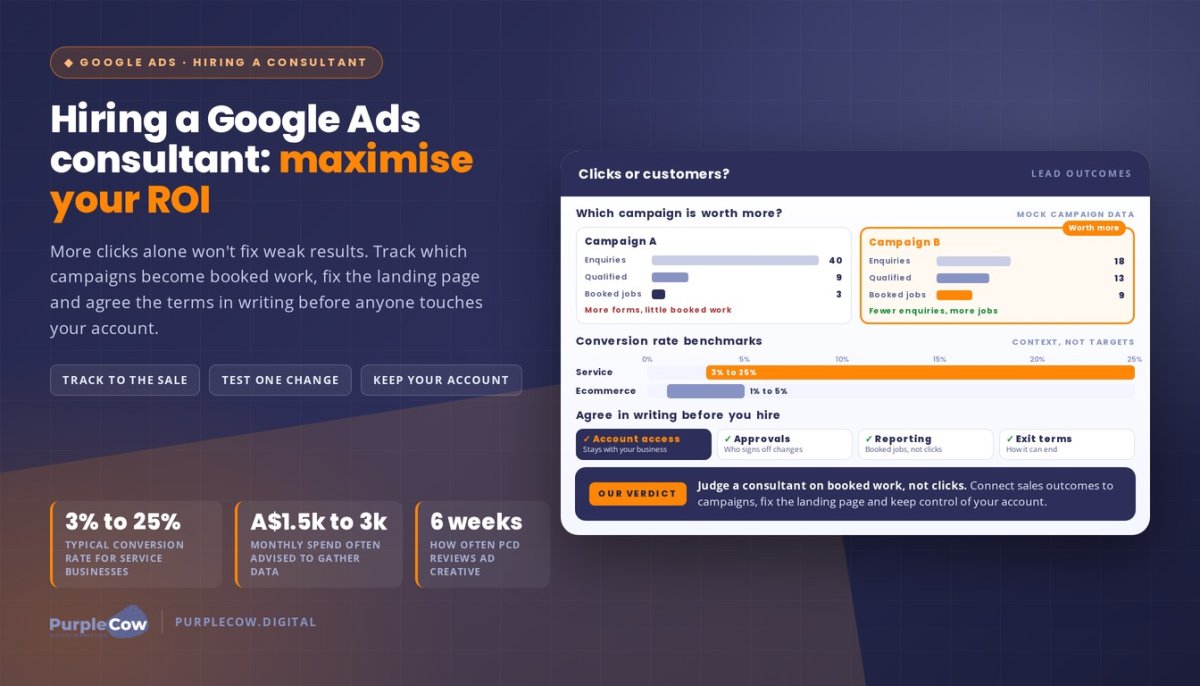
More clicks alone won’t solve it. For example, the typical conversion rate for a service-based business can range from 3% to 25%, so the right benchmark depends on your offer, audience and website experience. You’ll learn how to identify what’s holding your results back, improve conversion rates, test ad copy and weigh consultant support against an agency. We’ll also cover what to look for in a practical partner, so you can make your next move with clearer priorities.
Key Takeaways
- Trace which campaigns lead to qualified enquiries and sales, not just clicks, by connecting offline outcomes to campaign data.
- Choose advertising channels around your offer and audience, then compare the distinct roles of Search, Display, Shopping and YouTube.
- Test ad copy with a clear goal and use Quality Score as a diagnostic signal, not the only measure of campaign success.
- Keep control of your advertising account and build internal capability so your business can make informed decisions over time.
- Assess a specialist’s experience through their measurement approach and campaign thinking, and improve the website experience that turns visits into enquiries.
How can you improve your conversion rate with Google Ads?
Improve conversion rates by measuring valuable actions, refining the landing page, and using sales outcomes to guide campaign decisions. More clicks matter only when they bring qualified enquiries or customers.
Offline Conversion Tracking
A form submission is only the start of a sales journey. Offline conversion tracking connects advertising clicks with later outcomes, such as a qualified enquiry, booked inspection, or completed job. For an Australian trade business, this can show which campaigns attract customers who go beyond requesting a quote. Use those outcomes to assess lead quality, not just the number of submitted forms.
Record each lead’s progress consistently in your customer management system, then connect relevant sales outcomes to campaign data. Review lead status alongside campaign performance before changing targeting or budget. If one campaign generates fewer enquiries but more booked work, it may be more valuable than one producing a larger volume of unqualified contacts.
Conversion Tracking and Performance Calculations
Set up conversion tracking for meaningful actions, such as a completed quote form or a sale. Check that each action is recorded once, then compare conversions with the visits generated by your campaigns. A conversion rate can help show how often visitors complete a desired action. This helps you see whether the platform is producing outcomes, rather than simply attracting traffic.
Calculate cost per sale by dividing advertising spend by completed sales. These examples show how improving the page and measuring completed sales can change campaign economics.
Use benchmarks as context, not targets to copy. Typical conversion rates range from 1-5% for e-commerce websites and 3-25% for service-based businesses. The right comparison depends on what counts as a conversion, the offer and how visitors reach the page. A Google Ads case study on Jamie Williamson’s site reports 286 leads and a 13.2% conversion rate over 30 days, illustrating how results vary by campaign and business.
Improve the landing page one step at a time. Match its headline to the ad, explain the service clearly, and make the next action easy to find. For example, an electrician’s page should make its service area and quote enquiry process clear. Review mobile usability, page speed, and form fields, then remove friction that could stop a suitable customer from getting in touch.
Test one meaningful change at a time, such as a shorter form or a more specific call to action. Compare conversion tracking before and after the change, while considering the campaign and audience context. This gives you a practical basis for deciding which landing-page improvement to keep, rather than treating every click as proof of success.
What’s the difference between a Google Ads consultant and an agency?
A consultant may provide strategic advice or hands-on campaign support, while an agency like Digitalix can bring several specialists and services together. A consultant’s role may include planning, managing, and reviewing advertising. Agree on the work, access, reporting, and exit terms in writing, because the job title alone doesn’t define your agreement.
Google Ads Channel Expertise
Ask which Google Ads channels suit your offer and what experience informs that choice. Search ads can reach people actively looking for a service, while Display ads can show visual promotions across websites and apps. Shopping ads showcase product listings, and YouTube ads use video placements. An ecommerce store may prioritise Shopping, while a plumber may focus on Search enquiries.
Channel expertise means matching the format to the customer’s decision, not running every campaign type at once. Ask how the consultant will assess clicks, qualified leads, and sales across your chosen channels. You should also understand which campaigns they’ll manage directly and which need creative assets, product information, or input from your team.
Budget and Advertising Suitability
Paid advertising suits businesses that can meet incoming demand and measure its value. Before setting a budget, map the customer journey: what should a click lead to, and can your team respond to the resulting enquiry? A service business with limited booking capacity may need tighter location and schedule targeting than an online store selling nationally.
Budget decisions depend on market competitiveness, the value of a sale, and how much evidence campaigns need to guide changes. Don’t split a limited budget across Search, Display, Shopping, and YouTube without a clear reason. A consultant should explain each campaign’s role and how performance will inform the next adjustment.
Consultant Responsibilities and Agreements
Set out practical responsibilities before work begins: campaign strategy, keyword selection, ad creation, account changes, reporting, and communication. Clarify whether you or the consultant will supply landing-page content and creative assets. These details help you compare consultant support with an agency, where different specialists may handle separate parts of the work.
Check how success will be reported. A trades business, for example, might distinguish quote enquiries from booked jobs, while an online retailer tracks completed purchases. Agree who owns account access and who approves changes. A clear agreement should record the scope, reporting approach, payment terms, and process for ending the engagement.
Paid search isn’t the only option. For an Australian service business, local SEO can help build visibility in unpaid search results alongside advertising. The two approaches serve different roles: paid campaigns can place ads in search results, while local SEO strategies focus on organic discovery and local relevance. Compare them against your goals, customer demand and capacity.
Ecommerce businesses should look for experience with product feeds, Shopping campaigns, and the path from product view to checkout. Ask how the strategy accounts for product margins, stock availability, and the pages shoppers land on. For other paid platforms, such as Meta Ads, assess whether the audience and creative format suit your offer rather than assuming the same campaign will work everywhere.
If you’re weighing paid advertising against organic search, talk through your marketing priorities and decide which channel best fits your next growth goal.
Ad copy testing and quality scores
Verify experience by asking for examples, campaign objectives and reporting that separates clicks from business outcomes. Ask how the consultant tested changes and what the results measured. Jamie Williamson’s site reports he was named a finalist in the Australian Small Business Champion Awards’ Digital Marketing category in 2023 and 2025. Awards offer context, but they don’t replace evidence of relevant campaign work.
Ad Copy and Creative Testing
Good testing changes a clear message, then measures how the audience responds. Compare distinct headlines or calls to action, such as “Book a roof inspection” against “Request a roofing quote”. Keep the offer and audience consistent while testing, so the comparison is useful. PurpleCow Digital recommends reviewing or refreshing Google ad creative every 6 weeks.
Creative testing applies beyond text. A campaign might compare product images, video formats, or different descriptions of the same service. Ask how the agency records each change and decides what to keep. Paid Media Plus reports that a case study maintained its cost per lead over three years while testing new creative formats. That illustrates the value of steady experimentation, not a guaranteed result.
Give each test a business purpose. A trades business could test whether an ad highlighting emergency call-outs generates more qualified enquiries than one promoting general repairs. Review the enquiry quality, not just click-throughs. Allow time for a fair comparison: one consultant recommends 3-6 months of testing and iteration to build profitable campaigns, while recognising that each account has its own conditions.
Quality Score Considerations
Quality Score is a Google Ads diagnostic that helps assess keyword, ad, and landing-page relevance. It can point to a mismatch, such as an ad promising “timber deck repairs” that leads to a general services page. Use this signal to investigate relevance and user experience, rather than treating a high score as the campaign’s main objective.
Review the search term, the ad shown, and the destination page together. For example, if someone searches for “air conditioner servicing”, the ad and landing page should clearly match that specific service. A well-aligned path helps people find the information promised in the ad. Quality Score alone won’t tell you whether those visitors become valuable customers.
When reviewing a Google Ads account, ask for the testing record, the period measured, and the conversion definition. A lead count means little without knowing whether it represents a form submission, a qualified enquiry, or a completed sale. Ask how the consultant separates and reports those outcomes against the campaign’s objective.
Testimonials can reveal how a consultant communicates and works with brands, but look for specific details. A useful testimonial names the challenge, describes the work, and explains the reported outcome. Check that the example relates to your business type or audience. In Australia, experience with relevant service areas may matter more than a broad claim about managing accounts across unrelated industries.
Finally, ask what the consultant personally did. “Helping brands grow” is broad; a clear answer explains the strategy, tests, and decisions made from results. Match that evidence to your goals, whether you need stronger enquiries, more product sales, or clearer reporting. A practical review connects creative decisions and Quality Score signals with measurable business outcomes.
Not getting results with Google Ads?
Start with the actual business outcome, not the dashboard’s click count. A Google Ads consultant’s fees in Australia vary with experience and scope, and may be charged hourly or by project. The agreement should explain which work and reporting those fees cover.
Assess results against agreed KPIs, such as qualified enquiries, booked jobs, cost per lead, and sales. Campaign data may appear within a few days, but meaningful improvements can take a few weeks as tracking, targeting, and landing pages are reviewed.
Hiring risks include unclear responsibilities, poor measurement, and decisions made without your business context. Keep access to your Google Ads account, agree who approves changes, and make sure reports connect advertising activity with actual outcomes.
Business Fit and Budget
Paid advertising works best when your business can respond to demand and give visitors a clear next step. A trades business, for example, needs capacity to answer calls and service the locations targeted by its campaigns. If your landing pages don’t explain the offer or make enquiries easy, extra clicks may not solve the underlying problem.
Budget should account for both advertising spend and the time needed to test and review campaigns. Australian businesses are often advised to spend A$1,500-A$3,000 per month on Google Ads to gather meaningful data quickly. Treat that as a planning reference, not a universal rule: competition, service area and sales value affect what makes sense for your business.
Results and Performance KPIs
Agree on a focused set of KPIs before changing campaigns. A service business might track qualified enquiries, booked appointments, and cost per booked job, while an online retailer may focus on completed sales and revenue from advertising. Pair each metric with reliable conversion tracking, so a form submission isn’t mistaken for a sale.
Ask for reporting that connects campaign decisions to those outcomes. If Performance Max generates enquiries, for example, review whether they become customers before expanding the campaign. Results may start appearing within a few days, while significant improvements can take a few weeks. Use regular reviews to decide what to test next.
Hiring Risks and Business Benefits
Google Ads can put a business in front of people searching for relevant products or services. That visibility can help generate enquiries and sales, while campaign data shows which messages and audiences attract responses. The benefit depends on accurate tracking, a useful landing page, and the ability to fulfil the work or orders generated.
Reduce hiring risk by retaining business account access and agreeing on the consultant’s responsibilities, reporting schedule, and approval process. Ask how they’ll handle testing and explain changes. Performance Max, for example, should have a clear purpose and be judged against your business KPIs, not simply left running without review.
Build in-house capability by having the consultant document campaign structure, tracking, and optimisation decisions. This gives your team a practical record for future decisions, even if external support changes. A transparent working relationship should leave you better able to understand your account and its performance.
Consultant experience and qualifications
Choose a partner who can connect digital marketing activity with your business goals. Relevant experience means more than years in advertising: look for clear thinking about your industry, measurement, and the customer journey from search traffic to sale.
In Australia, ask how they’ll assess your account and what they’ll improve first. How do they define a valuable lead? Which results will they report? Ask for an example of a campaign decision made after reviewing conversion data, and how that decision supported a business outcome.
Qualifications can help show professional development, but practical skills matter too. A useful specialist should understand Google Ads, Google Analytics 4 (GA4) and Google Tag Manager, and how conversion actions connect with enquiries or sales. For a local service business, that might mean distinguishing a completed quote request from a phone call that didn’t become a job.
Ask how the consultant approaches performance when traffic rises but sales don’t. A thoughtful answer should explore search intent, campaign settings, the landing page, and lead follow-up. If they focus only on clicks, ask how they’ll connect those clicks with customer outcomes and return on investment.
Check experience against the work you need. An ecommerce account may require product feed and Shopping campaign knowledge; a trades business may need strong local targeting and enquiry measurement, or even an industry-focused team like Digital Farmers for specific trade niches such as tree care. Ask who will work on the account, what they’ll manage directly, and how often you’ll review progress together.
Request a relevant case example and ask what it measured. Was success defined as traffic, qualified leads, booked appointments, or completed sales? What changed in the account, and how did the consultant assess the result? A useful example explains the context and method, not just a headline figure.
Before agreeing to work together, clarify account access, reporting, and approval processes. Ask, “Will my business retain access to its Google Ads account?” and “How will you explain changes before they’re made?” Clear answers help you understand the investment and keep decisions connected to your goals.
A strong working relationship includes knowledge-sharing. Ask whether the consultant will document campaign structure, tracking, and testing decisions, so your team can understand what’s happening. That matters if you want to build in-house capability or brief another digital marketing partner later.
Choose based on relevant evidence, communication, and a practical plan, not a confident sales pitch alone. The right questions reveal whether the consultant can explain the work in plain English and connect activity with the return your business needs.
PurpleCow Digital: Website Design
PurpleCow Digital can help when your advertising brings visitors to a website that isn’t turning enough of them into enquiries. Our Website Design creates a clear path from landing page to action, so visitors can quickly understand your services and how to get in touch.
If your website needs ongoing updates, Website Maintenance can help keep it current. Search Engine Optimisation can support organic visibility alongside paid campaigns. The right next step depends on where your customer journey is losing momentum, whether that’s the landing page, website structure, or search visibility.
Contact PurpleCow Digital to discuss what your website needs next.
Make your next marketing move count
Your next step doesn’t need to be a complete campaign overhaul. Choose one business outcome to focus on, then decide what evidence will show progress. A Google Ads consultant can help turn that priority into a practical plan, with clear responsibilities for you and your team.
Make the plan fit the way your business works. Consider who will respond to new enquiries, how your team will record outcomes, and when you’ll review campaign decisions. These details keep marketing connected to daily operations, not just activity inside an account.
Start with a focused goal, learn from the results, and adjust with purpose. That’s how you build momentum without losing sight of the customers you want to reach and serve.
Take the next step with a clear goal and a plan your team can act on.
Frequently Asked Questions
Can I just hire you for Google Ads without the strategic stuff?
Yes, you can keep the scope focused on campaign work rather than a broader marketing plan. For example, you might ask for help refining search terms, excluding irrelevant searches, or adjusting ad scheduling. Before work starts, identify which campaigns are in scope and which decisions remain with your team. This keeps a focused engagement practical without extending it into unrelated marketing tasks.
Do you manage Google Ads accounts, or just train?
We manage Google Ads campaigns, rather than offering training-only support. If you want your staff to learn as the work progresses, discuss how campaign decisions can be explained and documented. Your team could review why certain search terms were excluded or why an ad variation was kept. This builds understanding alongside hands-on account management, without confusing training with campaign work.
How do conversion rates affect the cost of using Google Ads?
Before comparing conversion rates, make sure each figure uses the same definition of a visit and the same conversion action. A rate based on landing-page visits may differ from one based on all website sessions. For example, compare quote-form completions with quote-form completions, not with phone calls from another period. Consistent definitions make campaign comparisons more useful for business decisions.
Google Ads consultant vs Google Ads agency: which is better?
Choose the arrangement that makes coordination easiest for your business. If you need a specialist to focus on a particular account, one point of contact may suit your workflow. If several marketing activities need coordination, consider how decisions and responsibilities will be shared. Map the work your team needs done, then compare the proposed structure with your internal capacity and priorities.
What qualifications or certifications should a Google Ads consultant have?
Ask whether the person working on your account holds a relevant Google Ads certification through Google Skillshop. Then ask them to explain, in plain English, how a platform feature would apply to your campaign. For example, they could describe how they’d assess a search term report. This helps you distinguish a credential from the ability to explain practical account decisions clearly.
How do I hire a Google Ads consultant and get started?
Prepare a short business brief before your first discussion. Include the services you most want to promote, the jobs or products you don’t want to prioritise, and any seasonal changes that affect capacity. This gives a Google Ads consultant useful context for shaping the initial work. You’ll also be ready to discuss how campaign priorities fit your team’s day-to-day operations.
Are Google Ads consultants in Australia subject to specific rules or contract requirements?
The material gives no specific legal rules. It recommends agreeing in writing on the work scope, reporting, payment terms, account access, approval of changes, and how the engagement can end.
How much does a Google Ads consultant cost in Australia?
Fees may be hourly or project-based, and vary with experience and campaign scope.

Article by
Angie Neal
Angie Neal is the founder and CEO of PurpleCow Digital, a full-service digital marketing agency based on Queensland's Redcliffe Peninsula. With deep expertise in SEO and web design, as well as a certification as a GoHighLevel Admin. Angie helps small-to-medium businesses build scalable growth systems through AI-powered automations, CRM workflows, and smart digital strategy. She's also passionate about building a community of like-minded agency owners at the After Party — sharing insights, solving real problems, and helping others grow. Whether it's search visibility, lead management, or end-to-end automation — Angie's focus is always on helping businesses scale sustainably.
Disclaimer
This page may contain affiliate links. If you sign up for software through our links, we may earn a commission at no extra cost to you. We only recommend tools we use and trust – software that is the backbone of our agency.