
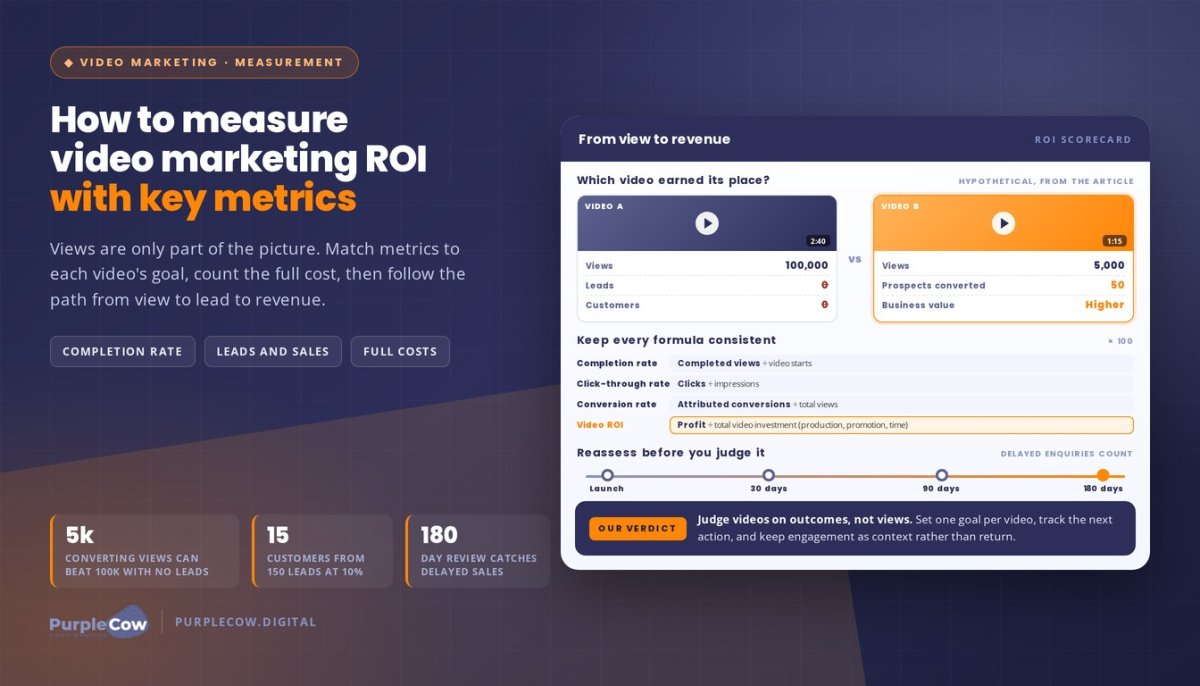
A video with fewer views can deliver more business value. To measure video marketing ROI, look beyond views at the leads and revenue you can connect to a campaign, compared with its full costs. For example, in a hypothetical comparison, a video with 100,000 views and no leads could be less valuable than one with 5,000 views that converts 50 prospects into customers.
Views matter, but they’re only part of the picture. Choose metrics that match each video’s purpose: keeping viewers watching, earning clicks, encouraging conversions or building engagement.
This guide covers completion, click-through, conversion and engagement metrics, then explains how to assess video activity on your website and in email marketing. You’ll learn how to connect those signals to business outcomes and identify which videos are earning their place in your marketing mix.
Key Takeaways
- Set a clear goal for each video, then choose metrics that show whether it’s working, from watch completion to leads or sales.
- Include production, promotion, distribution and internal time when assessing campaign costs, so your ROI reflects the full investment.
- Use click-through, conversion and cost-per-lead metrics to follow the path from a video view to a business result.
- Connect website and email activity with video engagement to build a fuller picture of how people discover and consider your offer.
- Compare results across platforms and audiences, then use what you learn to refine your videos, landing pages and campaigns.
What’s a good video completion rate?
There’s no single completion-rate target that works for every video. When measuring the ROI of video marketing, compare completion rates in context: consider video length, platform, audience and purpose, then connect the results to clicks, conversions and profit. For Australian businesses, the key question is whether a video moves people forward in their customer journey without wasting production or distribution spend.
To compare video ROI with other marketing channels, use the same reporting period, cost categories and profit measure for each. Build responsible data collection and supportable promotional claims into campaign planning, while complying with privacy and advertising rules.
- Set the campaign goal before assessing completion. Decide whether the video should build awareness, generate enquiries or support sales. An awareness video may help when people watch but don’t click; a sales video needs evidence of conversion. Match completion to the intended outcome rather than treating it as the final result. A clear goal also helps you decide which follow-up action matters.
- Calculate completion consistently. Divide completed views by video starts, then multiply by 100. Use the same platform and reporting period when comparing versions. For example, compare two edits shown to similar audiences, not a short social media clip against a longer website explainer. Keep the platform’s definition of a completed view consistent across your comparisons.
- Measure the next action in the journey. Calculate click-through rate as clicks divided by impressions, multiplied by 100. Calculate conversion rate as conversions attributed to the video divided by total views, multiplied by 100. Engagement rate is total engagements divided by impressions or reach, multiplied by 100. Keep each denominator consistent, so one campaign’s result isn’t compared against a differently defined metric.
- Add every relevant production and distribution cost. Include video production expenses, paid promotion, distribution and internal time spent planning, scripting, filming and editing. If one shoot creates several assets, allocate its cost across those assets. This shows whether repurposing improves the return rather than hiding the original investment. Use the same cost categories for each campaign you compare.
- Connect revenue to profit before calculating ROI. Attribute sales to the video using campaign, website or CRM data, then subtract associated costs to identify profit. Divide that profit by total video investment and multiply by 100. A consistent method makes measuring the ROI of video marketing more useful across campaigns.
- Compare results and refine the weakest link. Review completion alongside click-through, conversion and engagement. Strong completion with few clicks may point to an unclear call to action; clicks without sales may signal friction after the video. Compare channels using the same cost and profit definitions, then adjust the video or its destination. Change one element at a time to see what shifts.
How do you work out your CTR, conversion rate, or engagement rate?
Track each metric against a specific action, then connect that action to leads, customers or revenue. A view on its own won’t show where people drop out of the customer journey.
-
Choose Lead and Acquisition Metrics
First, define what counts as a lead, a qualified prospect and a new customer for your campaign. Then track cost per lead, cost per acquisition and conversion rate separately. A video might generate enquiries, for example, but only some may become customers. Compare the cost of each stage with its business value, and don’t treat every form submission as an equivalent sale.
-
Track Conversions in Google Analytics 4
Configure Google Analytics 4 to record meaningful actions, such as a completed enquiry form or a booking. Use campaign tagging to distinguish video traffic from other sources, then review the relevant events alongside landing-page visits. Check that the tracked action represents a genuine business outcome. A video view or page visit alone isn’t a lead or a sale.
-
Measure Conversions on Video Pages
Compare conversion rates on pages with video against relevant pages without it, using the same conversion definition and reporting period. Check whether viewers reach the enquiry form, click the call to action or leave without acting. If a page gets views but few enquiries, review the video’s message and the next step. Don’t credit the video for conversions you can’t connect to it.
-
Select Video Measurement Tools
Combine platform analytics, Google Analytics 4, CRM records and customer feedback to follow views through to revenue. YouTube Analytics and social platform reports show viewing and engagement; GA4 can report website activity; CRM data helps connect leads with sales. These tools can track video views, engagement, leads and revenue when their records are connected consistently. Check that each conversion is counted once.
Keep the stages distinct: a click-through rate, a lead count and a sales conversion aren’t interchangeable. Record video clicks that take people to the next step, then track whether those visitors complete the campaign’s intended action. Define that action clearly and use the same conversion-rate measure when comparing results. A lead-generation campaign can report enquiries, while a sales-focused campaign can report completed purchases.
Engagement shows how an audience responds before taking a business action. Track likes, comments, shares and subscribers, then review them alongside clicks, leads and sales conversions from video campaigns. Report consistently, and treat changes in engagement as context for the desired outcome, not proof of a purchase. First-party data can help you track customer journeys from video engagement to purchase. Google Analytics, YouTube Analytics and Facebook Insights can help you examine performance and audience interaction. Compare their reports with connected lead and sales records, and check that you’re not counting the same action twice. This gives you a clearer view of whether engagement leads to meaningful progress towards a purchase.
Engagement metrics
Common measurement risks include choosing metrics that don’t match a video’s goal, treating engagement as revenue and overlooking attribution gaps. Review the full customer journey, not just one platform’s dashboard.
-
Set Goals and Select Relevant Metrics
Choose one primary goal for each video, then select metrics that show progress towards it. For awareness, track views, impressions and website visits. For lead generation, focus on enquiries and conversions. YouTube views and social media likes can provide context, but they don’t prove business success on their own. Record the goal before launch so you don’t redefine success after seeing the results.
-
Match Metrics to Customer Journey Stages
Map each video to a stage in your audience’s journey, then measure the action that fits. An introductory video might build reach and viewing time, while a product demonstration should encourage a next step, such as visiting a service page. Track shares, comments and clicks as signals of interest. Don’t expect an awareness video to produce immediate sales if its role is to introduce your business.
-
Prioritise Business Outcomes Over Vanity Metrics
Separate activity from outcomes by connecting engagement metrics to leads, sales or another defined business result. A high view count can show reach, but it doesn’t tell you whether viewers took useful action. Compare likes and shares with enquiries or completed purchases from the same campaign. Include engagement in your report, but don’t count it as return on investment without evidence of business impact.
- Use a separate scorecard for internal videos, such as staff training or process explainers. Track completion and watch time alongside the intended action, such as completing a training task or following a documented process. A full view of a safety briefing, for example, doesn’t prove understanding. Pair video data with relevant operational feedback, and keep internal efficiency goals separate from external marketing outcomes.
What is ROI in video marketing?
Paid video campaigns may show early signals sooner, while organic content and SEO can take longer to build results. When measuring the ROI of video marketing, review early indicators first, then assess revenue and longer-term customer value as the customer journey continues.
-
Assign Value to Registrations and Leads
Estimate each registration’s value from the expected value of that customer relationship over time. For lead generation, track cost per lead alongside the share of leads that become customers. For example, a campaign producing 150 leads and converting 10% would generate 15 customers. Use your own sales records to estimate average customer value, rather than treating every registration as a sale.
-
Attribute Revenue and Acquisition Costs
Connect revenue to video content using campaign data, CRM records and sales information. Unique referral links or discount codes can help identify direct responses, while multi-touch attribution can share credit across the customer journey. Last-click reporting may undervalue a video that introduced your business earlier. Compare attributed revenue with customer acquisition cost, including production and distribution expenses.
-
Include Customer Lifetime Value
Compare customer acquisition cost with customer lifetime value to look beyond the first transaction. A returning customer may contribute value beyond their initial purchase. Use historical sales and retention data to estimate that relationship, then compare it with the cost of acquiring customers through video. Keep assumptions consistent across platforms, and distinguish observed revenue from projected future value.
- Review long-tail and qualitative value alongside immediate profit. Reassess campaign performance at 30, 90 and 180 days to capture delayed enquiries and sales. Website analytics may show return visits after an initial video view; customer feedback can reveal whether video helped explain a service. A disciplined approach to measuring the ROI of video marketing records these signals separately from revenue, so influence isn’t mistaken for a confirmed sale.
How do video marketing ROI benchmarks vary by industry and platform
A useful benchmark compares like with like: the same goal, audience, platform and measurement period. For Australian businesses, a trade-services explainer and an online retailer’s product video shouldn’t share the same expected result.
- Start with your industry’s buying journey. Map how customers choose your service or product before comparing performance. A homeowner might watch a roofing explainer before requesting a quote, while an online shopper may purchase after seeing a product demonstration. Compare videos that support similar decisions, not videos from different industries with different sales cycles.
- Separate platform results. Record views, watch time, clicks and conversions for each platform, such as YouTube, Instagram or Pinterest. Audiences and viewing behaviours vary, so one platform’s completion rate isn’t a universal target. Compare your own videos on the same platform, with the same objective and a consistent reporting period.
- Match the format to the platform. Check whether the video suits how people use each channel. A vertical social clip might introduce a local service, while a detailed YouTube demonstration can answer questions before an enquiry. Compare each format against its intended action rather than ranking every video by views or direct sales.
- Use platform-specific purchase signals carefully. Pinterest reports that users are 2.6 times more likely to make a purchase after viewing branded video content. Treat that as a platform-specific finding, not a promised result for your Australian campaign. Compare your own attributed purchases with your baseline and campaign costs before judging ROI.
- Build an internal benchmark from comparable campaigns. Group results by industry, platform, audience and goal. For example, compare two YouTube service explainers aimed at similar customers, rather than a YouTube explainer with an Instagram awareness clip. Keep tracking definitions consistent so changes reflect performance, not different measurement methods.
- Review quality as well as reach. Look beyond a platform’s headline view count. Check whether viewers watched, clicked, visited your website or completed the intended action. A local trades business might value qualified quote enquiries more than broad social reach. Choose an outcome that fits your sales process, then use each review to refine targeting and creative.
- Use benchmarks as a decision tool. If a video falls below comparable results, find where the customer journey weakens. Low watch time may call for a clearer opening; clicks without enquiries may point to a mismatch on the landing page. Test one change at a time, then compare the result with the same campaign baseline.
PurpleCow Digital
PurpleCow Digital can help connect video activity with the website and marketing results you’re working towards. If views are coming in but enquiries are difficult to attribute, we can help review the customer journey, measurement setup and next practical improvement.
Start with your goal. A local trades business might use an explainer to help potential customers understand a service before enquiring. Useful measures could include visits to the relevant page, completed enquiry forms and lead quality. We help you focus on the signals that matter to your business, rather than treating views as the whole story.
Your website is part of the customer journey. Our Website Design work can shape pages around a clear next action, while Website Maintenance supports the site as your content and tracking needs change. If video pages aren’t being found through organic search, Search Engine Optimisation can help improve your visibility for relevant searches. Each service addresses a different part of the measurement challenge.
For paid campaigns, Meta Ads can support distribution and provide campaign activity to assess alongside website enquiries. We can help align the campaign goal, landing page and conversion action. For example, a video promoting a service should lead to a page with a clear next step, not leave visitors searching for how to enquire.
Turn to us when you need a clearer link between video engagement and business outcomes, or when website and campaign data are difficult to interpret together. We’ll help identify the gap and shape a practical path forward, without assuming every video needs the same strategy.
You don’t need a complicated dashboard to make a better decision. Start with the business question your video should answer, then build your measurement around it. If you’d like to discuss how your website and marketing activity can support clearer video results, contact PurpleCow Digital.
Frequently Asked Questions
How do I create KPIs, goals and objectives from these metrics?
Turn your business priority into a clear decision rule, then assign someone to review it. If your team needs more suitable project enquiries, for example, agree on what makes an enquiry qualified and who records that judgement. Document the objective, KPI definition, data owner and action to take if results fall short. This makes reporting useful in team meetings, not just another dashboard.
Why measure return on investment?
Measuring return on investment helps you decide what deserves attention next, not just whether a campaign looks busy. Use the results to compare options, such as promoting an existing video or creating a different one. Consider the quality of the opportunities it supports, too. A campaign with modest immediate sales may still provide useful insight into which customer concerns your next video should address.
How do you calculate ROI for video marketing?
Use the article’s ROI calculation, but first define the campaign boundary: which sales and expenses belong in the assessment? For a practical review, match the campaign period to sales records and exclude unrelated transactions. Separate confirmed profit from projected customer value, and label each clearly. This keeps forecasts from being presented as money already earned and makes your next campaign comparison more grounded.
Which KPIs measure video marketing performance and conversions?
For service businesses, include lead quality and sales progress in your performance review. Record whether an enquiry becomes a suitable opportunity, receives a proposal or books work. These indicators help explain what happens after someone responds to a video. Agree on the meaning of each sales stage with your team, so one person’s “qualified lead” isn’t another’s casual enquiry.
How do you attribute sales and leads to video campaigns?
Keep lead records distinct and complete before drawing campaign conclusions. If someone submits a form and later calls, link both interactions to the same opportunity rather than counting two leads. Preserve the original enquiry details as the sales conversation develops, including whether the person mentions a video. This gives your team a clearer account of campaign influence and reduces the risk of overstating results.

Article by
Angie Neal
Angie Neal is the founder and CEO of PurpleCow Digital, a full-service digital marketing agency based on Queensland's Redcliffe Peninsula. With deep expertise in SEO and web design, as well as a certification as a GoHighLevel Admin. Angie helps small-to-medium businesses build scalable growth systems through AI-powered automations, CRM workflows, and smart digital strategy. She's also passionate about building a community of like-minded agency owners at the After Party — sharing insights, solving real problems, and helping others grow. Whether it's search visibility, lead management, or end-to-end automation — Angie's focus is always on helping businesses scale sustainably.
Disclaimer
This page may contain affiliate links. If you sign up for software through our links, we may earn a commission at no extra cost to you. We only recommend tools we use and trust – software that is the backbone of our agency.