
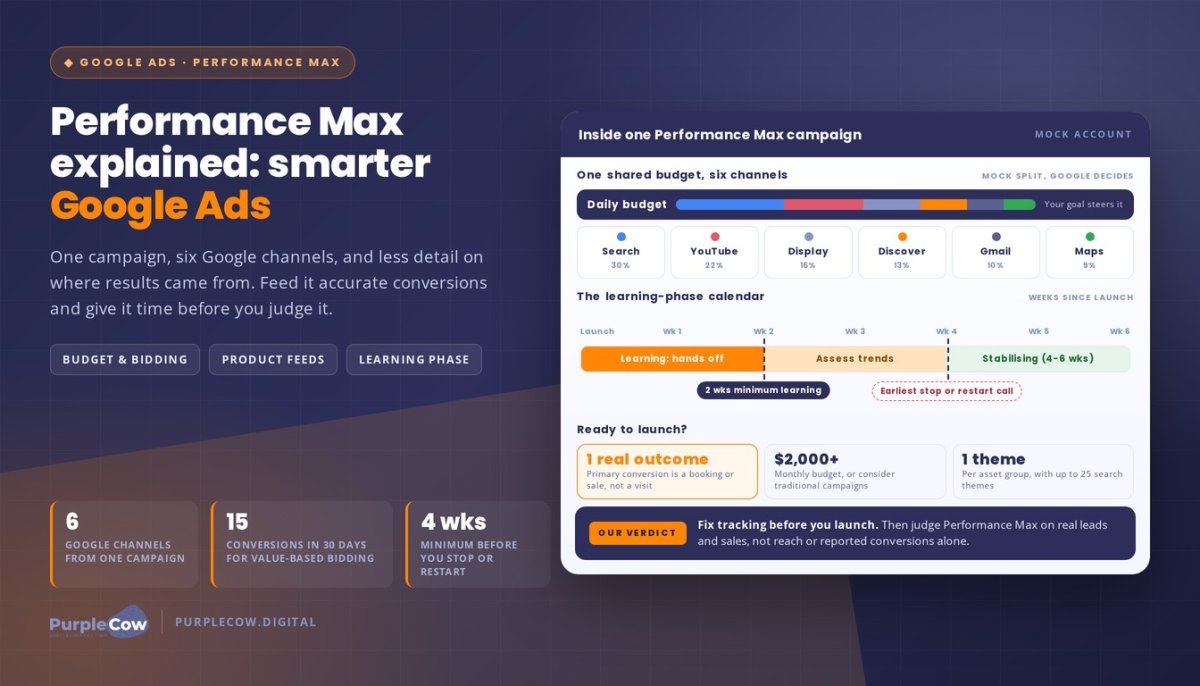
To have Performance Max explained clearly, start with its reach: one Google Ads campaign can show ads across YouTube, Display, Search, Discover, Gmail and Maps. It uses your campaign objectives, conversion goals and audience signals to guide where ads appear and how they’re optimised. For an online retailer, a product feed provides information and images for ads across those channels.
That broad reach can be useful, but it also means you get less detail about specific placements and search terms than with a standard Search campaign. You’ll learn how Performance Max budgets work, what makes a product feed useful and why accurate conversion tracking matters while a campaign learns. We’ll also cover where automation can help, where it can make performance harder to assess, and what to consider before deciding whether it suits your business.
Key Takeaways
- One campaign can reach people across YouTube, Display, Search, Discover, Gmail and Maps, but it offers less placement and keyword detail than standard Search campaigns.
- Choose your campaign type and budget around your goals: Performance Max’s broad reach may not suit every lead-generation business.
- Accurate conversion tracking gives automation the data it needs; incorrect or poorly chosen conversion actions can steer optimisation towards the wrong outcomes.
- For ecommerce, accurate product titles, descriptions and images help your feed give campaigns useful information about what you sell.
- Allow time for the learning phase, and assess performance with care before making major changes to the campaign.
What Performance Max campaigns are and where ads can appear
Google’s current advertising policies apply to Performance Max ads and their landing pages. Australian advertisers must also follow applicable Australian laws. Choosing a campaign goal and conversion actions that reflect the outcomes you want to measure can help guide optimisation.
A Performance Max campaign is a goal-based campaign type that uses Google’s advertising network across YouTube, Display, Search, Discover, Gmail and Maps. You provide campaign objectives, conversion goals, creative assets and audience signals. Google’s automation selects eligible inventory and adjusts ad delivery towards your chosen conversions. Put simply, having Performance Max explained means understanding how those goals and signals guide Google’s channel selection.
For example, a Brisbane electrician could supply service information, images and a completed-enquiry conversion action. Google may use those inputs to show different creative across Search and YouTube. This broad reach is a key benefit: one campaign can access several channels without separate campaigns for each. The trade-off is less control over individual placements.
Performance Max includes controls, but it isn’t a manual placement-by-placement buying tool. Depending on campaign settings, advertisers can use brand exclusions and negative keywords to restrict some traffic. Search themes can also guide discovery, with up to 25 themes per asset group. These are signals, not exact-match keywords that guarantee ads appear only for those searches.
Standard Search campaigns can suit lead-generation businesses that need tighter control over search terms and clearer keyword-level reporting. Performance Max provides less granular detail about the placements and searches behind results. To understand Performance Max in context, compare its broader automated reach with Search’s clearer view of queries. If cross-channel reach matters more, Performance Max can extend your ads beyond search results.
Importing Google campaigns into Microsoft Advertising doesn’t make Google’s cross-channel automation identical on Microsoft’s network. Treat an import as a starting point, then review the campaign type, targeting, creative and conversion tracking in Microsoft Ads. A Google Performance Max campaign’s access to YouTube, Gmail and Maps doesn’t transfer as matching inventory there.
Set a concrete objective before choosing a campaign. A retailer measuring completed purchases needs different conversion actions from a trades business measuring qualified enquiries. When those actions are accurate, Google can optimise towards the intended outcome. When they count the wrong event, broader reach may simply produce more of the wrong signal.
Australian advertisers must follow Google’s current advertising policies for Performance Max ads and landing pages, as well as applicable Australian laws. Google Ads requires a campaign goal and conversion actions that match the outcomes you want to measure.
Google advertising channels and budget allocation
Performance Max can distribute spend across Google channels while you set a shared campaign budget. Understanding that trade-off helps you assess reach, reporting and bidding together.
Delivery Across Google Channels
Performance Max automatically selects eligible Google inventory to pursue your campaign’s conversion goal. This can include Search, YouTube, Display, Discover, Gmail and Maps, with delivery shaped by your creative assets and audience signals. An online retailer might reach someone through a product-focused Search ad, then show them different creative on YouTube. The channel mix responds to predicted opportunities, rather than a fixed allocation you set for each placement.
Asset groups organise related creative assets, such as headlines, images and video, around a product or theme. Audience signals give Google useful starting information about likely customers. Search themes describe relevant search interests and help the system understand your offer’s context. Together, these inputs guide delivery, but they aren’t strict channel or audience boundaries.
Budget Allocation and Bidding
Your campaign budget is the amount available for Google Ads delivery, while bidding tells the system which outcomes to prioritise. Performance Max can use conversion actions you define, plus an optional target cost per action or return on ad spend. In Australia, the cost depends on your budget, auction competition, conversion goal and bid strategy, rather than a universal campaign price.
For example, a service business seeking booked jobs might optimise towards qualified enquiries, while an online shop may prioritise purchases and their value. A target that’s too ambitious for the available conversion data can restrict delivery. Set the budget and bidding goal around business outcomes, then assess results against the same conversion definition.
Google Ads channel reporting gives you a view of performance across campaign inventory, but not the same query-level detail as standard Search campaigns. Use channel insights to spot broad patterns, such as whether YouTube or Search contributes to conversions. Compare those patterns with total leads or sales, rather than treating channel reach alone as proof of business impact.
Think of the mix as a Power Pack of Google inventory, not a promise of equal visibility everywhere. Placement reporting can reveal where ads appeared, but the scale can be substantial: an analysis identified 532,000 unique Performance Max placements in a 30-day period. Review placement insights for relevance and quality, while remembering that individual placements don’t explain every conversion.
Before increasing spend, check whether your conversion actions reflect genuine business value and whether the budget supports the chosen target. If you want help interpreting Google Ads performance alongside your wider marketing, talk with our team.
A monthly Google Ads budget under $2,000 is a reason to consider traditional campaigns instead of Performance Max.
Performance Max reporting provides less detail about the specific placements or keywords that triggered conversions. It may also capture inexpensive brand searches and take credit for them, making reported results look better than they are. Compare reported outcomes with broader business results when assessing whether the budget allocation is working.
Common setup and management mistakes
Performance Max relies on campaign inputs, conversion data and creative working together. A setup mistake can direct optimisation towards activity that looks useful in Google Ads but doesn’t support your actual business goal.
Set up a campaign by choosing its objective and meaningful conversion actions first. Confirm that tracking records genuine outcomes, then set your budget and bidding approach. Build asset groups around related products or services, add suitable creative and audience signals, review campaign controls, then publish. For a trades business, a completed quote request may matter more than a page view.
That sequence matters because Performance Max learns from the conversion signals it receives. If a phone-button click counts as a lead, even when no call follows, the system may seek more clicks instead of qualified enquiries. Before launch, review each conversion action’s purpose, source and recorded event. Keep useful business outcomes primary, and don’t give incidental visits the same importance.
Another mistake is grouping unrelated offers in one asset group. A plumber promoting emergency repairs and bathroom renovations needs distinct messaging for each service. If headlines, images and landing pages point in different directions, Google has fewer connected assets to match with relevant opportunities. Each asset group should tell one clear story, not bundle every service under generic copy.
Over-fragmenting creates the opposite problem. Too many narrowly themed groups can split useful signals and make reporting harder to interpret. One home-improvement campaign improved performance by 60% after its asset groups were consolidated around a broader theme. The practical lesson is to organise groups by meaningful customer intent, then check whether each group has enough relevant creative.
Audience signals and search themes need careful use, too. They guide discovery, but don’t guarantee ads reach only those people or searches. Add signals that reflect likely customers, such as people researching a specific service, rather than treating broad interest as proof of purchase intent. Check search-term and placement insights alongside conversions, because a display impression alone doesn’t show lead quality.
Finally, avoid changing several settings at once. If you alter bidding, assets and conversion actions together, later reporting won’t show which change affected results. Record each meaningful adjustment and its date, then compare performance against the same conversion goal. This simple change log helps distinguish a genuine trend from ordinary campaign variation and keeps optimisation decisions tied to evidence.
Before launch, use this short review: confirm conversion tracking, match each asset group to one clear theme, check landing-page relevance, and ensure the bidding goal reflects a real business outcome. After launch, review the same measures consistently. A disciplined strategy gives Google clearer signals and gives you more useful reporting for your next decision.
Ecommerce and product feeds
For an e-commerce Performance Max campaign, the product feed gives Google structured information about the items you sell. Accurate product titles, descriptions and images can improve ad relevance and visibility across eligible inventory. A vague title such as “Everyday essential” gives less product context than “women’s cotton linen shirt”. Specific, truthful details help connect the item with relevant searches and audiences.
Think of the feed as a product catalogue, not a substitute for creative assets. Google can use feed information to build product-focused ads, while campaign assets such as headlines and images add broader brand messages. A retailer selling camping equipment, for example, could group sleeping bags and tents around related themes, then provide assets that explain the range. Keep each message consistent with the products it represents.
Feed accuracy matters beyond the ad itself. If a product title describes one item but its landing page shows another, the mismatch can confuse shoppers and weaken the path to purchase. Review each product’s title, description and image, then compare them with the corresponding product page. For a blue ceramic mug, both the feed and landing page should clearly identify that item.
Incomplete information can affect a large part of a catalogue. In one example, a client’s feed had incomplete descriptions for 40% of its products before the data was cleaned up. That figure illustrates why reviewing the feed as a whole matters: a handful of polished listings won’t fix gaps across the rest of your inventory. Check product groups for missing or generic descriptions, then prioritise the items most relevant to your campaign.
Product selection also shapes what the campaign can promote. If the feed includes discontinued items or products that don’t support your current business priorities, Google may have a broader catalogue to draw from than you intend. Organise product data around what you want to advertise, and use product-level exclusions where campaign controls allow. This sets clearer boundaries without confusing product information with audience signals.
Performance Max combines feed data with campaign settings, creative assets and conversion goals to seek relevant traffic across Google placements. That reach can help an online store show product ads beyond one channel, but reporting won’t always reveal every search or placement behind a sale. Compare campaign results with product-level sales and conversion data, not impressions alone.
Before launch, treat feed review as a practical quality check: make titles descriptive, complete product descriptions, use clear images, and confirm each listing leads to the matching product page. Then assess which products attract valuable sales, not just clicks. A clean feed gives the campaign stronger product information, while your business goals determine what counts as a worthwhile result.
Machine-learning optimisation and the learning phase
Performance Max uses machine learning to choose when and where ads appear, based on your campaign settings and conversion data. During the learning phase, the system tests delivery opportunities and adjusts towards your chosen target. It needs useful signals, not just time, to discover which interactions are more likely to become valuable conversions.
Conversion tracking is the foundation. If an Australian service business counts every website visit as a lead, Google may optimise for visits instead of genuine enquiries. Set the primary conversion action to a meaningful outcome, such as a completed booking or purchase. Check that the recorded event matches what happened, and remove duplicate or irrelevant actions that could distort the signal.
Value-based bidding also depends on enough recent conversion information. According to Google, advertisers using value-based bidding for Performance Max should have at least 15 conversions in the past 30 days. This is a recommendation for that bidding approach, not a promise of results. If your campaign has limited conversion activity, a simpler bidding strategy may provide a more practical starting point.
Give the system room to learn before judging its performance. Allow at least two weeks for the learning period, then assess trends rather than reacting to a single quiet day. Performance may take 4-6 weeks to stabilise. The right review window helps separate normal variation from a persistent issue, especially when weekly demand changes.
That doesn’t mean leaving the campaign unattended. Review tracking, spend, conversion quality and asset performance, while avoiding frequent, conflicting edits. Changing the target, budget and creative together makes it difficult to identify which adjustment affected results. For example, if qualified enquiries fall after a bidding change, compare the conversion data and timing before replacing every asset.
Wait at least four weeks before deciding whether to stop or restart a Performance Max campaign, unless a clear setup fault needs immediate correction. A broken conversion action is different from a short-term dip: the first corrupts the data, while the second may reflect normal fluctuation. Keep a simple change log so you can connect decisions with later campaign performance.
Use the learning phase to ask practical questions: are conversions being recorded accurately, does the target reflect business value, and are changes based on enough evidence? Those checks help you judge ads across channels against real outcomes, not activity alone. For a small Australian business, that distinction can keep marketing decisions focused on qualified leads and sales.
View campaign data in context, rather than treating each fluctuation as a verdict. The advised minimum of two weeks gives the campaign time to gather evidence, but it does not replace checking whether that evidence reflects genuine business outcomes.
When results are mixed, compare the quality of recorded conversions with the changes made and when they occurred. If the evidence doesn’t support a clear conclusion, verify the tracking and let the campaign produce a more useful signal before making another adjustment. This keeps decisions tied to business value and helps distinguish a setup problem from ordinary variation.
PurpleCow Digital
PurpleCow Digital can help connect your advertising decisions with the website and customer journey behind them. If Performance Max sends visitors to pages that are unclear, outdated or difficult to use, our Website Design and Website Maintenance services can help address those barriers. Search Engine Optimisation can also support your broader visibility strategy, alongside paid advertising.
Turn to us when you need to assess how your website, search presence and digital processes support your business goals. We’ll work with you to identify practical priorities, from improving key landing pages to making essential website information easier for customers to find. The right next step depends on where your marketing journey is losing momentum.
Contact PurpleCow Digital to discuss your website and marketing priorities.
Make your next move with intent
With Performance Max explained, the next decision is how it fits your business goals, not whether automation sounds impressive. Start by identifying the outcome your marketing needs to support, then make sure your website and campaign measurement can show whether you’re moving towards it. A clear plan makes it easier to decide what to improve, what to test and what deserves your attention next.
For some businesses, the priority may be a more useful landing page. For others, it may be a clearer view of how search activity contributes to enquiries. Focus on the gap between the customer’s first interaction and the result your business values. That’s where a considered next step can make your marketing work harder.
If you’d like a sounding board for your campaign direction, get in touch with PurpleCow Digital.
Build on what you’ve learned, make your next decision with purpose, and keep moving towards marketing that helps your business grow.

Article by
Angie Neal
Angie Neal is the founder and CEO of PurpleCow Digital, a full-service digital marketing agency based on Queensland's Redcliffe Peninsula. With deep expertise in SEO and web design, as well as a certification as a GoHighLevel Admin. Angie helps small-to-medium businesses build scalable growth systems through AI-powered automations, CRM workflows, and smart digital strategy. She's also passionate about building a community of like-minded agency owners at the After Party — sharing insights, solving real problems, and helping others grow. Whether it's search visibility, lead management, or end-to-end automation — Angie's focus is always on helping businesses scale sustainably.
Disclaimer
This page may contain affiliate links. If you sign up for software through our links, we may earn a commission at no extra cost to you. We only recommend tools we use and trust – software that is the backbone of our agency.