
A conversion report can tell you who got the credit. It can’t always tell you what moved a customer to act. To understand what is marketing attribution and why it matters, start here: attribution connects marketing touchpoints, such as a Google search, a review and a follow-up email, with outcomes like an enquiry or sale. It helps you interpret the customer journey without pretending one report tells the whole story.
If your Google Ads dashboard, Meta Ads report and sales records seem to tell different stories, you’re not imagining it. Each platform can assign credit differently, and customers rarely follow a neat, single-channel path. A customer might find a trades business through search, check its Google Business Profile, then call after seeing a social post. Last-click reporting may credit only that final step, overlooking what helped start the journey.
This guide explains what attribution can and can’t show, how different models answer different questions, and how to use the evidence to make clearer channel and budget decisions. You don’t need a complex analytics setup to get started. Connect marketing activity to meaningful outcomes, such as qualified enquiries, booked work and sales, then interpret the numbers with their limits in mind. The goal is to make measurement useful for your business, not another dashboard to check.
Key Takeaways
- Understand what is marketing attribution and why it matters when you need to connect marketing activity with enquiries, sales and other business outcomes.
- Trace how channels can play different roles across a customer’s journey, from first awareness to an enquiry.
- Compare attribution models to see what each one credits and which parts of the journey it can miss.
- Start with a meaningful conversion, check your tracking, then review what the data suggests before changing your marketing.
- Use attribution to guide channel priorities and tests, alongside lead quality, sales feedback and business context.
What Is Marketing Attribution and Why Does It Matter?
You can see marketing activity in reports: website visits, search visibility, email engagement and ad clicks. But when an enquiry comes in, it’s not always clear which activity helped bring that person to you. That’s why what is marketing attribution and why it matters is a practical question for any business that wants to connect marketing with leads, sales and return on investment (ROI).
Marketing attribution is a way of assigning credit to the marketing touchpoints associated with a conversion. A conversion is the outcome you want to measure, such as a customer making an enquiry, booking a service or completing a purchase. Touchpoints are the interactions along the way. They’re related, but they aren’t the same thing: the enquiry is the outcome, while a search, website visit or email may be part of the journey leading up to it.
Attribution gives you a framework for interpreting those interactions. It can help you see which channels appear in customer journeys and where they show up. It can’t prove, by itself, that a particular channel caused someone to enquire or buy. A customer’s decision may also be shaped by timing, recommendations, previous experience or factors your marketing reports don’t capture.
That distinction matters when you’re deciding what to do next. If a report gives all the credit to the final interaction, you might overlook earlier activity that introduced your business or helped a potential customer compare options. Treat the result as evidence to consider, not a verdict. The aim is to make better-informed marketing decisions, not to find one channel to credit for every sale.
What counts as a marketing touchpoint?
A touchpoint is an interaction a person has with your business or marketing. For example, someone might discover your business through organic search, visit your website, receive an email and then send an enquiry. In this path, the search and email happen before the conversion, while the website visit could happen earlier or closer to the enquiry.
Touchpoints can also include offline interactions, such as seeing a sign or speaking with someone at an event. These are examples, not a promise that every interaction can be tracked or connected to a particular customer. Some may be recorded in your systems; others may only come to light when you ask a new customer how they found you.
How does attribution differ from marketing analytics?
Marketing analytics is the broader measurement of activity and performance. It can help you review website visits, search visibility, email engagement or enquiries. Attribution is one way to interpret that evidence by looking at how recorded touchpoints relate to a conversion. It answers a narrower question: which interactions received credit under the method you’re using?
This view is more useful when your channels work together rather than compete for credit. PurpleCow Digital’s digital marketing services bring channel activity into a connected strategy, while clear reporting helps you assess performance against meaningful business outcomes. Use attribution to organise the evidence, then weigh it alongside what you know about your customers and sales process.
How Marketing Attribution Follows the Customer Journey
A customer rarely moves from first hearing about your business to making an enquiry in one neat step. They might notice you in search, compare your services, return to your website later and then get in touch. Attribution organises the recorded interactions along that path, so you can see which channels appeared at different stages.
Think of the journey in three broad stages. At awareness, someone first discovers your business. During consideration, they explore your services, compare options or look for reassurance. At conversion, they take an action you value, such as submitting an enquiry or making a purchase. Channels can assist at more than one stage, and the path may include interactions you can’t see in your reports.
There’s no fixed journey length. A customer looking for a straightforward service may decide quickly, while a higher-value or less familiar offer can involve more research and discussion. Your audience, offer and sales process all shape the path. The useful question isn’t whether every customer follows the same sequence. It’s whether your available evidence helps you understand how people move towards an enquiry or sale.
A practical example of multiple touchpoints
Illustrative scenario only, not client performance data or a typical conversion path: someone searches online for an electrician and visits a business’s website. They leave without making an enquiry. Later, they return to the website directly and submit an enquiry after reviewing the services. The search visit and the later return are separate touchpoints; the enquiry is the conversion.
This simple path shows why the last interaction isn’t the whole story. The return visit is close to the enquiry, but the earlier search may have helped the person discover the business. Attribution makes those recorded steps easier to review, while leaving room for other influences that weren’t captured.
Why channel reports can disagree
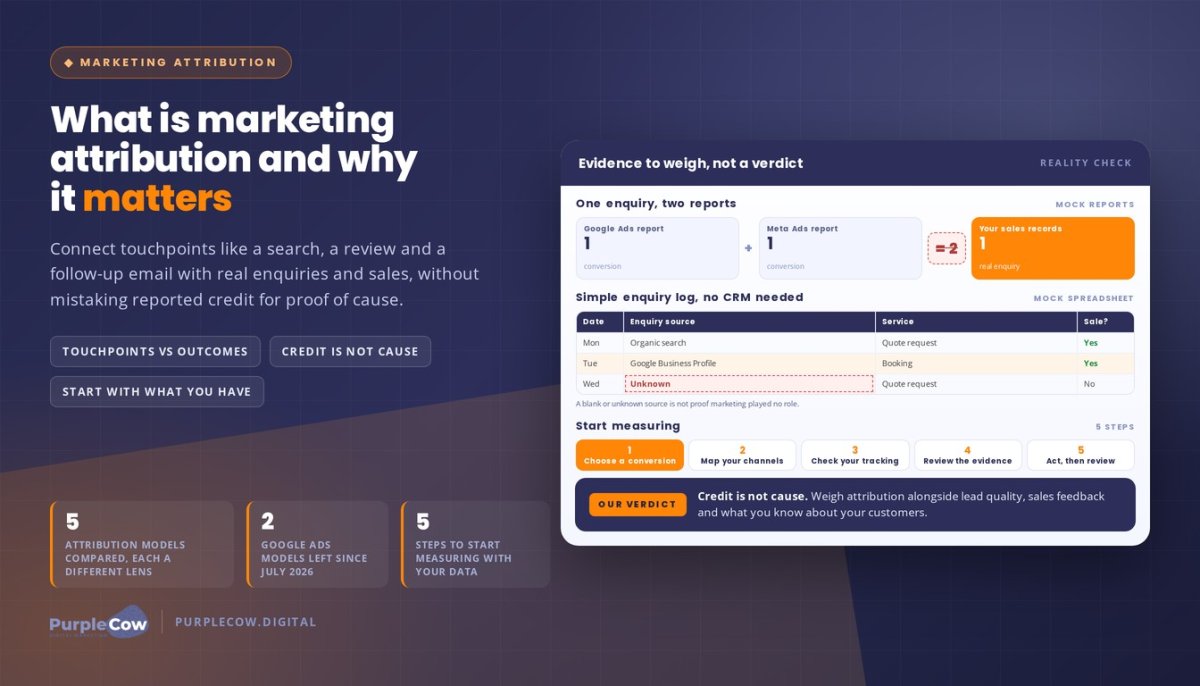
Advertising platforms report activity within their own measurement environments and apply their own attribution settings. If a person interacts with an ad on one platform, later engages with another channel, then enquires, more than one platform may report credit for that conversion, depending on what each records and how its settings assign credit. So, don’t automatically add the figures in separate reports together as if they represent unique enquiries.
A platform’s result isn’t a complete cross-channel account. Compare its reported conversions with your enquiry or sales records, and note any changes to reporting settings when reviewing performance over time. Marketing Attribution Trends and Insights offers further context on how attribution is used and evolving.
That’s the practical side of what is marketing attribution and why it matters: it helps you interpret the journey without mistaking reported credit for proof of cause. If you want a clearer view of how your channel activity connects with enquiries, talk with our team about your measurement approach.
Which Marketing Attribution Models Give Credit, and What They Miss
An attribution model is a set of rules for deciding which recorded touchpoints receive credit for a conversion. The model you choose changes the story your report tells. To understand what is marketing attribution and why it matters, treat each model as a lens for a particular question, not a neutral verdict on which marketing worked.
First-touch, last-touch, and multi-touch models
First-touch highlights discovery; last-touch highlights the final recorded interaction. Multi-touch models spread credit across several interactions, but they do so in different ways. Here’s what common models emphasise and what they can leave out:
| Model | What receives credit | What it may overlook |
|---|---|---|
| First-touch | The earliest recorded interaction. | Later activity that helped build consideration or prompt conversion. |
| Last-touch | The final recorded interaction before conversion. | Earlier touchpoints that introduced or reassured the customer. |
| Linear | Equal credit for each recorded interaction. | Differences in the influence or importance of those interactions. |
| Time-decay | More credit to interactions closer to conversion. | Earlier activity that may have started the journey. |
| Position-based | More credit to selected positions, often the first and last, with some shared across the middle. | The actual influence of each interaction, which may not match the preset weighting. |
These models answer different questions. First-touch can help you examine discovery, while last-touch can show which recorded interaction immediately preceded an enquiry. Linear, time-decay and position-based models recognise more of the journey, but their rules still shape the result.
Data-driven attribution and model availability
Data-driven attribution uses available conversion-path data to estimate how different interactions relate to outcomes. It isn’t a magic fix, and it may not suit a business with limited conversion data. Check what your reporting platform supports and understand the rules behind its figures. For example, Google Ads removed first-click, linear, time-decay and position-based models in July 2026; its remaining conversion attribution options are data-driven and last-click.
Attribution credit is not the same as causation
A recorded interaction before an enquiry shows a sequence, not what would have happened without that interaction. A customer may have found you through search and later enquired, but that alone doesn’t prove search caused the enquiry. Other influences may matter, and some parts of the journey may not appear in your data.
Incrementality testing investigates whether marketing activity changed outcomes by comparing results with a suitable comparison group that wasn’t exposed to the activity. It can add useful evidence, but it doesn’t remove every uncertainty or measurement gap. Use attribution to guide questions, then weigh the findings against lead quality, sales feedback and business context before changing your marketing.
How to Start Measuring Attribution with the Data You Have
You don’t need a complex analytics setup to start connecting marketing with business results. Begin with one meaningful outcome, use the information already available, and improve your measurement as you spot gaps. A simple, consistent process is more useful than a detailed report built on unclear definitions.
Work through these steps in order to build a practical view of where enquiries and sales are coming from, without mistaking clicks or visits for business outcomes.
- Choose a conversion. Pick an action that matters to your business, such as a submitted enquiry, a booked appointment or a completed purchase. Define exactly what counts. For example, decide whether you’re measuring every enquiry or only qualified enquiries that match the services you provide.
- Map your channels. List the marketing channels you actively use, such as organic search, paid advertising, social media and email. Note where each channel’s activity is recorded and which outcomes you can connect to it. Keep the map simple enough to maintain.
- Check your tracking. Confirm that the conversion action is recorded and that campaign links use consistent labels. Urchin Tracking Module (UTM) parameters are labels added to links that help identify a campaign’s source, medium or name in analytics reports. They make campaign traffic easier to sort, but they aren’t a complete attribution system.
- Review the evidence. Compare channel patterns over a reporting period that suits your sales cycle, and keep that period consistent when reviewing changes. Check for missing tracking, duplicate enquiry records and sales made offline that may not appear in digital reports.
- Act, then review again. Use the findings to shape a focused next step, such as checking whether a channel brings qualified enquiries or improving how you record campaign links. Note what you changed so you can compare later results using the same conversion definition.
Choose a conversion and define consistent tracking
Consistency matters more than adding every possible label. Agree on clear campaign names and use the same naming pattern across channels. For example, use one straightforward format for a campaign name rather than giving the same activity different labels in separate reports. That makes the data easier to group and interpret later.
Review findings without overreading the data
Use your reports to identify patterns, not to claim certainty the tracking can’t support. If some enquiries arrive by phone, sales happen offline or campaign information is missing, your view will be incomplete. Treat what you find as directional: useful for deciding what to investigate or test next, but not a definitive account of every customer journey.
For ongoing search engine optimisation (SEO), consistent tracking and reporting can help you assess activity as part of a long-term strategy. SEO is not an overnight fix, but clear reporting can help you connect search performance with meaningful business outcomes. Our SEO tracking and reporting supports that process.
Turn Attribution Insights into Better Marketing Decisions
A report is useful only if it helps you make a better decision. Attribution can inform which channels to prioritise, what creative to test and where to improve follow-up, but it shouldn’t make those decisions for you. The practical answer to what is marketing attribution and why it matters is that it gives you evidence to weigh, not instructions to follow blindly.
From report to practical next step
Choose one focused change to test rather than making a sweeping budget decision based on a single report. Before you act, write down three things: the business question you want to answer, the signal you expect to see, and when you’ll review the result. That gives your test a clear purpose and helps you avoid changing several things at once.
For example, ask whether a particular search campaign is bringing qualified enquiries, not just website visits. Your expected signal could be more relevant enquiries recorded against that campaign. Set a review point that suits your sales cycle, then compare the results with lead quality and sales feedback before deciding whether to continue, adjust or pause the activity.
Keep the wider journey in view, too. A channel with fewer directly attributed conversions may still introduce your business or support a customer’s research before another channel receives the final credit. An SEO article, for instance, may help a potential customer understand a service even if they later enquire after a different interaction. Consider these roles as you build a marketing strategy for your small business, and weigh channel reports alongside what you learn from real customer conversations.
Use attribution to guide your next question, not to declare a winner. If a channel appears to bring fewer enquiries, check whether its leads are more suitable, whether it assists earlier in the journey, and whether your tracking captures the outcome consistently. A channel that looks quiet in one report may still support the broader path to a sale. Business context matters.
When expert support can help make the picture clearer
It can be difficult to make sense of performance when channel reports, tracking and sales records don’t connect. A joined-up view helps you compare marketing activity with outcomes such as qualified enquiries and sales, while being clear about what the data can and can’t show. At PurpleCow Digital, we interpret results in the context of your business, so measurement can support practical decisions rather than become another dashboard to manage.
Build the picture one useful decision at a time. Talk with PurpleCow Digital about measuring your marketing.
Make Your Next Marketing Decision with Confidence
Your next step doesn’t need to be a major strategy overhaul. Choose one business outcome you want to understand better, then use the evidence you have to decide what question to investigate next. A small, deliberate improvement to how you measure or follow up can make future marketing decisions clearer.
Keep your expectations grounded. Attribution won’t produce a perfect account of every customer journey, but it can help you ask sharper questions about where enquiries come from and what might help customers move forward. You don’t have to figure out every channel at once. Start with the outcome that matters most to your business, then build from there.
That’s what is marketing attribution and why it matters in practice: not as a final scorecard, but as a way to make your next decision with more context. Keep learning from each decision, and let the evidence sharpen your next move.
Make progress one informed decision at a time. Keep your focus on the business outcomes that matter, and build a marketing approach that helps you stand out.
Frequently Asked Questions
Is marketing attribution accurate?
Marketing attribution is only as reliable as the data it can access and the rules used to assign credit. Missing visits, unrecorded phone enquiries or inconsistent campaign labels can affect what a report shows. Understanding what is marketing attribution and why it matters means treating results as useful estimates, not a perfect record of every customer decision. Check whether reported conversions align with your enquiry records before acting on a pattern.
Can marketing attribution show which channel caused a sale?
No attribution report can prove on its own that a channel caused a sale. It can show that a recorded interaction appeared before a purchase, but that doesn’t reveal what would have happened without it. For example, a customer may click a search ad after already hearing about your business from a colleague. Use attribution to guide further questions, then consider sales feedback and other evidence before changing channel investment.
What is the difference between marketing attribution and incrementality?
Attribution assigns credit to recorded interactions associated with a conversion. Incrementality examines whether marketing activity changed the outcome by comparing results with a suitable group that wasn’t exposed to that activity. For example, a business might compare responses from people who saw a campaign with a comparable group who didn’t. That comparison can provide evidence about impact, but the result still depends on how the test is designed and what it can measure.
How do UTM parameters help with marketing attribution?
Urchin Tracking Module (UTM) parameters help identify where campaign traffic came from when someone follows a tagged link. For example, links in an email newsletter and a paid campaign can use different source and campaign labels, making their visits easier to distinguish in analytics reports. Keep the labels consistent, or the same campaign may appear under different names. UTMs describe tagged link traffic; they won’t capture every interaction or prove that a campaign caused an enquiry.
Can offline sales be included in marketing attribution?
Yes, you can include offline sales if you record relevant information and can connect it to a marketing interaction. A simple starting point is to ask new customers how they heard about your business and record their answer with the sale. Treat that information as customer-reported context, not a complete journey history. If staff record answers differently or customers can’t recall the source, the resulting picture will be less consistent.
Can a small business use marketing attribution without a CRM?
Yes. A customer relationship management (CRM) system can help organise customer records, but it isn’t essential for a basic starting point. You could use a spreadsheet to record enquiry date, enquiry source, service requested and whether the lead became a sale. Keep the fields manageable and use the same source names each time. Review the records regularly, and avoid treating an unknown or blank source as proof that marketing played no role.
What happens when a customer uses multiple devices before converting?
The journey may appear as separate visits if your measurement tools can’t reliably connect activity across devices. Someone might first research a service on a phone, then return on a work computer to submit an enquiry. Unless the system can associate those interactions appropriately, a report may show only the later visit or count separate users. Don’t assume the available data represents one complete journey; compare it with enquiry details and customer feedback where practical.

Article by
Angie Neal
Angie Neal is the founder and CEO of PurpleCow Digital, a full-service digital marketing agency based on Queensland's Redcliffe Peninsula. With deep expertise in SEO and web design, as well as a certification as a GoHighLevel Admin. Angie helps small-to-medium businesses build scalable growth systems through AI-powered automations, CRM workflows, and smart digital strategy. She's also passionate about building a community of like-minded agency owners at the After Party — sharing insights, solving real problems, and helping others grow. Whether it's search visibility, lead management, or end-to-end automation — Angie's focus is always on helping businesses scale sustainably.
Disclaimer
This page may contain affiliate links. If you sign up for software through our links, we may earn a commission at no extra cost to you. We only recommend tools we use and trust – software that is the backbone of our agency.