
What if every piece of content you generated carried a hidden digital signature that you couldn’t see, but the rest of the world could? Since 2 August 2026, every output from Anthropic’s models includes a Claude text watermark, an invisible cryptographic signal woven into the very fabric of your sentences. If you’re an Australian business owner already juggling a dozen different roles, this probably feels like another technical hurdle designed to trip you up just as you’re getting ahead with AI.
We understand the skepticism and the fear of being “caught” by a search engine. It’s unsettling to think that these invisible markers might lead to SEO penalties or make your brand look like it’s taking the easy way out. However, we’re here to tell you that transparency doesn’t have to mean a drop in rankings; in fact, it’s often the opposite. Google’s primary focus remains on the value you provide to your audience, not the tools you used to get there.
In this guide, we’ll explain exactly how this technology influences word choices without affecting the quality of your copy. You’ll learn why Google rewards high-performing content regardless of its origin and how to ensure your marketing remains remarkable enough to stand out in the paddock, regardless of its digital fingerprint.
Key Takeaways
- Understand how the Claude text watermark acts as an invisible cryptographic signature without slowing down your site or affecting the readability of your content.
- Learn why global regulations are making AI transparency mandatory and why this shift is actually a win for honest, high-quality brands.
- Discover why Google prioritises real-world value and expertise over whether a piece of content was assisted by AI tools.
- Get practical steps on how to infuse your brand’s unique Australian voice into drafts to ensure your marketing never looks “beige” or generic.
- See how we use AI as a high-speed engine for efficiency while keeping human strategy at the wheel to drive leads and ROI.
What is the Claude Text Watermark and Why Does it Exist?
Imagine you’re sending a professional enquiry to a potential new client. You use AI to polish your thoughts, ensuring the tone is just right. What you don’t see is that the Claude text watermark is now quietly tagging that content with a hidden digital signature. This isn’t a visible logo or a stamp at the bottom of the page. Instead, it’s a cryptographic signal woven into the very fabric of the sentences Claude generates for you.
To better understand this concept, watch this helpful video:
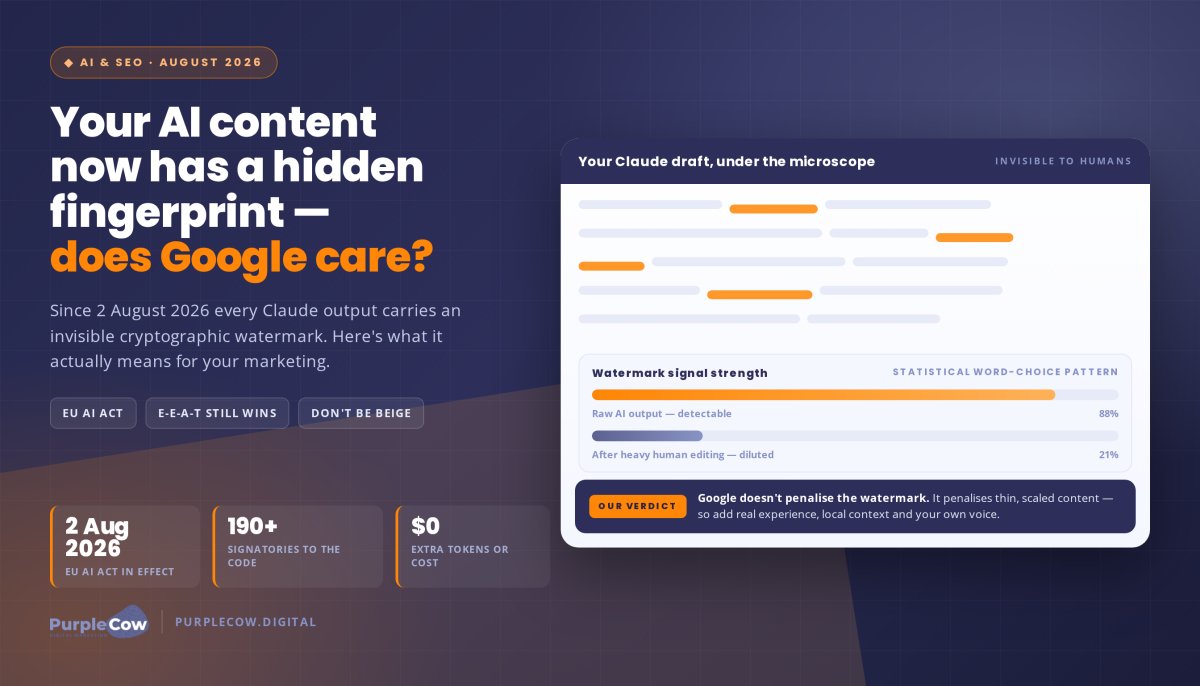
This shift toward marking content isn’t about catching you out or penalising your creativity. It’s a direct response to the EU AI Act, which took effect on 2 August 2026. This landmark regulation requires AI developers to ensure their outputs are detectable. Anthropic, along with roughly 190 other signatories, has committed to these transparency standards to help distinguish between human-led work and fully automated text.
The Shift Toward AI Transparency
The move toward universal watermarking is about provenance, not punishment. By signing the EU AI Act’s Code of Practice, major providers like Anthropic and Google are creating a global standard for accountability. We can define text watermarking as a statistical signature embedded in word choice frequency. It works by influencing the probability of certain words appearing, creating a pattern that a machine can recognise but a human reader will never notice. It doesn’t cost more to produce, and it doesn’t use extra tokens; it’s simply a new way for the model to “write.”
Does This Apply to Australian Businesses?
You might wonder if a European law matters to a business operating in Australia. The reality is that AI models are updated globally. When Anthropic released its new standards on 2 August 2026, those changes applied to every user from Sydney to Perth. The EU AI Act has become the “gold standard” for global regulation, and other countries are likely to follow suit.
For Australian SMEs, staying ahead of these trends is a competitive advantage. Using AI for efficiency is smart, but understanding how to maintain your unique brand voice is what makes you stand out. If you want to see how this fits into a broader strategy, our guide on how to use AI in local businesses provides a roadmap for staying remarkable. Embracing transparency now ensures your brand remains trusted as the digital world becomes more crowded with automated content.
How Does Claude Watermarking Actually Work?
You don’t need to be a data scientist to understand the Claude text watermark, but you do need to know it’s not just a hidden file or a line of code at the bottom of your document. It’s much cleverer than that. This technology doesn’t rely on “tricks” like hidden characters or invisible white spaces that old-school detection tools used to look for.
Think of it as a subtle preference for certain words over others. When Claude writes, it constantly predicts the next word in a sentence. For every “slot” in a sentence, there are usually several synonyms that would work perfectly. The system uses a secret cryptographic key to influence which of those synonymous words it picks, creating a pattern only a machine can recognise.
The Statistical Signature Explained
At its core, this is a mathematical pattern. While a human sees a naturally flowing paragraph, a detection tool sees a specific distribution of word choices that wouldn’t occur by chance. This technology creates an invisible ‘watermark’ for AI-generated text by slightly biasing the model’s output frequency.
This method is far more robust than previous attempts at AI identification. Because the signature is woven into the language itself, it travels with the text wherever it goes. It doesn’t matter if you copy and paste it into a plain text editor or a WordPress block; the statistical fingerprint remains embedded in the word choices.
Machine-Readable Marks vs. Human Eyes
Your customers won’t spot the difference. To a human reader, the text looks like high-quality, professional copy. However, machine-learning algorithms can scan the frequency of these word choices and flag the content as likely AI-generated. These tools aren’t looking for specific “AI words,” but rather the underlying mathematical rhythm that Claude’s secret key creates.
There’s a catch, though. This signal is delicate. If you take a Claude-generated draft and heavily edit it, you’re essentially breaking the pattern. By injecting your own stories, changing the sentence structure, and swapping out words for your own terminology, you dilute the statistical signature until it’s no longer detectable.
One of the biggest wins for business owners is that this process doesn’t affect your bottom line. Generating watermarked text doesn’t use extra tokens or increase your API costs. It’s built into the generation process itself. Balancing efficiency with a unique brand voice is the key to staying remarkable. If you’re unsure how to integrate these tools into your workflow without losing your edge, reach out to us to discuss a strategy that works for your business.
The Big Question: Will AI Watermarks Hurt Your SEO?
Many Australian business owners worry that a Claude text watermark is essentially a “kick me” sign for Google’s search crawlers. We hear this concern often, especially from tradies and service providers who’ve seen the digital goalposts move before. The fear is that an invisible mark will lead to a sudden drop in rankings or a manual penalty that’s hard to recover from.
Google’s official guidance remains consistent: they reward high-quality content, however it’s produced. Their spam policies specifically target “scaled content abuse,” which refers to the practice of pumping out low-quality pages in bulk to manipulate search results. This policy was reinforced in major core updates in March 2024 and again in March 2026 to clean up the search results.
If you’re using AI to support a local SEO strategy that actually answers your customers’ enquiries, you aren’t the target of these penalties. Google rewards the E-E-A-T factor: Experience, Expertise, Authoritativeness, and Trustworthiness. A Claude text watermark doesn’t diminish these qualities; your lack of oversight does. Machine-readable marks are about transparency, helping search engines understand the provenance of a piece of text without automatically demoting it.
Why “Remarkable” Content Beats Detection
The real risk to your business isn’t AI detection; it’s being “beige.” Generic AI output that sounds like every other website in your industry is what fails to rank. Google penalises “thin” content that offers no new value, not the specific tool used to write it. To stand out in the paddock, you must inject your own unique Australian perspective and real-world business insights into every draft.
- Add Case Studies: Mention a recent project you completed in your local area.
- Use Brand Voice: Ensure the tone matches how you actually speak to your customers.
- Specific Knowledge: Include details about Australian regulations or climate that a generic AI might miss.
At PurpleCow Digital, we view AI as a high-speed engine, but human strategy is the navigator. We use these tools to build efficiency while ensuring the final product is remarkable enough to convert visitors into leads. This balanced approach is at the heart of our SEO services, focusing on ROI and real-world outcomes rather than just filling a page with words. When you stay remarkable, a digital fingerprint becomes irrelevant.
Practical Steps: Using Claude Without Being “Beige”
Using AI to scale your content is efficient, but lazily copy-pasting is a fast track to becoming invisible. If you rely on raw output, you aren’t just risking a Claude text watermark; you’re risking a brand that sounds like every other competitor on the web. We call this “beige” marketing, and it’s the enemy of growth.
The first step is to use Claude as a high-level research assistant or a structural architect. It’s brilliant at outlining a complex topic, but the actual “meat” of the content needs to come from your experience. You should treat the first draft as a rough block of marble that needs your specific touch to become a masterpiece.
The SME Guide to Better AI Prompting
To get the best results, you must steer the model away from generic corporate speak. Feed Claude your specific branding guidelines before you start. Tell it to use Australian English, avoid flowery adjectives, and keep paragraphs brief. Asking for varied sentence length helps create a more human rhythm that feels natural to your readers.
The Human-in-the-Loop Editing Checklist
Heavy editing is your best tool for breaking predictable AI patterns. When you rewrite sentences and swap generic terms for industry-specific jargon, you effectively dilute the Claude text watermark signal. This ensures your content aligns with your broader marketing strategies for small business. Use this checklist for every draft:
- Kill the fluff: Remove overused AI phrases like “unlocking potential” or “a testament to.”
- Add local context: Mention specific Australian standards, weather conditions, or local suburbs.
- Inject real-world proof: Include a brief case study or a specific example from a recent client enquiry.
- Check the “Purple Cow” factor: Ask yourself if this content is remarkable enough that a reader would actually share it.
The Claude text watermark isn’t a wall; it’s a window. It shows where the technology is heading, but it doesn’t define your brand’s future. At PurpleCow Digital, we see AI as a high-speed engine that gets us to the destination faster. However, human strategy remains the navigator that ensures we actually arrive at a place of profit.
We don’t get excited about how many AI articles we can generate in an hour. We focus on ROI and leads because vanity metrics won’t pay your subcontractors or grow your fleet. Whether we’re building web design that converts or managing your Meta Ads, every tool we use is aimed at one goal: making your business stand out in the paddock.
Beyond the Watermark: Building a Standout Brand
In a world where everyone has access to the same AI tools, professional content marketing is more critical now than ever. If everyone uses the same prompts, everyone ends up with the same beige results. PurpleCow eliminates that mediocrity by combining AI efficiency with human creativity and strategic discipline.
We don’t just “post content”; we build authority. Our approach ensures your brand has a pulse, a personality, and a clear reason for customers to choose you over the guy down the road. If you’re unsure where you stand, we offer a free audit to see if your current strategy is truly remarkable or just blending into the background.
Partnering for Growth
Most Australian SME owners are time-poor and frankly skeptical of marketing promises. You’ve got jobs to quote and teams to manage; you shouldn’t have to worry about cryptographic signals or search algorithm shifts. That’s why smart businesses hire a team of experts to handle the heavy lifting.
Our commitment is simple: we are result-obsessed. We don’t hide behind jargon or technical excuses. We provide transparent, data-driven marketing that focuses on real-world outcomes and measurable growth. Let’s chat about making your business the Purple Cow in your field, ensuring you’re not just another name on a list, but the market leader your competitors fear.
Turn the Fingerprint into Your Brand’s Edge
The Claude text watermark is simply a new reality of the digital world, not a threat to your search visibility. If you focus on delivering real-world value and genuine Australian expertise, a hidden statistical signature won’t hold your business back. Google continues to reward content that solves actual problems for your customers, regardless of the tools you used to draft the initial enquiry or blog post.
We help you move beyond generic marketing and build a brand that truly stands out in the paddock. Our results-obsessed approach ensures your performance is measured in leads and sales, rather than just vanity metrics. With no hidden fees or black-box tactics, our team provides the clarity and strategy you need to scale with total confidence.
You’ve already got the expertise to lead your industry. Now it’s just about making sure your digital presence reflects that same level of authority. Let’s work together to ensure your brand is never just another face in the crowd, but a remarkable force that commands attention.
Frequently Asked Questions
Is Claude’s text watermark visible to my customers?
No, your customers will never see a Claude text watermark when reading your website or emails. It isn’t a visible stamp, a logo, or a hidden string of characters at the end of a sentence. Instead, it’s a mathematical rhythm woven into the frequency of the word choices the model makes. To a human reader, the copy looks like standard, professional text, while only specialised detection software can spot the underlying pattern.
Can I remove the Claude watermark by editing the text?
You can weaken or completely remove the watermark by performing heavy human editing on the draft. Because the signal relies on specific statistical patterns in word choice, changing the sentence structure and injecting your own terminology breaks that pattern. If you take an AI draft and rewrite significant portions to include your own stories and Australian-specific context, the original cryptographic signature becomes impossible for machines to detect with any certainty.
Will using watermarked AI text get my website banned from Google?
Google won’t ban your website simply for using AI-generated text. Their official guidance clarifies that they reward helpful, high-quality content that provides a good user experience, regardless of how it was produced. The Claude text watermark serves as a badge of provenance for transparency, not a signal for a penalty. As long as your content isn’t part of a low-quality, automated spam campaign, your search rankings remain safe.
Does the Claude watermark contain my personal data or business info?
No, the watermark does not store or transmit any of your personal details, business information, or private prompts. It is a universal signal applied to all outputs from the model to comply with global regulations like the EU AI Act. Its only purpose is to identify that the text was likely produced or edited by Claude. Your privacy remains protected, and the watermark doesn’t leak any sensitive data to third parties or search engines.
How do AI detection tools find Claude’s invisible watermark?
Detection tools look for a mathematical signature rather than specific words. Every AI model has a predictable way of predicting the next word in a sequence. By influencing these predictions with a secret cryptographic key, Anthropic creates a rhythm that is highly unlikely to occur in natural human writing. Software designed to find these marks analyses the frequency of these candidate words to determine the probability that the text is AI-generated.
Should I stop using Claude for my business blog because of this?
You shouldn’t stop using AI tools, but you must stop using them to create beige content. Claude is a brilliant engine for research and structure, but your blog needs your unique expertise to stand out. If you use AI to build the foundation and then layer on your own business insights and local Australian perspective, you’ll create something remarkable. The goal is to use the tool for efficiency while maintaining human oversight.
Does watermarking make Claude more expensive for Australian users?
Watermarking doesn’t add any extra costs or fees for Australian business owners. It’s a core feature of the model’s generation process, meaning it doesn’t use additional tokens or slow down the output speed. Whether you’re on a free plan or a paid subscription, the technology works in the background without affecting your bottom line. It’s simply a new global standard for how AI models operate in a regulated digital environment.
What is the difference between a watermark and metadata in Claude?
A watermark is woven directly into the text through word choice, whereas metadata is a separate tag attached to a file. Think of a watermark like the security thread inside a banknote; it’s part of the paper itself. Metadata is more like a digital sticker or a label that can often be stripped away more easily. Claude uses the watermark approach because it travels with the text even when you copy and paste it into different platforms.

Article by
Angie Neal
Angie Neal is the founder and CEO of PurpleCow Digital, a full-service digital marketing agency based on Queensland's Redcliffe Peninsula. With deep expertise in SEO and web design, as well as a certification as a GoHighLevel Admin. Angie helps small-to-medium businesses build scalable growth systems through AI-powered automations, CRM workflows, and smart digital strategy. She's also passionate about building a community of like-minded agency owners at the After Party — sharing insights, solving real problems, and helping others grow. Whether it's search visibility, lead management, or end-to-end automation — Angie's focus is always on helping businesses scale sustainably.
Disclaimer
This page may contain affiliate links. If you sign up for software through our links, we may earn a commission at no extra cost to you. We only recommend tools we use and trust – software that is the backbone of our agency.