
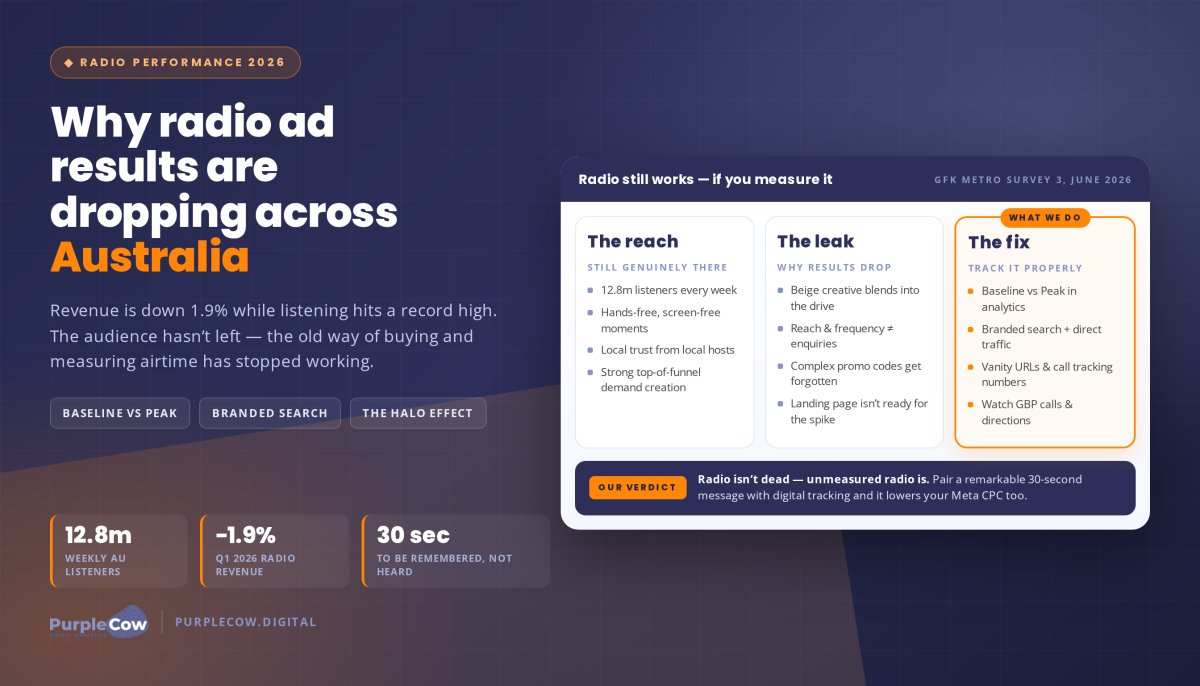
Commercial radio revenue in Australia dropped by 1.9% in the first quarter of 2026, yet listenership hit a record 12.8 million weekly listeners. This paradox proves that while the audience is still there, traditional radio ads results are often failing because the old ways of buying and measuring airtime no longer work for modern businesses. If you feel like your broadcast spend is disappearing into a black hole, you aren’t alone.
At PurpleCow Digital, we understand the frustration of paying for a high-frequency campaign only to see a flatline on your website analytics. It’s exhausting to worry that your hard-earned budget is being swallowed by “beige” creative that blends into the background noise of the morning commute, leaving you with no clear way to track a specific enquiry back to the source. Most business owners are tired of being told to focus on “reach” when what they really need is a measurable return.
We’re here to bridge that gap. We’ll show you exactly how to track, measure, and maximise your radio ads results to ensure your brand remains remarkable and your ROI stays high. You’ll discover a clear framework for measuring performance, how audio supports your SEO, and actionable ways to ensure your ads actually build your business rather than just filling airtime.
Key Takeaways
- Radio audiences in Australia remain stable at 12.8 million weekly listeners, but traditional revenue is shifting towards more measurable digital audio formats.
- Stop guessing your ROI and learn to track radio ads results by monitoring digital intent signals and using the “Baseline vs Peak” method in your analytics.
- Discover how radio creates a “halo effect” that builds brand trust and can significantly lower your Cost Per Click on Meta Ads.
- Ensure your website is ready to act as your best salesperson, because even a remarkable radio ad will fail if your digital landing page is beige and confusing.
- Focus your campaign on a singular, high-impact message delivered during specific dayparts that match your target audience’s daily routine.
Does Radio Advertising Still Deliver Remarkable Results?
Many business owners assume radio is a relic of the past, but the data tells a different story. For Australian tradies on-site and commuters stuck in traffic, the radio is a constant companion that digital platforms can’t always replicate. It’s a high-impact environment where your message can reach thousands, provided you don’t settle for being part of the background noise.
We see radio as a powerful top-of-funnel engine. It doesn’t just broadcast; it plants seeds of curiosity that later bloom into searches on Google or clicks on Meta Ads. To see real radio ads results, you must stop viewing the airwaves as a silo and start seeing them as the catalyst for your entire digital presence.
To better understand how audio still drives performance, watch this discussion on radio’s role in modern marketing ROI:
The Reality of Radio Reach in Australia
As of June 2026, commercial radio reaches 12.8 million Australians every week, according to GfK Metro Survey 3. While streaming services offer personalisation, radio offers a sense of local community and immediate trust that’s hard to buy elsewhere. For service-based businesses, local stations provide a direct line to a captive audience that’s already primed to listen to recommendations from their favourite hosts.
This medium holds its own because it’s hands-free and passive, meaning it occupies the spaces where screens can’t go. Whether it’s a workshop floor or a long haul on the M1, radio is there. When integrated into broader marketing strategies for small business, it builds the brand familiarity needed to make your digital ads convert at a higher rate.
Why “Beige” Radio Ads Fail to Convert
The biggest threat to your budget isn’t the platform; it’s the high cost of being boring. Most listeners have developed a “filter” for average, uninspired creative that we call beige marketing. This Radio advertising overview explains the various formats, but regardless of the style, your ad must disrupt the listener’s routine to be effective.
There’s a massive psychological gap between someone “hearing” your ad and actually “noticing” your brand. Within a 30-second window, you must make a bold promise or share a unique insight that forces a driver to remember your name when they eventually park. If your message is forgettable, you aren’t just losing airtime; you’re throwing away the chance to stand out in a crowded market. Remarkable radio ads results only happen when you dare to be different enough to be remembered.
Tracking Your Radio Ads Results: Modern Metrics for SMEs
Traditional radio reporting often relies on vague reach and frequency numbers that don’t tell the full story of your investment. To truly understand your radio ads results, you must look at what happens on your website and phone lines the moment your spot airs. We move beyond “vanity metrics” to focus on intent-based digital signals that prove your offline spend is working.
Measuring performance requires a shift from looking for direct clicks to identifying spikes in brand interest. When a listener hears your ad while driving, they won’t click a button; they’ll search for your name later or visit your site directly once they’ve parked. Monitoring your Google Business Profile for increased “Request Directions” or “Call” clicks during your campaign window is a vital part of this process.
The “Baseline vs Peak” method is the most effective way for SMEs to isolate radio-driven traffic. By establishing your average daily traffic before the campaign starts, you can clearly see the “spikes” that align with your broadcast schedule. If you’re unsure how to set this up in your analytics, reach out to us for a strategy chat.
Digital Footprints: Website Peaks and Direct Traffic
Branded search volume is the truest indicator of radio success. If more people are Googling your specific business name rather than general industry terms, your radio creative is doing its job. It means you’ve successfully moved past being “heard” to being noticed and remembered.
You should also pay close attention to your “Direct” channel data in Google Analytics. This captures users who typed your URL straight into their browser after hearing it on the air. These are high-intent visitors who are often much further along the buying journey than someone who found you through a generic search.
Attribution Tools: Promo Codes and Unique Enquiries
Promo codes offer a direct way to track an enquiry, but they come with a catch. Recent research on ad avoidance suggests that listeners often mentally check out during long ad breaks. If your code is too complex, they simply won’t remember it by the time they reach their destination.
Unique landing pages or vanity URLs are often more effective for tracking. A short, punchy web address mentioned in your ad allows you to segment that traffic entirely from your organic visitors. This provides a clean dataset to measure your conversion rate specifically from radio listeners.
Call tracking numbers provide the most granular data for service-based businesses. By assigning a different phone number to each station or time slot, you can see exactly which audience is picking up the phone. This level of detail ensures you aren’t wasting budget on stations that deliver reach but no real-world outcomes.
Comparing Radio ROI with Digital Marketing Performance
Digital marketing is often praised for its surgical precision, but it lacks the broad “halo effect” that a solid audio campaign provides. While digital platforms excel at capturing existing demand, radio is unmatched at creating it. To see the best radio ads results, you have to understand how these two worlds interact rather than pitting them against each other.
When your brand is heard repeatedly on the air, the friction in your digital funnel starts to disappear. We often see that high radio frequency leads to a significantly lower Cost Per Click (CPC) on Meta Ads because users are already familiar with your name. They don’t just see another ad; they see a brand they recognise from their morning commute.
This multi-channel approach is the only way to truly dominate your market in 2026. Unlike the “on-off” nature of paid search where traffic vanishes the second you stop paying, radio builds long-term brand equity. It’s an investment in the memory of your potential customers, ensuring you’re the first choice when they finally need your service.
The Multiplier Effect: Radio + SEO
A well-executed radio campaign does more than just fill airtime; it actually improves your organic performance. When people hear your brand on the radio, they are far more likely to click on your listing in search results, even if you aren’t in the top spot. This increased click-through rate sends powerful signals to Google that your business is relevant and trusted.
Integrating your broadcast message with professional SEO services ensures that when those listeners search for you, they find a website that delivers on your on-air promise. However, recent Australian radio ad research suggests many local campaigns fail because they lack strong brand recognition. If your creative is beige, your SEO won’t get the boost it deserves.
Cost Per Acquisition (CPA) Across Channels
Judging radio ads results through a narrow 7-day attribution window is a recipe for disappointment. Radio is a long-term play designed to reduce your overall Cost Per Acquisition (CPA) across your entire marketing ecosystem. It builds the trust that makes a lead eventually choose you over a cheaper competitor.
Instead of looking at radio in isolation, you should calculate your “Blended ROI.” This means looking at how your total marketing spend converts into revenue. When radio is working, you’ll see your conversion rates climb on Meta Ads and search engines alike, proving that a remarkable brand is always more profitable than a hidden one.
How to Build a Radio Campaign That Actually Gets Results
Building a campaign that sticks requires more than just buying airtime; it’s about a strategic framework that prioritises impact over volume. To see genuine radio ads results, you must move away from the “spray and pray” approach that many agencies still push. We focus on a four-step process designed to make your brand impossible to ignore.
First, define one singular, remarkable message. Most SMEs fail because they try to list every service they offer in a 30-second window, which only leads to listener confusion. Second, choose your dayparts based on your target audience’s daily routine. If you’re targeting tradies, you need to be on-air before 7:00 am, not during the mid-morning school run.
Third, invest in professional voice talent that reflects your unique branding and personality. Avoid using the station’s “free” production if it sounds like every other ad in the break. Finally, ensure your CTA is incredibly easy to remember. If a driver needs a pen to write down your phone number, you’ve already lost the lead.
Crafting a Remarkable Script
You have exactly three seconds to stop a listener from mentally tuning out. A powerful hook isn’t a loud noise or a generic “Are you looking for a plumber?” question. It’s a statement or a scenario that creates immediate curiosity and forces the listener to pay attention to what comes next.
Use storytelling instead of a dry list of features. People remember how you solved a problem, not that you’ve been “family-owned since 1982.” In our world, average is a dirty word. If your script feels safe or familiar, it’s probably beige, and beige marketing is the fastest way to waste a high-cost radio slot.
Frequency vs Reach: Finding the Sweet Spot
It’s a common mistake to chase reach at the expense of frequency. In reality, it’s much better to reach 1,000 people three times than to reach 3,000 people once. This is known as the “Rule of Three,” and it’s the psychological threshold required for a brand to move from the background into a listener’s active memory.
Repetition is the key to recall, especially in a medium as passive as radio. When budgeting for impact, we always recommend a short, heavy burst of ads over a long, thin campaign that disappears into the static. This concentrated approach ensures you achieve the necessary frequency to see a real spike in your radio ads results.
Beyond the Airwaves: Integrating Radio into Your Digital Strategy
Think of your radio ad as a bold promise made to a listener in a fleeting moment. Your website is the delivery of that promise. If your on-air creative is remarkable but your digital presence is beige, you will lose the lead before they even finish reading your homepage. To secure the best radio ads results, your digital storefront must be ready to close the deal that your audio campaign started.
We see too many Australian business owners invest heavily in airtime only to send that traffic to a site that hasn’t been updated since 2015. This disconnect is where ROI goes to die. Your website design must act as your best salesperson, greeting every radio-driven visitor with the same energy and professionalism they heard on the morning show.
Consistency across every touchpoint is the only way to build a brand that people actually remember. When someone hears your voice on the radio and then sees your logo on a Google search, that mental connection needs to be instant and reinforcing. If your digital strategy and your radio spots aren’t talking to each other, you’re effectively paying for reach while ignoring conversion.
Turning Listeners into Leads with High-Performing Websites
Most people who hear your ad will eventually look you up on a mobile device while they’re on a lunch break or between jobs. If your site takes more than a few seconds to load, they’ll bounce back to the search results and choose a competitor. You need to greet these “radio visitors” with a clear, relevant message that mirrors exactly what you promised on the air.
A friction-free enquiry process is non-negotiable for capturing high-intent listeners. Don’t force them to hunt for a phone number or fill out a twenty-field form. The goal is to make it as easy as possible for them to take the next step while your brand is still fresh in their mind. A fast, mobile-optimised site is the foundation of any campaign that aims to scale.
Why Your Brand Identity Matters More Than the Airtime
Successful radio ads results rely on a “mental hook” that sticks with the listener long after the ad break ends. This is where professional branding and identity become your most valuable assets. Your audio personality should flow into your visual identity, using consistent tones and messaging that reassure the customer they’ve found the right place.
A strong logo and a bold colour palette serve as visual anchors when listeners find you online later. In a crowded market, you can’t afford to be just another name in the directory. You have to stand out in the paddock by being consistent, brave, and remarkable. When your audio and visual elements work in partnership, you stop being a background noise and start becoming a market leader.
Stop Wasting Your Airtime and Start Scaling Your Brand
Radio remains a powerhouse for reaching Australian audiences, but the days of “set and forget” broadcast campaigns are over. To get the most out of your radio ads results, you must bridge the gap between what people hear in their cars and what they find on their screens. A remarkable brand is one that is consistent, bold, and easy to find when the listener finally parks and picks up their phone.
You don’t have to navigate this shift alone. With the right strategic partner, your offline and online efforts will work together to make your business the only choice in your market. Let’s build something remarkable together.
Frequently Asked Questions
Is radio advertising still effective for Australian small businesses in 2026?
Yes, but only if you move away from beige marketing and integrate it with your digital strategy. Radio reaches 12.8 million Australians weekly, making it a powerhouse for building awareness. However, effectiveness now depends on your ability to catch that traffic on a high-performing website. If you treat it as a standalone silo, you’ll likely see your budget disappear without a trace. Effectiveness requires being remarkable enough to be remembered.
How long does it take to see results from a radio ad campaign?
You should see immediate spikes in website traffic or branded searches, but building lasting brand equity takes a minimum of three to six months. Radio is a frequency game. A single burst might get some phones ringing, but a sustained, remarkable campaign is what creates long-term trust. Don’t expect a one-week “test” to transform your business. Patience is required to see significant radio ads results across your entire funnel.
Can I track exactly how many sales came from a specific radio ad?
You can’t track every single sale with 100% precision, but you can get very close with modern attribution. By using unique landing pages, vanity URLs, or call tracking numbers, you can isolate specific enquiries. You should also monitor “Direct” traffic and branded search volume in your analytics. These digital footprints are the most reliable indicators that your on-air promise is actually driving real-world action from high-intent listeners.
What is a good ROI for a radio advertising campaign?
A healthy campaign should aim for a 2:1 return on investment, according to 2025 Nielsen data. However, you must look at the “Blended ROI” across your entire marketing ecosystem. If your radio ads are making your Meta Ads cheaper and your SEO more effective, the real value is much higher. Don’t judge radio ads results through a narrow lens; look at the overall growth and lead quality of your business.
Should I use a unique phone number for my radio ads?
Yes, using a unique call tracking number is the smartest way to measure station performance. It allows you to see exactly which station or time slot is making your phone ring. While some worry it might confuse customers, most people are used to seeing different contact points. It’s a small trade-off for the clarity you’ll gain when deciding where to reinvest your marketing budget for maximum impact and scale.
How much should a small business spend on radio advertising to see results?
There is no “one size fits all” price, but you must spend enough to achieve the “Rule of Three” frequency. For most SMEs in major metro areas, a few thousand dollars per week is the minimum to avoid being drowned out by larger competitors. It’s better to dominate a smaller community station with a heavy burst than to be a quiet, invisible whisper on a major commercial network.
What happens to my SEO when I run radio ads?
Your SEO usually gets a significant boost because radio drives branded search volume. When people hear your name on the air, they search for you on Google. This sends positive signals to search engines that your brand is relevant and authoritative. If you’ve optimised your Google Business Profile, you’ll likely see a spike in “Request Directions” and “Call” clicks that correlate directly with your on-air schedule.
Is it better to advertise on commercial radio or community stations?
Commercial radio offers massive reach, but community stations often provide a more loyal and engaged local audience. For a service-based business like a plumber or electrician, a community station can build trust faster within a specific suburb. The best choice depends on your budget and goals. Sometimes, being a big fish in a small pond delivers more remarkable radio ads results than being invisible on a metro station.

Article by
Angie Neal
Angie Neal is the founder and CEO of PurpleCow Digital, a full-service digital marketing agency based on Queensland's Redcliffe Peninsula. With deep expertise in SEO and web design, as well as a certification as a GoHighLevel Admin. Angie helps small-to-medium businesses build scalable growth systems through AI-powered automations, CRM workflows, and smart digital strategy. She's also passionate about building a community of like-minded agency owners at the After Party — sharing insights, solving real problems, and helping others grow. Whether it's search visibility, lead management, or end-to-end automation — Angie's focus is always on helping businesses scale sustainably.
Disclaimer
This page may contain affiliate links. If you sign up for software through our links, we may earn a commission at no extra cost to you. We only recommend tools we use and trust – software that is the backbone of our agency.