
AI won’t rescue marketing without a clear goal. But AI marketing for a small business can reduce time spent on repetitive tasks, leaving more room for the work that attracts the right enquiries.
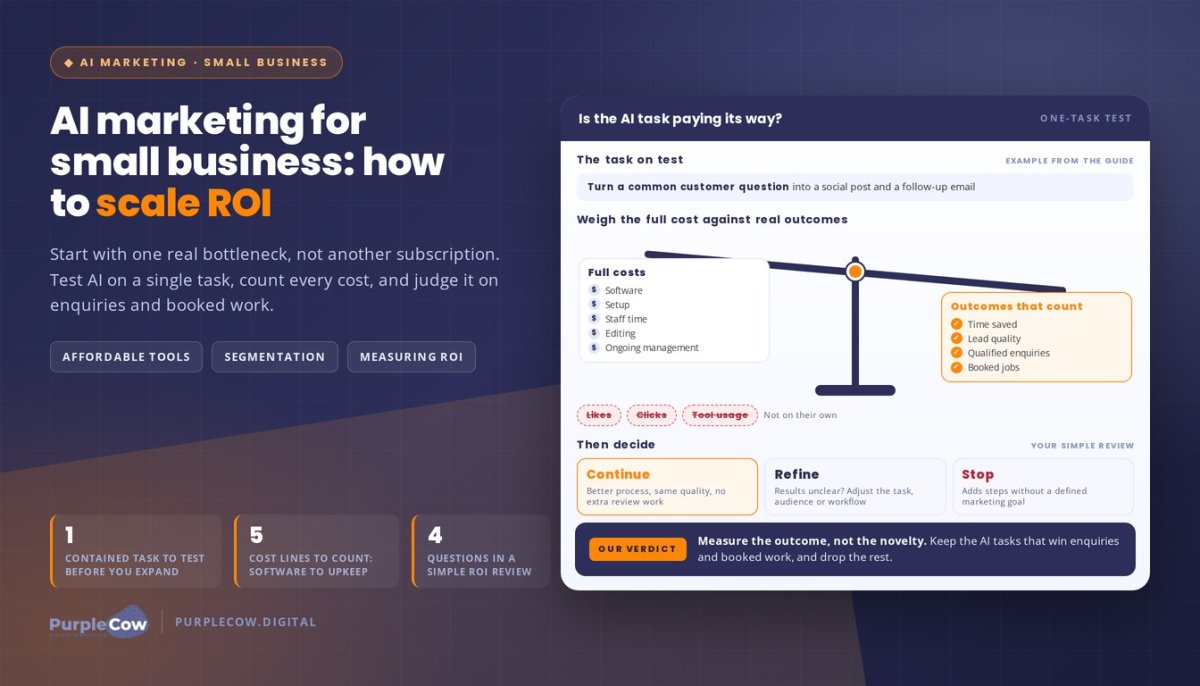
It’s fair to be cautious: another tool won’t help if it adds cost and complexity without improving results. Start with a real bottleneck, such as turning common customer questions into useful social posts or tailoring follow-up emails to different customer needs.
This guide explains what AI can do for an Australian small business, how to find practical tools without overcomplicating your setup, and how to use customer data thoughtfully for audience segmentation. You’ll also see where AI can support B2B marketing, where human judgement still matters, and how to assess whether the time and money invested are contributing to ROI. Start with the problem you want to solve, then use the examples ahead to decide which AI tasks could help your business grow.
Key Takeaways
- Start with a specific marketing bottleneck, then choose a small set of affordable AI tools that fit your goals and existing workflow.
- Use accurate customer data to shape audience segments and more relevant follow-ups, while protecting private information.
- Let AI support B2B research and content, but keep human oversight for accuracy, brand voice and important customer conversations.
- Assess AI’s contribution by tracking practical outcomes such as time saved, lead quality and campaign results, not tool usage alone.
- When your website, search visibility or paid campaigns need a clearer growth strategy, PurpleCow Digital can help connect those parts of your marketing.
What are the most affordable AI marketing tools for small business?
For many small businesses, the most practical starting point is a tool already in the marketing workflow, rather than another subscription. AI can help draft social posts, email copy, blog outlines and ad variations. Choose one recurring task, such as adapting a common customer question into a post and an email, then assess the time saved and editing required.
ChatGPT can produce a first draft when you give it a clear audience, goal and tone. For example, ask for social captions explaining how an electrician prepares customers for a switchboard upgrade. Replace generic statements with accurate details from your business, then edit the wording to sound like you. Treat the draft as a starting point, not a substitute for practical expertise.
For visual content, Canva Magic Studio can help develop design ideas and marketing materials. You could create a graphic concept for a seasonal service reminder, then adapt it to different social formats. Keep your logo, colours and message consistent so customers recognise your business across posts rather than seeing disconnected designs.
Generative AI can also help with blog outlines, website copy, product descriptions and alternative ad versions. Use it to explore ideas or create a first draft, then check the facts, tone and relevance before publishing. The most useful tool fits a task you already need to complete, not simply the one with the longest feature list.
To manage costs, review the tools and plan limits you already have before adding a subscription. Consider whether the features, integrations and time saved justify the expense. Before connecting a platform to customer data, understand how it stores and uses information. Don’t enter private customer details into a public AI chat.
A simple workflow can make social media marketing and content creation more manageable: use ChatGPT to draft a caption, edit it for accuracy, then create a matching visual in Canva Magic Studio. Track how long the process takes and whether the content earns useful audience responses. A clear plan matters as much as the tool, so shape your marketing strategies for small business around the customers and outcomes you want to reach.
Audience segmentation using customer data
Useful segmentation starts with a business question, not an AI dashboard. A plumbing business might separate past maintenance customers from people who requested a quote but didn’t book. Each group needs different messages, follow-up timing and offers. Clean, relevant contact records help an AI tool identify patterns and suggest segments. Incomplete or outdated records can produce poor recommendations, so data quality matters.
Start with information you already collect for customer service, such as enquiry type, service location or previous purchase. Group customers by a meaningful difference, then tailor a communication to each group. For example, a home services business could send maintenance reminders to past customers and booking information to new enquirers. Review replies, bookings and feedback to see whether each message is relevant.
AI can help draft personalised email marketing, suggest subject lines and adapt follow-ups to customer behaviour. A custom ChatGPT can use approved business information and instructions to prepare a first draft for common service enquiries. Keep the instructions specific and have someone review the draft before sending. Personalisation should make communication more useful, not intrusive or falsely familiar.
Australian AI marketing still needs to comply with applicable privacy, spam and consumer-protection requirements. AI doesn’t remove the need to handle personal information carefully, respect email preferences or keep marketing claims truthful. Avoid uploading sensitive customer details to a public AI service, especially if you don’t understand how the provider stores or uses them.
Before connecting a customer list to an AI tool, understand what information it receives, where it’s stored and how it may be used. Limit access to the data needed for the task. Use anonymised examples when testing prompts, leaving out names, phone numbers, addresses and private service histories. This reduces unnecessary exposure while still allowing you to explore broad audience patterns and customer insights.
Keep the workflow practical: define a segment, review its data quality, draft a relevant message, then check the result before sending. If customer records sit across disconnected systems, organise them before adding automation. For support shaping customer-focused marketing and follow-ups, talk with our team about your marketing needs.
Can AI help with B2B marketing strategies?
AI can help a small Australian business organise B2B leads, spot patterns in its sales pipeline and tailor account-based outreach. For example, a commercial cleaning company could group enquiries by property type and service needs. A person still decides which prospects fit the business, what to say and when to follow up.
Lead scoring ranks prospects by signals that may indicate buying interest. An AI tool can help summarise enquiry histories or highlight patterns in past opportunities. Treat those insights as prompts for closer review, not automatic verdicts. A strong score can’t replace a conversation about the prospect’s needs, budget or decision process.
AI can also help prepare account-specific messages. Give it approved details about a target organisation and ask for a first draft focused on a relevant business problem. For instance, a supplier could create separate outreach versions for builders and facilities managers. Check every claim against reliable information before sending, especially details about the recipient’s business.
The main risks include inaccurate content, generic copy that weakens your brand voice and privacy problems if confidential information enters an AI service. Human review can catch invented details and awkward messages before publication. Avoid entering sensitive customer or prospect data into public tools, and understand how a service handles information before using it.
Build oversight into the workflow. First, define the audience, business goal and approved facts. Next, use AI to draft or organise information. Then have someone check the sources, tone, offer and call to action. Finally, review the response and campaign results before revising the next version. This keeps strategy in human hands while AI supports repeatable tasks.
Brand authenticity needs more than a prompt asking for a friendly tone. Give staff clear guidance on your point of view, terminology and promises, then edit drafts to sound like your business. A documented brand identity and guidelines can help keep B2B emails and social media consistent across channels.
Keep complex or sensitive customer conversations with a person. AI can prepare a summary or draft, but a team member should handle issues that need context, judgement or care. Use AI to support the strategy, not set it. Your customers, business goals and real conversations should guide the direction.
AI-powered marketing tools for small businesses
Choose AI tools based on the marketing task you need to improve, not the longest feature list. For an Australian trade business, that might mean turning completed jobs into social content, organising a campaign calendar or summarising common website enquiries. Start with one workflow and keep the customer outcome clear.
AI can support content planning, draft campaign variations, summarise engagement patterns and help prepare email sequences. A scheduling tool can organise approved posts, while a writing assistant can suggest a first draft or alternative headline. These tools help with execution, but they don’t decide which customers you want, what makes your service distinctive or which result matters most.
ChatGPT can help brainstorm topics or draft copy from a clear brief. Canva Magic Studio can assist with visual content, such as adapting a seasonal service reminder into social graphics. The right fit depends on your workflow, existing tools and the amount of human editing needed. For many small businesses, a writing tool and a design tool are more practical than several overlapping subscriptions.
Traditional marketing still relies on planning, customer understanding and human judgement. AI can speed up repeatable tasks, generate draft variations and help organise information, while traditional methods may involve more manual work. The strongest approach combines both: use AI for support, then apply your knowledge of local customers and business goals.
To get started, choose a regular task, such as drafting an email or preparing social posts for a new service. Write down the steps, identify the information the tool needs, and test it on one small campaign. Check the output for accuracy and tone, then compare the time involved and audience response with your usual process.
Keep customer data out of public prompts unless you understand how the tool handles it. Use general examples instead, such as “write a reminder for a routine roof inspection”, rather than entering a customer’s name, address or job history. For scheduling and follow-up workflows, a connected system such as GoHighLevel may help bring marketing tasks together. Its suitability depends on the tools and processes you already use.
Measure the outcome, not the novelty. Track whether the workflow helps you publish consistently, respond to enquiries more efficiently or learn which campaign earns meaningful engagement. If an AI tool adds steps without supporting a defined marketing goal, simplify the process before adding another tool.
AI adoption and profitability for Australian small and medium-sized businesses
AI adoption matters when it improves a business outcome, not simply because a tool is new. For Australian small and medium-sized businesses, the useful question is which task AI can improve and how you’ll measure the change. AI marketing for small businesses earns its place when it supports a clear commercial goal rather than adding a disconnected process.
Start with a specific marketing problem. A trades business might spend too much time drafting service updates, while a professional firm may struggle to follow up with suitable enquiries. AI could help with either workflow, but your strategy must define the intended result first. Choose a measure that reflects the problem, such as time spent preparing campaigns, qualified enquiries or booked work.
To measure ROI, compare the value attributable to an AI-supported marketing activity with its full costs. Include software, setup, staff time, editing and ongoing management. Then compare results with a similar campaign or period, while considering other changes that may affect demand. Judge AI marketing for a small business by business outcomes, not tool use, clicks or engagement alone.
For example, if AI helps draft follow-up emails, track whether suitable enquiries receive a response and progress to a sale. If it supports social content, look at qualified enquiries and booked jobs rather than likes alone. The key question is whether the workflow contributes to a business objective. More output matters only when it reaches the right audience and supports customer decisions.
Take a staged approach. Record your current process, test AI on one contained task, then compare the workload and marketing outcomes. Keep the tool if it improves the process without lowering quality or adding review work. If the results are unclear, adjust the task, audience or workflow before expanding AI use to other campaigns.
Profitability also depends on sound foundations. Inaccurate customer records, unclear offers or a weak follow-up process can limit the value of AI-assisted drafting. A service business could use AI to prepare content around a seasonal need, then connect it to a clear enquiry path. An effective strategy links each marketing activity to a useful customer action.
Keep a simple review: what task changed, what it cost, what improved and whether that improvement mattered commercially. This gives you a practical basis for deciding whether to continue, refine or stop an AI marketing activity.
PurpleCow Digital
PurpleCow Digital can help connect AI-assisted marketing with the digital foundations your customers rely on: your website, search visibility, site upkeep and Meta Ads. We focus on how these elements support your business goals, not on adding tools for their own sake. The right next step depends on where your marketing is losing momentum.
If AI helps you draft content but your website makes it difficult to enquire, Website Design can create a clearer path from useful information to action. For example, a trade business might publish an AI-assisted service guide, then direct readers to a well-structured page explaining the service and how to enquire. Your expertise shapes the message; the website makes it easier for customers to act.
Search Engine Optimisation helps people find your pages through relevant search results. AI can help organise content ideas, but a sound search strategy still needs to reflect what customers are looking for and what your business genuinely provides. We can help shape that strategy and strengthen your Search Engine Optimisation so useful content supports discoverability over time.
Website Maintenance matters when your online presence needs ongoing care. A broken enquiry form or outdated service information can undermine the customer journey, even when your campaigns attract attention. Maintaining site content and functionality helps your marketing lead to a working destination, rather than a dead end.
Meta Ads can support a campaign promoting a specific service or reaching a defined audience. AI-generated copy or creative variations can inform campaign development, while people decide which message suits your brand and review performance. We can help align the campaign with the landing page so the advert and next step tell a consistent story.
Consider getting in touch if you’re unsure which marketing gap to address first, your website isn’t turning attention into enquiries, or search and paid campaigns feel disconnected. We can help assess how Website Design, Search Engine Optimisation, Website Maintenance and Meta Ads fit your goals, then focus on practical priorities. You don’t need a complete AI plan; a clear business challenge is a useful starting point.
To discuss what could work for your business, contact PurpleCow Digital for a conversation.
Make your next marketing move count
AI marketing for a small business isn’t a finish line or a shortcut to growth. It’s a capability you can build into how your business understands customers, communicates value and makes decisions. The opportunity is to keep your marketing distinctive as your tools and workflows evolve.
Give your next step a clear purpose. Choose a business outcome you want to improve, then decide whether AI, a stronger digital foundation or a more connected marketing approach can support it. Keep the customer experience at the centre, and make sure every change still sounds and feels like your business.
You don’t need to overhaul everything at once. A focused conversation can help you see where your marketing is working, where it’s getting stuck and what deserves attention next. PurpleCow Digital can work alongside you to shape a practical path forward, grounded in your business goals.
Your next step can be simple, thoughtful and built around the growth you want. Keep moving with purpose and give your business room to stand out.
Frequently Asked Questions
What can AI do for your small business?
AI can help turn scattered business information into material your team can use. For example, it can summarise a lengthy product or service document into an internal reference sheet, helping staff find key details without rereading the whole file. Set boundaries on what the tool may use, and check the summary against the original. This works best when information is repetitive, documented and low risk.
Can AI help small businesses compete with bigger brands?
AI can help a small business put its specialist knowledge to work across more customer touchpoints. For example, an equipment supplier could use approved product information to prepare consistent answers for website enquiries and sales materials. The distinction comes from the business’s expertise, service and point of view, not AI alone. Keep content specific to the customers and problems your business understands best.
Can Artificial Intelligence help your business?
Artificial intelligence may support work beyond marketing when your team has clear, repeatable information to use. For instance, it can help turn a documented onboarding process into a concise staff guide or summarise a long internal report for a meeting. Choose a task with a clear owner and useful output. Avoid automating decisions that require context, accountability or direct customer care.
How does AI improve customer segmentation for small businesses?
AI can make audience segments more useful by identifying who shouldn’t receive a particular message. For example, a business promoting a first-purchase offer could exclude existing customers who have already bought. Clear inclusion and exclusion rules reduce irrelevant communication. Keep segment labels understandable to your team, and revisit them when services, customer needs or business priorities change.
How much does AI marketing software cost for a small business?
Software costs vary by provider, plan and features. Compare billing terms, user limits, usage allowances and the cost of integrations before choosing. A short trial can show whether a tool fits your workflow, but review how trial access converts to paid use. Also consider whether staff need separate accounts and whether the plan includes the controls your business requires.
What about privacy?
Set a simple internal rule for what staff may enter into AI tools. For example, allow general business questions but prohibit customer identifiers, payment details and confidential records unless the tool has been assessed for that use. Limit account access to people who need it, and remove access when roles change. Clear guidance helps staff use AI responsibly in everyday marketing work.

Article by
Angie Neal
Angie Neal is the founder and CEO of PurpleCow Digital, a full-service digital marketing agency based on Queensland's Redcliffe Peninsula. With deep expertise in SEO and web design, as well as a certification as a GoHighLevel Admin. Angie helps small-to-medium businesses build scalable growth systems through AI-powered automations, CRM workflows, and smart digital strategy. She's also passionate about building a community of like-minded agency owners at the After Party — sharing insights, solving real problems, and helping others grow. Whether it's search visibility, lead management, or end-to-end automation — Angie's focus is always on helping businesses scale sustainably.
Disclaimer
This page may contain affiliate links. If you sign up for software through our links, we may earn a commission at no extra cost to you. We only recommend tools we use and trust – software that is the backbone of our agency.