
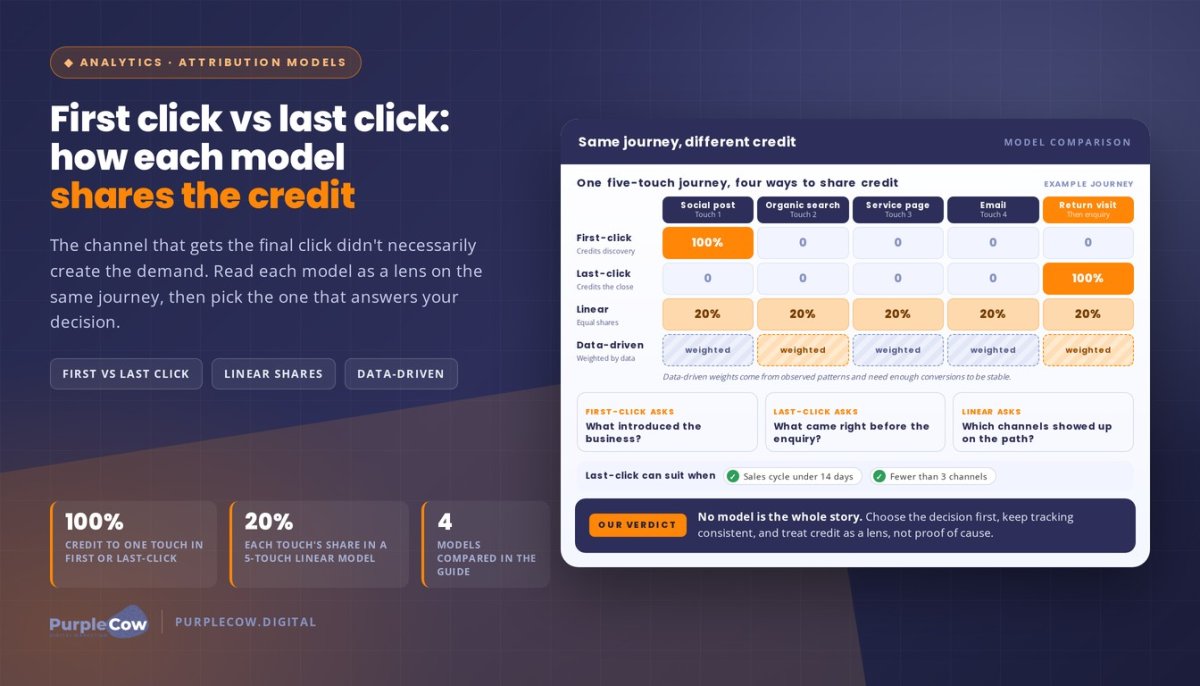
The channel that gets the final click didn’t necessarily create demand. First-click vs last-click attribution models explained simply: first-click gives all conversion credit to the first interaction, while last-click gives it all to the final one.
That difference can change how you assess your marketing. Imagine someone sees a Meta ad for a trades business, then searches on Google and sends an enquiry. First-click credits the ad that introduced the business; last-click credits the search just before the enquiry. Neither model tells the whole story on its own.
You’re right to want a clear view of which channels help bring in leads and which help turn interest into action. This guide explains how first-click and last-click work, where each can mislead you, and how linear and data-driven attribution compare. You’ll get a practical way to interpret each model’s assigned credit and make more informed marketing decisions for your Australian business.
Key Takeaways
- First-click and last-click models each assign all conversion credit to one interaction, so use them to understand different parts of the customer journey, not as a complete picture.
- Linear attribution shares credit equally across touchpoints, while data-driven attribution uses observed patterns to assign credit.
- Consider your sales cycle and channel mix when deciding whether last-click is a useful, practical view of performance.
- Keep tracking consistent across campaigns so you can compare channel contributions more clearly.
- For organisations covered by the Privacy Act, the Privacy Act 1988 and Australian Privacy Principles may impose obligations on collecting and using personal information through cross-site tracking, depending on the circumstances.
What is last click attribution?
Last-click attribution gives the final click before a conversion all the credit, while first-click gives it to the first interaction. For Australian advertisers, attribution settings don’t replace privacy obligations: the Federal Register of Legislation sets out the Privacy Act 1988 and Australian Privacy Principles, which may apply when organisations collect or use personal information for cross-site tracking, depending on the circumstances.
Last-Click Credit Assignment
Last-click attribution assigns 100% of conversion credit to the final click recorded before a sale or enquiry. That makes it easy to see which tracked interaction preceded the result, but it can hide earlier work that helped build interest.
For example, a customer might first discover a service through organic search, then see a Meta ad, and later click a retargeting ad before enquiring. Last-click assigns the conversion to the retargeting click. The first search and earlier ad receive no credit in this model, even though both were part of the customer’s journey.
Use this view to understand the final tracked step, not to assume it created demand on its own. If branded search is consistently the last click, for instance, that may show customers return to search when they’re ready to act. It doesn’t reveal which earlier touchpoint introduced the business.
Credit Across Customer Touchpoints
Click-based attribution connects recorded clicks with a conversion, then allocates credit according to the chosen model. First-click gives all credit to the first recorded click; last-click gives it all to the final one.
Linear attribution takes a different approach: it divides credit equally across the recorded touchpoints. In a journey with four clicks before a sale, each click receives 25% of the credit. The result recognises several interactions, but equal shares don’t show whether one interaction had more influence than another.
Imagine Google Search introduces a business, a service page supports consideration, and a Meta ad brings someone back. Last-click highlights the final click; first-click highlights discovery; linear attribution shares credit equally across all recorded interactions. These are different ways to interpret the same path, not proof that each channel caused a sale.
A Customer Journey Example
Consider a customer who discovers a local electrician through organic search, reads a service page, clicks a retargeting ad, then submits an enquiry. Last-click assigns 100% of that conversion’s credit to the retargeting ad click.
First-click assigns 100% to the organic search click instead. A linear model splits credit equally among the four recorded clicks, giving each 25%. Each model answers a different question: what introduced the business, what preceded the enquiry, or how credit looks when shared equally.
That distinction matters when you assess results. If you judge every channel by last-click credit, discovery activity may seem less valuable because it doesn’t close the journey. Read the final click alongside earlier steps, and treat each model’s allocation as a reporting lens, not a complete account of how customers make decisions.
Comparing single-touch and multi-touch attribution models
Single-touch models credit one interaction; multi-touch models distribute credit across a customer journey. Compare them by asking which marketing decision the report needs to support.
First-Click and Last-Click Comparison
First-click credits the earliest recorded interaction, while last-click credits the final recorded click before conversion. Both assign all credit to one touchpoint, so they offer sharply different views of the same journey.
For example, a prospect might discover a service business through Google, return through a branded search, then enquire after clicking an ad. First-click highlights discovery; last-click highlights the final ad. Together, they show which touchpoints opened and closed that recorded path, but neither captures every influence on the decision.
Single-Touch and Multi-Touch Tradeoffs
First-click attribution is useful when assessing acquisition and prospecting because it identifies the recorded interaction that introduced a customer. Its advantage is clarity: you can see which channel started a tracked journey. Its drawback is just as clear: it ignores everything after discovery and can over-credit awareness campaigns.
Multi-touch approaches include more of the recorded journey, helping you see how channels work together. But distributing credit doesn’t prove that each touchpoint drove the conversion. A customer may see a social post, visit from Google, and later respond to an email. The allocation depends on the model’s rules, not direct evidence of each interaction’s influence.
Setting Attribution in Google Analytics 4 and Google Ads
In Google Analytics 4, review the attribution settings and reporting options available to your property. Choose a supported model that matches the question you’re investigating, then compare its results with the conversion journey you can observe. For Google Ads, review the attribution setting attached to each conversion action and select an available model that fits your measurement approach.
Before changing either platform, confirm what counts as a conversion and which campaign touchpoints are captured. For example, a phone enquiry and a submitted form may be recorded as separate conversion actions. If platforms report different actions, comparing their totals can confuse tracking differences with model differences. Keep the conversion definition consistent when assessing results.
For a practical comparison, use first-click to examine discovery, last-click to examine the final recorded step, and a multi-touch view to see how tracked interactions share credit. Then connect each view to a specific marketing decision, such as whether to maintain prospecting activity or improve the steps between discovery and enquiry. The best model is the one that helps you make that decision while keeping its blind spots in mind.
If you’d like help making your channel reporting more useful, talk through your attribution questions.
Linear attribution
Linear attribution divides conversion credit equally across every recorded touchpoint in a customer journey. It gives you a broader view than a single-touch model, but equal credit doesn’t mean each interaction had the same influence.
Consider a journey with five interactions before an enquiry: a social post, an organic search, a service-page visit, an email, and a return visit. Linear attribution gives each touchpoint 20% of the conversion credit. The arithmetic is simple, making it easier to see which channels appeared along the path.
The model can help when your marketing relies on several channels working together. An awareness campaign may introduce your business, while later content helps someone compare options. If a customer interacts with four recorded clicks before converting, each receives 25% of the credit. Earlier touchpoints remain visible instead of disappearing behind the final click.
That visibility can inform budget discussions, especially when a channel supports consideration rather than generating the last recorded interaction. For example, a campaign that brings prospects to an explainer page may appear earlier in the journey before an enquiry. Linear attribution recognises its place in the journey, but doesn’t establish that the campaign caused the conversion.
Equal credit also creates a limitation. A brief page visit and a detailed consultation-related interaction receive the same share if both count as touchpoints. In a two-interaction journey, each receives 50%, even if one seems more closely connected to the customer’s decision. The model measures allocation, not the actual strength of each interaction.
Linear attribution also differs from partner preferences. A business may value a referral partner, an email campaign, or a paid channel for different reasons. Linear rules don’t reflect those preferences; they distribute credit equally across recorded interactions. That consistency can reduce disputes over which channel deserves credit, but it can also flatten meaningful differences between partner roles.
Use linear attribution as a comparison view, not a final budget instruction. For instance, if a five-touch journey gives an awareness post 20%, that shows the post appeared in the path. Compare that result with channel costs, lead quality, and the role each interaction was meant to play before changing spend.
To make the model useful, define which interactions count before comparing campaigns. A click, an email interaction, and a website visit may each appear in a journey, but inconsistent tracking can change which touchpoints receive credit. With a consistent measurement approach, linear attribution can help you see how channels contribute along the path, while keeping its equal-credit assumption in view.
Data-driven attribution
Data-driven attribution uses observed conversion patterns to assign different weights to customer journey touchpoints. Unlike first-click, last-click, or linear rules, an algorithm can give more credit to interactions that appear more influential in converting customers.
For example, a tracked journey might include a referral website, an organic search, and a return visit. In a data-driven example, the referral website receives 60% of the credit. That allocation reflects the model’s analysis of available data; it doesn’t prove the referral caused the conversion by itself.
Machine learning compares journeys associated with conversions with other observed interactions. It can then estimate how touchpoints relate to conversion outcomes and assign credit accordingly. A channel near the top of the funnel may receive some credit if its observed role differs from that of the final click. The model’s output depends on the data it can access.
Data-driven attribution can be useful when a simple touchpoint rule doesn’t reflect the shape of your customer journey. First-click may over-credit awareness, while last-click may favour the final tracked action. An algorithm can offer a more tailored allocation, but its estimates still depend on accurate, connected records.
Algorithmic attribution needs enough conversion activity to identify meaningful patterns. These models need sufficient conversion activity to produce more reliable estimates. If your Australian business has fewer conversions, the available evidence may not support stable estimates. A simpler model can be easier to interpret while your tracking gathers more consistent activity.
Data quality matters just as much as volume. Use a shared UTM naming convention across campaigns, supported by a URL builder template and periodic audits. For example, if one campaign labels a source “email” and another uses “newsletter”, reports may split activity that belongs together. Consistent tags help analytics tools group channel interactions correctly.
Tracking gaps can still distort the picture. A customer might see a Meta ad without clicking, then convert through another route; Meta attribution may count a conversion after an ad view. Adding platform-reported totals can also exceed actual conversions if multiple platforms claim the same order. Treat each report as one platform’s view, not a unique count to add automatically.
Click-based first-touch and last-touch models also miss interactions that tracking doesn’t capture, including journeys spanning devices. In Australia, the Privacy Act 1988 and Australian Privacy Principles set obligations for handling personal information. Whether those obligations apply to cross-site tracking depends on the information collected and how it is used, as set out in the Federal Register of Legislation. Build privacy-aware measurement around the data you can appropriately collect, and interpret modelled credit as an estimate rather than a complete record of influence.
Last-click attribution and the final pre-purchase interaction
The final click is a useful marker, not a complete explanation of why someone converted. It identifies the last recorded interaction before an enquiry or sale, which can help you assess campaigns designed to prompt action. But a customer may have discovered your business through another channel and returned when ready to decide.
For example, a homeowner might first find a plumber through organic search, read a service page, and later click a paid search ad before submitting an enquiry. Last-click reporting gives the final ad the closing position in the recorded journey. That’s useful for understanding which interaction preceded the enquiry, but it doesn’t show whether the earlier search or page shaped the decision.
Last-click can be a pragmatic choice when your sales cycle is under 14 days and you use fewer than three channels. In that simpler setting, the final pre-purchase interaction may offer a clear operational signal. If your customer journey spans more channels or takes longer, the final click can leave meaningful earlier points outside the picture.
Use the model to answer a focused question: which recorded campaign most often appears immediately before a conversion? Then compare the answer with the campaign’s purpose. A branded search campaign may capture demand created elsewhere, while an enquiry-focused ad may prompt a ready-to-act customer. Analytics can show the sequence, but attribution alone doesn’t establish which interaction caused the result.
To test whether last-click credit is shaping your decisions too strongly, compare it with a multi-touch view and review the differences. Recalibrate attribution models quarterly rather than treating one model as permanent. Geo-holdout experiments across Australian states can also help test whether a credited channel causes conversions, instead of merely appearing near them in reports.
The practical takeaway: keep last-click in your reporting when you need a clear view of the final recorded step, but don’t let that position determine every budget choice. Read it alongside campaign goals, earlier touchpoints, and actual enquiry quality. If last-click repeatedly favours one channel, investigate whether it closes demand or captures customers already influenced elsewhere.
For a clearer view of how attribution fits your marketing decisions, talk with PurpleCow Digital about your reporting.
PurpleCow Digital
We help Australian businesses connect marketing activity with clearer decisions about leads and growth. If attribution reports leave you unsure how your website, search presence, and campaigns work together, we can help strengthen those foundations through Website Design, Search Engine Optimisation, Website Maintenance, and Meta Ads.
Turn to us when you’re ready to make your digital marketing easier to assess and align with your business goals. We’ll work with you to identify the right next steps for your situation, without treating one attribution model as the whole story.
Contact PurpleCow Digital to discuss your marketing goals.
Make your next marketing decision with clarity
Attribution becomes useful when it informs a real decision, not just a report. Understanding first-click vs last-click attribution models helps you frame the question: are you trying to build awareness, improve the path to enquiry, or understand which activity supports conversion? Choose a decision first, then use the reporting view that best informs it.
Next, connect your analytics with the outcomes that matter to your business. For an Australian service business, that could mean assessing whether enquiries are relevant and whether campaigns support how customers find and choose your services. Treat attribution as one input to your judgement, alongside business goals and incoming lead quality.
You don’t need a perfect model to make a more considered choice. Start with a clear question, keep your measurement consistent, and adjust your approach as priorities change. That gives your marketing a direction you can act on.
Your next decision can be more informed, focused, and firmly connected to the growth you want to build.
Frequently Asked Questions
What are the Different Attribution Models?
Common models include first-click, last-click, linear, time-decay, position-based, and data-driven attribution. Each applies a different rule to recorded marketing interactions. Time-decay gives more weight to interactions closer to conversion, while position-based prioritises selected points, often the beginning and end. For example, compare the same campaign report under linear and time-decay models to see how the chosen rule changes channel credit.
How does marketing attribution help you prove marketing’s value?
Attribution helps connect recorded marketing interactions with outcomes such as enquiries or sales. It gives you evidence about which channels appeared in customer journeys, but can’t by itself prove that a channel caused a conversion. For a useful business review, pair attribution reports with lead quality, completed sales, and campaign goals. A channel that generates enquiries may play a different role from one that helps turn enquiries into customers.
Which strategies improve your attribution data quality?
Use one shared UTM naming convention, build campaign links with a consistent URL template, and audit tags periodically. Keep conversion definitions consistent across reporting tools, too. For example, label an email campaign consistently rather than switching between terms such as “newsletter” and “email”. This helps prevent one source from being split across reports. Review whether campaign links and conversion events are recorded as intended before comparing channel performance.
Why does marketing attribution matter for budget decisions?
Attribution gives you a structured way to assess how recorded channels relate to conversions, which can inform budget discussions. It doesn’t give budget instructions on its own. For example, if a channel appears early in journeys but rarely gets final-click credit, assess it against its awareness goal, cost, and the quality of later enquiries. Considering those factors helps avoid cutting activity simply because another channel receives more closing credit.
What is first-click attribution and how does it work?
First-click attribution gives conversion credit to the earliest recorded click in the customer journey. It can help you identify which channels introduce people to your business, particularly when assessing prospecting activity. For example, if organic search is the first tracked interaction before a later enquiry, this model credits that search. It doesn’t show whether the same channel supported the customer’s later decision.
What is last-click attribution and how does it work?
Last-click attribution gives conversion credit to the final recorded click before conversion. It can help you examine the interaction closest to a form submission or purchase. For example, a person may click a search result, return through a paid campaign, then submit an enquiry. If the paid campaign is the final tracked click, last-click assigns it the credit, regardless of earlier interactions.
How do first-click and last-click attribution differ?
They select opposite ends of the recorded journey: first-click identifies the earliest tracked click, while last-click identifies the final tracked click before conversion. Consider someone who first arrives through a social campaign and later returns through a search ad. First-click highlights the social campaign; last-click highlights the search ad. Comparing both views shows how your assessment changes depending on the question you’re asking.
What are the advantages and disadvantages of last-click attribution?
Last-click is straightforward to interpret and can help identify which recorded interaction preceded a conversion. Its main limitation is that earlier interactions receive no credit, so discovery or consideration activity can be overlooked. For example, a customer might read an educational article before returning through a branded search. Last-click highlights the search, not the earlier article. Use it to assess closing activity, not as your only measure of marketing contribution.

Article by
Angie Neal
Angie Neal is the founder and CEO of PurpleCow Digital, a full-service digital marketing agency based on Queensland's Redcliffe Peninsula. With deep expertise in SEO and web design, as well as a certification as a GoHighLevel Admin. Angie helps small-to-medium businesses build scalable growth systems through AI-powered automations, CRM workflows, and smart digital strategy. She's also passionate about building a community of like-minded agency owners at the After Party — sharing insights, solving real problems, and helping others grow. Whether it's search visibility, lead management, or end-to-end automation — Angie's focus is always on helping businesses scale sustainably.
Disclaimer
This page may contain affiliate links. If you sign up for software through our links, we may earn a commission at no extra cost to you. We only recommend tools we use and trust – software that is the backbone of our agency.