
Your website looks fine. Your service is solid. Clients who do find you are happy. But when someone in Canberra searches for what you sell, your business is buried under directories, competitors, and map listings that seem to get all the clicks.
That’s the frustrating part of local search. Visibility isn’t always a quality problem. It’s often a structure problem. Google can’t rank what it can’t clearly understand, and buyers can’t choose a business they never see.
In Canberra, that problem carries real weight. Between 2021 and 2022, Canberra saw a 65.67% business closure rate among new enterprises according to Digital Spotlight’s Canberra SEO analysis. If you run a small or mid-sized business, “good enough” marketing usually isn’t good enough for long. Canberra SEO services matter because they help turn a hard-to-find business into one that shows up when intent is highest.
Table of Contents
- Why Your Canberra Business Is Invisible Online
- Understanding Local SEO for the Canberra Market
- The Core Components of a Canberra SEO Service
- Timelines and Realistic Investment for SEO in Canberra
- How to Choose the Right Canberra SEO Partner
- Your Next Steps to Dominating Canberra's Search Results
Why Your Canberra Business Is Invisible Online
A lot of Canberra businesses make the same mistake. They assume visibility comes from having a website, a logo, and a few service pages. That’s like opening a great shop down a side street with no signage. The business exists, but search engines and customers don’t get enough signals to trust it, rank it, or click it.
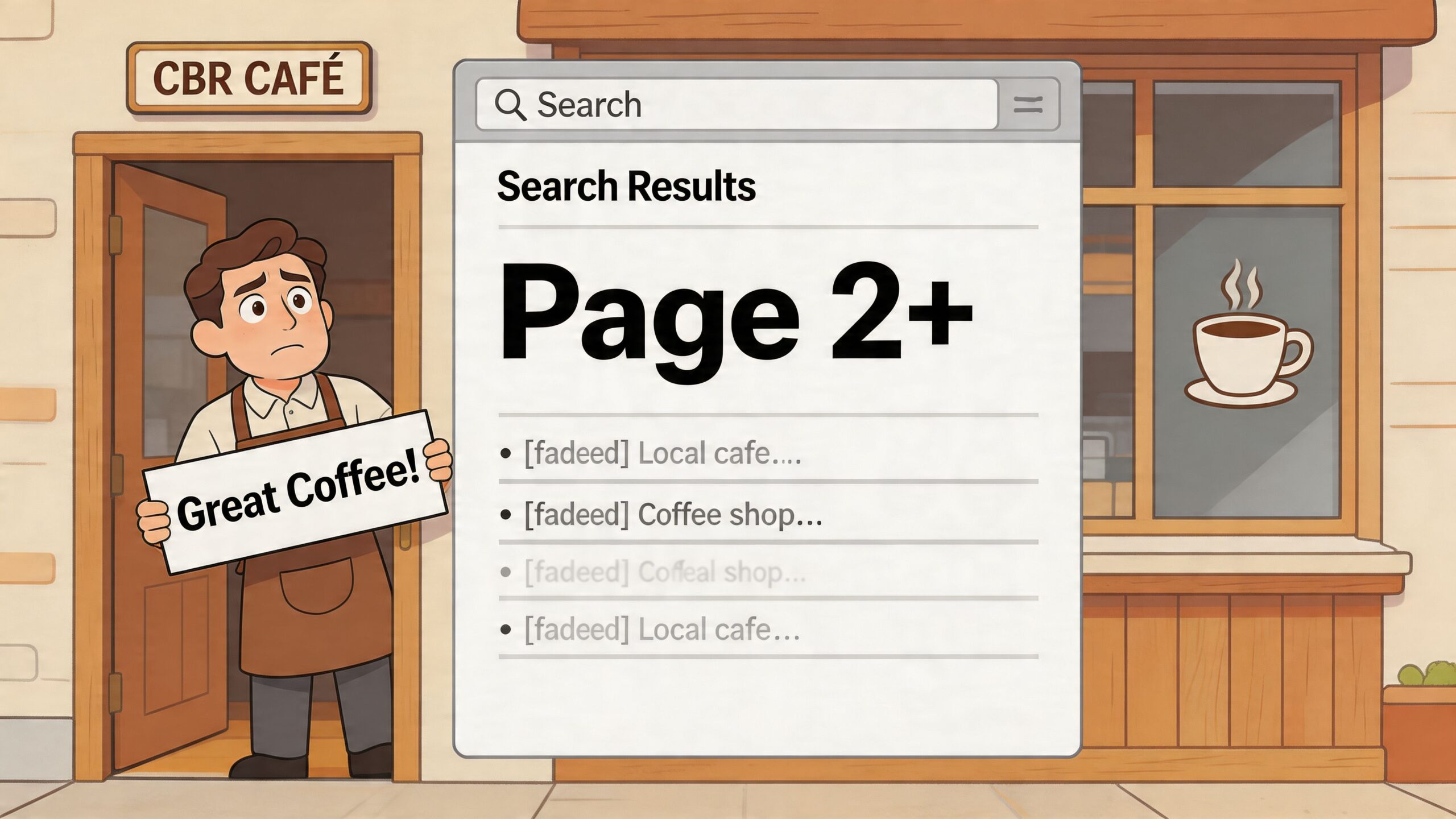
The issue usually isn’t one big failure. It’s a stack of smaller ones. Thin service pages. No suburb targeting. A weak Google Business Profile. Slow pages. Confusing navigation. No clear internal links. No reporting tied to leads. Each one chips away at discoverability.
Good businesses still disappear online
Canberra buyers are specific. They don’t just search for a category. They search with urgency, location, and intent. They want a nearby accountant, dentist, builder, physio, café, or consultant they can trust now. If your website speaks in generic terms and your local signals are weak, Google has no strong reason to put you in front of them.
Practical rule: If your website could belong to a business in any city, it probably won’t rank strongly in Canberra.
At this stage, SEO stops being a technical afterthought and becomes a business system. Done properly, it improves how your site is crawled, how your services are understood, and how your brand appears at the exact moment someone is ready to act.
A practical example
Take a Canberra electrician with strong word of mouth but poor organic visibility. Their homepage says “trusted electrical solutions”, but there’s no dedicated page for switchboard upgrades, emergency work, or key service areas. Their title tags are vague. Their Google Business Profile has old photos and limited detail.
A proper SEO campaign would tighten all of that. It would align service pages to real search behaviour, improve local relevance, and make sure search engines can crawl and index the site cleanly. The result isn’t magic. It’s clarity.
Action steps you can take today
- Search your top service terms: Look for your business using the phrases customers would type, plus Canberra or your suburb.
- Check what appears first: If directories, map competitors, or unrelated pages outrank you, that’s a signal problem.
- Review your service pages: Make sure each major service has its own page with local context and a clear conversion path.
- Audit your basics: Confirm your contact details, business description, and service areas are consistent across your site and key listings.
Understanding Local SEO for the Canberra Market
General SEO is like trying to be listed in a global directory. Local SEO is about becoming the obvious choice in the Canberra edition when someone nearby is ready to buy. That difference matters because local intent changes what Google shows and how people choose.
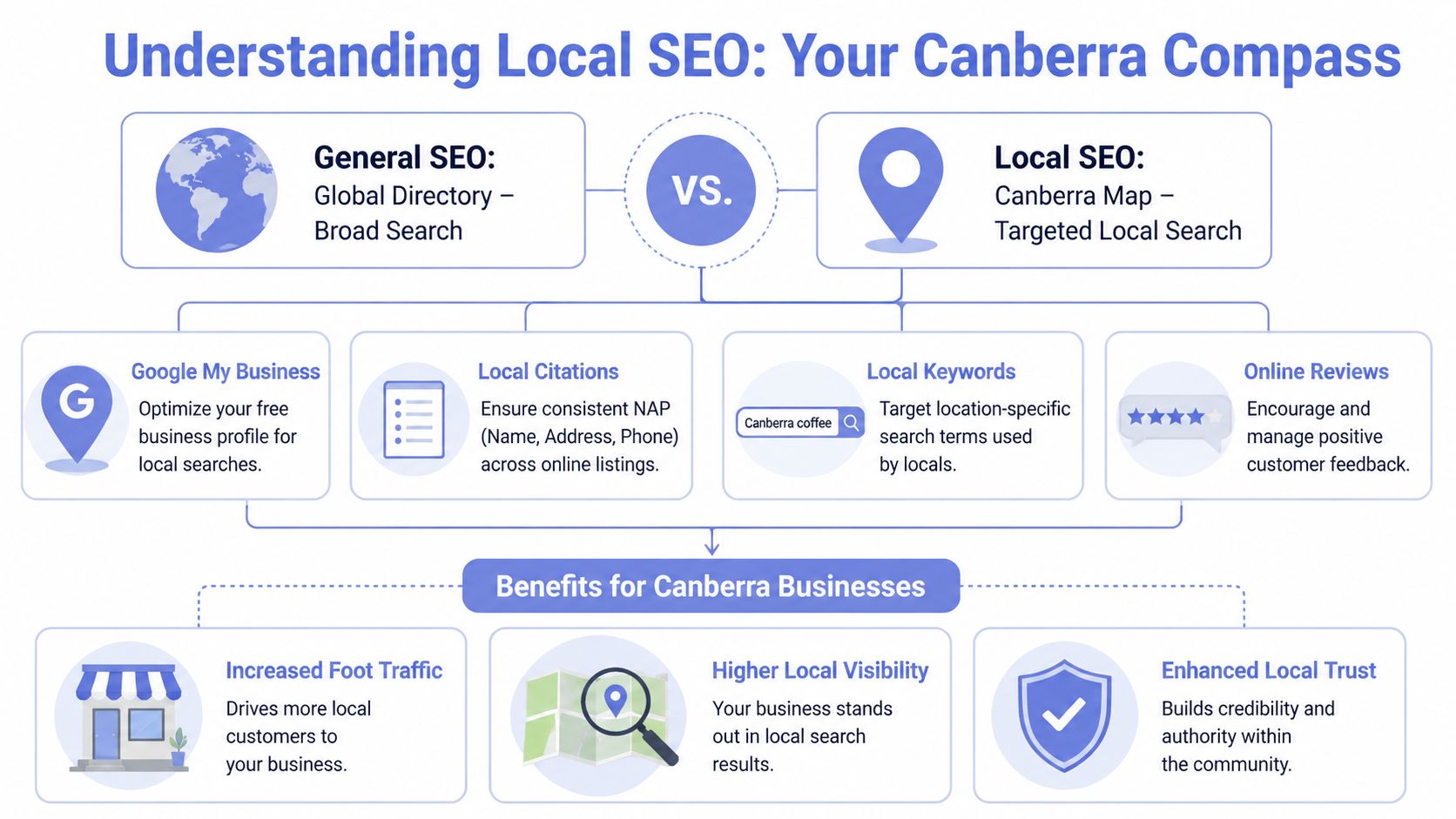
The behaviour behind local SEO is straightforward. 46% of all Google searches include local intent, and 86% of consumers in Australia use Google Maps to find local businesses, based on JSL Media’s local SEO overview. If you serve Canberra, your search presence needs to work in both standard search results and map-driven discovery.
Where local visibility actually happens
Most business owners think about rankings as a blue link on page one. That’s only part of the picture. For local businesses, visibility often means showing in the map pack, your Google Business Profile, localised service pages, review signals, and suburb-relevant searches.
Here's a simple way to understand it:
- General SEO helps Google understand your website broadly.
- Local SEO helps Google connect your business to a place, a service, and nearby buyers.
- Conversion-focused local SEO makes that visibility turn into calls, form fills, bookings, or visits.
If you want a strong primer on what shapes those outcomes, this local ranking factor guide is a useful reference because it breaks down the signals behind local search performance in plain language. For a more practical explanation of how those ideas apply to business websites, this guide on what local SEO is is also worth reading.
A Canberra example that makes it concrete
Say you’re a plumber servicing Belconnen, Gungahlin, and inner Canberra. If your website only has one generic “Plumbing Services” page, you’re asking Google to guess where you’re most relevant. A better setup would include service pages matched to actual jobs, clear service-area references, a well-maintained Google Business Profile, and supporting location relevance across your site.
That doesn’t mean creating spammy suburb pages stuffed with repeated keywords. It means building pages that reflect how real customers search and what they need to know before they contact you.
The businesses that win local search usually make things easier for both Google and the buyer.
What works and what doesn’t
What works
- Clear service-location alignment: Each core service has a dedicated page with local relevance.
- A complete Google Business Profile: Categories, services, business description, photos, and review management all support discovery.
- Consistent business details: Your business name, address, and phone details need to match across the web.
- Helpful local content: Answers to actual customer questions beat generic filler every time.
What doesn’t
- Keyword stuffing: Repeating “Canberra” everywhere makes pages worse, not stronger.
- Duplicate suburb pages: Thin copies rarely help.
- Ignoring maps: Many buyers never reach your website first.
- Chasing impressions instead of enquiries: Visibility only matters if it brings qualified traffic.
Action step
Search one of your top commercial phrases on your phone while logged out or in incognito. Check who appears in maps, who appears in organic results, and whether your own business message would earn the click. That simple test usually shows where your local SEO is breaking down.
The Core Components of a Canberra SEO Service
When a business owner asks what they’re paying for with Canberra SEO services, the answer should be concrete. Not “ongoing optimisation.” Not “monthly activities.” A proper SEO service has moving parts, and each part has a job.
The easiest analogy is this. Technical SEO is the plumbing and wiring. Google Business Profile is your street signage. On-page SEO and content are your sales conversation. Link building is reputation. If one of those fails, the whole system underperforms.
Technical SEO is the foundation
Technical SEO matters because search engines need clean access to your site before anything else can work. A thorough audit can address crawlability issues that cause up to 40% of indexing failures on Australian websites, and fixes often lead to a 25-40% uplift in organic traffic within 3-6 months, according to Prosperity Media’s Canberra SEO page.
That sounds technical, but the business implication is simple. If Google can’t reliably crawl your pages, it can’t rank them properly.
Common issues include:
- Crawl barriers: Important pages blocked or buried too deep in the site structure.
- Indexation waste: Low-value or duplicate pages getting indexed while core pages are ignored.
- Site speed and mobile friction: Slow templates, oversized media, and clunky mobile layouts.
- Broken internal pathways: Orphan pages and weak linking that stop authority flowing through the site.
A practical example is a professional services firm with strong expertise but a site built around old brochure content. Their team publishes articles, but those pages aren’t linked to service pages, technical settings are inconsistent, and Google keeps surfacing outdated URLs. Fixing that kind of architecture often improves performance before any new content is written.
Google Business Profile shapes local intent
For many local searches, your Google Business Profile is the first impression. It can influence whether someone calls you, visits your site, asks for directions, or moves on.
Good optimisation here isn’t about gaming the system. It’s about completeness and accuracy. Business categories, service descriptions, opening hours, photos, service areas, and review responses all help Google understand what you do and how relevant you are for local queries.
What businesses often miss is the operational side. Someone needs to keep this profile current. Holiday hours, new services, updated imagery, and fresh posts all contribute to trust.
Field note: A neglected profile sends the same signal as a neglected shopfront. People notice.
On-page and content turn relevance into rankings
On-page SEO is where strategy meets the page itself. Titles, headings, internal links, copy structure, local cues, schema, and calls to action all shape whether a page earns traffic and converts it.
This is also where many agencies either overcomplicate things or oversimplify them. Good on-page work doesn’t mean stuffing keywords into every sentence. It means matching search intent with clear content architecture. If a buyer searches for a service, the page needs to answer the practical questions that stop them from enquiring.
A strong content approach usually includes:
- Core service pages: Built around commercial intent, not generic company language.
- Support content: Articles that answer pre-sale questions and strengthen topical relevance.
- Internal links: Structured so authority flows toward money pages.
- Conversion paths: Clear next steps, forms, calls, or booking options.
If you want to compare what solid page-level optimisation looks like, this guide on optimising on-page and off-page SEO gives a practical view of how those layers work together.
Link building supports authority
Links are still a trust signal, but in this area, bad SEO gets expensive. Buying junk links, chasing irrelevant directories, or using recycled outreach templates usually creates noise rather than authority.
A better approach is selective and local. Industry citations, relevant partnerships, high-quality mentions, useful content assets, and legitimate digital PR all have a place. For Canberra businesses, relevance matters more than volume.
Here’s a simple breakdown of how the pieces fit:
| Service Component | Primary Goal | Key Performance Indicator (KPI) |
|---|---|---|
| Technical SEO | Improve crawlability and indexation | Indexed pages, crawl health, organic visibility |
| Google Business Profile Optimisation | Strengthen map and local presence | Calls, direction requests, profile interactions |
| On-Page and Content Strategy | Match search intent and improve conversions | Rankings for target pages, enquiries, engagement |
| Link Building | Build authority and trust | Referring domains, visibility gains, lead quality |
Action steps for evaluating a proposal
- Ask for deliverables, not vague promises: You should see audits, page plans, content priorities, and reporting detail.
- Check whether technical work is included: If it’s missing, the strategy may be cosmetic.
- Look at how they measure success: Enquiries and sales matter more than rank screenshots.
- Ask what they won’t do: A good provider should be clear about avoiding spammy shortcuts.
Timelines and Realistic Investment for SEO in Canberra
SEO works like compounding interest, not a switch you flick on Monday and cash in by Friday. Businesses that expect instant results usually end up buying the wrong service, or they abandon the right service too early.

The practical question isn’t “How fast can I rank?” It’s “How long until this starts producing qualified business value?” That answer depends on your site’s current health, your market, your offer, and how much work needs to be fixed before growth can begin.
What results usually look like over time
A business with a sound website, decent authority, and a neglected local profile may see traction sooner than a business with technical issues, thin content, and no real search footprint. SEO timelines vary because the starting point varies.
What should happen early is clarity. Within the first stage of work, you should know:
- What’s broken technically
- Which pages matter most
- Where local visibility is weak
- How success will be measured
- What work happens first and why
That matters because early SEO value often comes from prioritisation, not from chasing everything at once.
A practical example. A new café in Canberra might begin with a simple stack of priorities: fix the site structure, tighten metadata, improve mobile UX, fully optimise the Google Business Profile, and build pages around key intents like menu, location, bookings, and local discovery. It won’t own the market overnight, but it can start building a footprint that compounds.
For a general benchmark on local pricing structures and what tends to shape costs, this guide on how much SEO costs in Australia is useful reading before you request proposals.
What Canberra businesses are really paying for
In the Canberra market, top-performing agencies often charge $100-$149 per hour, and some have delivered over $50 million in client revenue, based on Firewire Digital’s Canberra SEO agency page. That doesn’t mean high pricing automatically equals good SEO. It does mean serious SEO is skilled work, and skilled work isn’t usually cheap.
The investment generally covers a mix of strategy, implementation, technical fixes, content, link development, and reporting. If a quote is dramatically lower than the field, the first question should be what’s missing.
A lot of business owners also compare retainers without comparing scope. One provider may include technical work, content planning, implementation support, and conversion tracking. Another may mainly send reports and ranking snapshots. Those aren’t the same service, even if both are labelled SEO.
To get grounded before you budget, this breakdown of SEO costs in Australia for 2026 is a practical way to understand where money tends to go and what outcomes a business should expect from that spend.
A short explainer can help if you’re weighing patience against shortcuts:
Sustainable SEO usually costs more upfront than shortcuts. It also tends to cost less than cleaning up shortcuts later.
Action steps before you commit budget
- Set a business goal first: More calls, more bookings, better lead quality, or stronger local coverage.
- Ask for a staged roadmap: You want to know what happens in the early phase, middle phase, and ongoing phase.
- Separate build from maintenance: Some sites need foundational repair before monthly growth work makes sense.
- Tie reporting to ROI: Traffic without enquiries is only partial progress.
How to Choose the Right Canberra SEO Partner
Hiring an SEO provider is less like buying software and more like hiring a strategic tradesperson. You’re not paying for a dashboard. You’re paying for diagnosis, prioritisation, execution, and honest communication.

Many businesses often find themselves stuck. They compare polished pitches, broad guarantees, and bundles that all sound similar. The difference usually appears when you ask better questions.
What a strong SEO partner does differently
The strongest providers don’t start by talking about rankings in isolation. They start by asking about your margins, sales process, lead quality, seasonality, service areas, and website constraints. That’s because SEO only creates business value when it fits the way your business wins clients.
Data from AdVisible’s Canberra SEO page says performance-based SEO models can yield 28% higher ROI for ACT SMBs, and 52% of Canberra SMBs prioritise measurable outcomes over simple rankings. That tracks with what smart buyers already know. A rank report means very little if the wrong traffic is arriving or nothing converts.
A capable partner usually shows these habits:
- They define success in business terms: enquiries, sales opportunities, booked calls, or revenue contribution.
- They explain trade-offs clearly: for example, whether to fix site architecture first or push new content first.
- They report in plain English: not just keyword movement.
- They’re comfortable saying no: especially to tactics that look impressive but won’t move the right KPI.
Questions worth asking before you sign
Use the meeting to test how they think, not just what they sell.
Ask questions like these
- How do you decide what to work on first?
- What would you fix in the first phase if my site has technical issues and weak local visibility?
- How do you track SEO against leads or revenue, not just rankings?
- What parts of implementation do you handle, and what stays with my team?
- How do you use automation or AI without turning the campaign into generic content production?
That last question matters more now. Many agencies talk about SEO as if it still runs on manual checklists alone. In practice, AI and automation can help with faster analysis, content workflows, internal linking suggestions, reporting, and lead routing. The value isn’t replacing strategy. The value is reducing wasted effort so humans can focus on decisions that affect ROI.
One practical option in this space is PurpleCow Digital Marketing, which combines SEO with WordPress development, analytics, funnels, and operational automation for businesses that want search growth tied to broader systems rather than isolated rankings.
A good SEO partner should be able to tell you where AI helps, where it hurts, and where human review is non-negotiable.
Red flags that should slow you down
Some red flags are obvious. Others sound reassuring until you look closely.
Be cautious if you hear any of these
- “We guarantee page one rankings.” No one controls Google.
- “We’ll submit your site to hundreds of search engines.” That’s outdated noise.
- “Our process is proprietary, so we can’t explain it.” You don’t need trade secrets, but you do need clarity.
- “We measure success by traffic growth only.” Traffic is not the same as qualified demand.
- “We can start without access to analytics or conversion data.” Then they can’t measure what matters.
A simple role-play helps. If you ask, “How will you show me this is working?” a weak agency says, “You’ll see ranking improvements.” A strong one says, “We’ll map target pages to target queries, track leads from organic and local sources, review conversion quality, and adjust based on what produces revenue.”
Action steps before choosing
- Request a sample report: You want to see whether they measure outcomes or vanity metrics.
- Ask for a priority list: A real strategist can tell you what they’d tackle first and why.
- Check implementation depth: Strategy without execution usually stalls.
- Look for honest limitations: Credible providers will tell you what SEO can’t solve on its own.
Your Next Steps to Dominating Canberra's Search Results
Good Canberra SEO services do three things well. They make your business easier for Google to understand, easier for local buyers to discover, and easier for visitors to trust once they land on your site.
That’s why the best SEO work rarely looks flashy from the outside. It looks organised. The site structure makes sense. Service pages match real intent. The Google Business Profile is maintained. Reporting ties back to leads. Technical issues get fixed before they become expensive drag.
For Canberra businesses, the biggest mistake isn’t usually choosing the “wrong keyword.” It’s treating SEO as a disconnected marketing add-on instead of part of a growth system. Search, website UX, conversion tracking, automation, lead handling, and follow-up all affect ROI. If those pieces don’t connect, rankings alone won’t carry the load.
A practical next step is to get a proper audit. Not a generic software export. A real review of your local visibility, technical barriers, service-page gaps, conversion paths, and where automation could save your team time without weakening quality.
Start with this shortlist
- Check your current local visibility
- Review whether your key services have strong pages
- Look at how enquiries are tracked
- Identify tasks AI or automation could speed up safely
- Choose a partner who talks about revenue, not just rankings
If your Canberra business needs clearer direction, a focused audit will usually tell you more in one sitting than months of guesswork.
If you want a practical next step, PurpleCow Digital Marketing can review your site, local search setup, and conversion path through a free, no-obligation audit. You’ll get clear findings, priority actions, and a grounded view of what to fix first so your SEO supports real business growth.
Made with the Outrank tool