


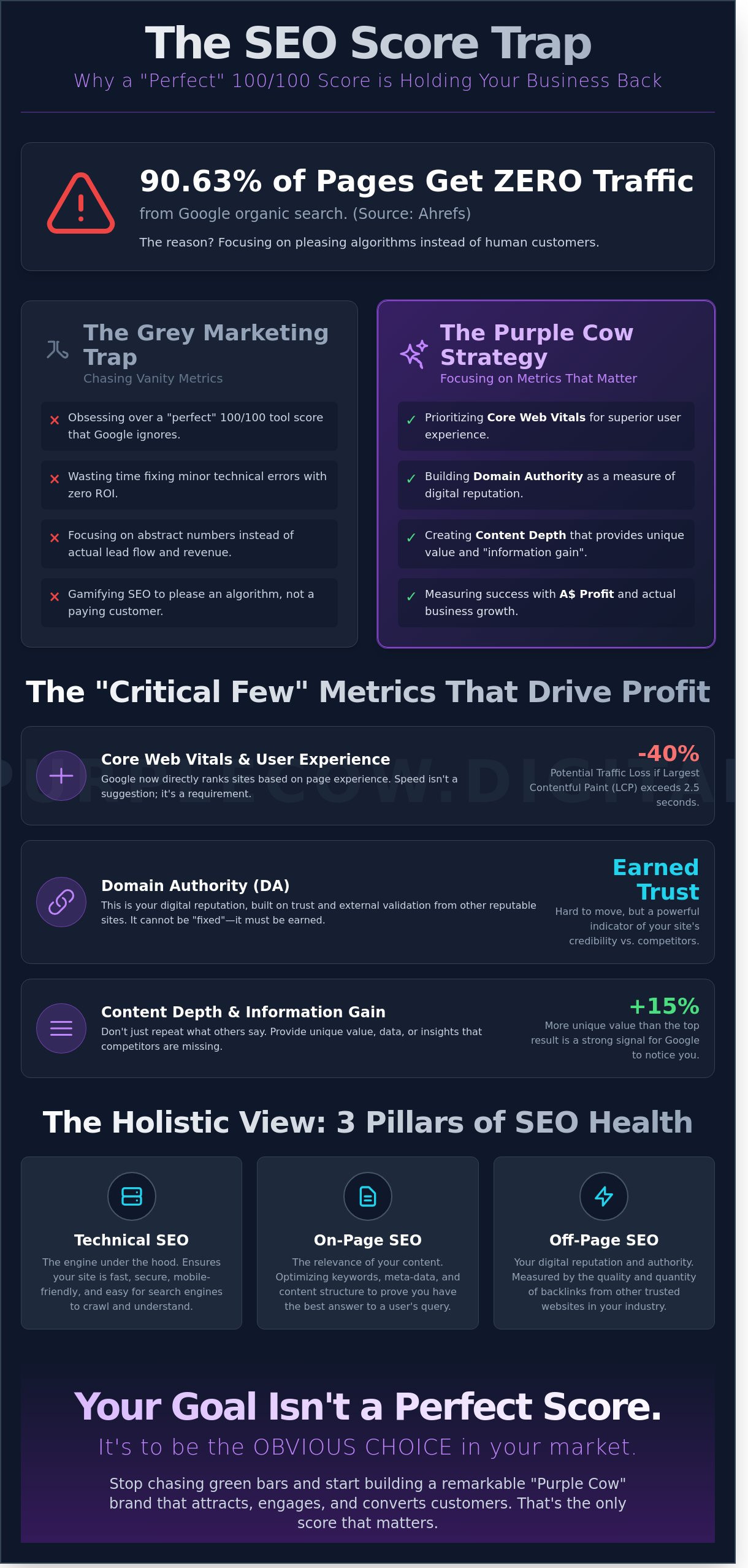
What if that perfect green 100/100 score on your SEO tool is actually the reason your revenue is flatlining? Most Australian business owners are trapped in a cycle of grey marketing, obsessing over technical checkboxes while their competitors steal the spotlight. You likely feel the sting of seeing a high score in your dashboard while your lead flow remains stagnant. It’s a common trap, especially when you’re trying to figure out what is a good seo score for a website without any real business context. According to a 2023 study by Ahrefs, 90.63% of pages get zero organic search traffic, often because they focus on pleasing an algorithm rather than a human customer.
You’re right to feel frustrated that high scores don’t always equal high revenue. We’ll show you why chasing a perfect 100 might be the very thing stopping your business from standing out in a crowded market. This guide provides a clear benchmark for success, moving you away from vanity metrics and toward a strategy that actually drives A$ profit. We’ll break down the metrics that matter and give you a prioritized roadmap to ensure your brand becomes the remarkable Purple Cow of your industry.
Key Takeaways
- Stop chasing vanity metrics and discover why a tool’s “perfect” number is often a distraction from the data Google actually uses to rank your business.
- Identify the “Critical Few” metrics that drive national visibility and learn why user experience is now a non-negotiable factor for Australian search rankings.
- Uncover what is a good seo score for a website by looking beyond the 100/100 trap and focusing on whether your site is actually remarkable enough to win leads.
- Stop wasting time on low-impact tasks and learn how to prioritize your SEO roadmap based on technical ROI and content gaps that actually impact your bottom line.
- Transform your site from a bland, indexed URL into a “Purple Cow” that builds long-term equity and makes you the obvious choice in your market.
Decoding the SEO Score: What Does That Number Actually Mean?
Most business owners are obsessed with a number. They see a 100/100 on a dashboard and think they’ve won the internet. It’s a lie. When asking what is a good seo score for a website, you have to realize that Google doesn’t care about your Semrush or HubSpot score. These numbers are proprietary guesses. They are third-party attempts to simplify the most complex algorithm on the planet. If you’re chasing a “perfect” score, you’re likely ignoring your actual customers.
Search engine optimization (SEO) is about visibility and conversion, not just making a tool’s progress bar turn green. Chasing vanity metrics is the fastest way to stay average. In a world of grey, boring websites, you need to be the Purple Cow that actually drives revenue. To better understand this concept, watch this helpful video:
The Three Pillars of a Comprehensive SEO Score
A holistic view of your site health usually breaks down into three distinct areas. Tools try to aggregate these, but they aren’t created equal. If you want to dominate, you need to understand the weights behind the numbers:
- Technical SEO: This covers the engine under the hood. It includes site speed, mobile-friendliness, and crawlability. If Google’s bots can’t read your site, your content doesn’t exist.
- On-Page SEO: This is about relevance. It looks at your keywords, meta descriptions, and how your content is structured. It’s where you prove you have the answer to the user’s query.
- Off-Page SEO: This is your digital reputation. It is measured by backlink strength and domain authority. It tells search engines that other reputable sites trust you.
Why Google Does Not Have a “Master Score”
Google doesn’t give you a report card. They use over 200 independent signals to determine where you land in the search results. Third-party tools attempt to reverse-engineer these signals, but they’re always one step behind. You could have a “perfect” 100 score in an audit tool and still be invisible for the keywords that actually make you money in the Australian market. These tools provide a benchmark, not a guarantee.
Gamifying your SEO is a dangerous trap. It’s easy to get addicted to fixing minor technical errors that have zero impact on your bottom line. A high score is a starting point, not the finish line. If your SEO services don’t translate into A$ in the bank, the score is worthless. Stop focusing on the metric and start focusing on the strategy that makes you remarkable. You aren’t here to please a software algorithm; you’re here to dominate your niche.
The Anatomy of a High-Performing Website: Metrics That Move the Needle
Stop chasing a perfect 100/100 score in a random WordPress plugin. It’s a vanity trap. While your competitors obsess over green lights, you should focus on the “Critical Few” metrics that actually drive national visibility and revenue. When asking what is a good seo score for a website, you have to look past the surface. A high score is worthless if your site doesn’t convert or if it’s built on a foundation of mediocre content.
Core Web Vitals are now the non-negotiable standard. Google’s Page Experience update means user experience is a direct ranking factor. If your Largest Contentful Paint (LCP) exceeds 2.5 seconds, you’re likely losing 40% of your potential traffic. To understand What Factors into SEO Rankings?, you must recognise that Google rewards speed and stability. It’s about how the user feels, not just how the crawler sees you.
Domain Authority (DA) remains a vital benchmark for measuring your site against Australian competitors. Unlike technical scores, DA is notoriously difficult to move because it relies on external validation. You can’t just “optimise” your way to a higher DA; you have to earn it. This pairs with content depth. Moving beyond simple word counts to “information gain” is how you win. If your article provides 15% more unique value or data than the current top result, Google notices. Don’t be another grey sheep in the herd; provide the unique insight your audience craves.
Technical Health: Your Foundation for Growth
Your technical setup is the engine room of your SEO. HTTPS security is the bare minimum for trust in the Australian market. Without an SSL certificate, 85% of users will abandon their cart or enquiry. Fixing 404 errors and broken redirects is about preserving “link juice” and ensuring Googlebot doesn’t hit a dead end. A clean XML sitemap acts as a GPS for search engines, ensuring your most profitable pages are crawled every 24 to 48 hours instead of once a month.
Authority and Trust: The Currency of the Web
Evaluating your backlink profile requires a scalpel, not a sledgehammer. Focus on E-E-A-T (Experience, Expertise, Authoritativeness, and Trustworthiness). Google’s search quality evaluator guidelines place immense weight on these factors. This is why affordable SEO packages must focus on quality over quantity. Ten high-authority links from reputable .com.au domains are worth more than a thousand spammy comments. If you want to dominate your market, your link profile must reflect genuine industry leadership. Consider how our SEO services can help you cut through the noise and build a profile that commands respect.
The Vanity Trap: Why a 100/100 Score Won’t Save a Boring Business
You’ve hit the jackpot. Your SEO tool shows a bright green 100/100. You’ve ticked every box, yet your phone isn’t ringing and your inbox is as empty as a Perth beach on a rainy Tuesday. This is the vanity trap. Many Australian business owners obsess over what is a good seo score for a website, thinking a perfect number automatically guarantees revenue. It doesn’t. A high score means you’ve followed the instructions; it doesn’t mean you’re worth following.
Google doesn’t just want “safe” content. Safe is risky. Safe is invisible. If your website looks and sounds like every other accountant or builder in Brisbane, you’re just another grey cow in a field of thousands. Being indexed is the bare minimum requirement for entry. Being remarkable is what actually drives growth and profit. Following the rules gets you on the map, but having a “Purple Cow” personality is what makes people actually stop the car and look.
Optimization vs. Innovation
Following Google’s SEO Starter Guide provides the structural foundation every Australian site needs to survive. However, over-optimising for bots often leads to “beige” content. This is copy that satisfies an algorithm but bores a human reader to tears. If your content lacks a pulse, users will bounce within 0.05 seconds of landing. You can’t rank your way out of a boring business model. Remarkable SEO is the intersection of technical health and unique brand voice.
The Conversion Gap
When asking what is a good seo score for a website, you have to look past the dashboard and at your bottom line. A high score is a hollow victory if your web design fails to guide the user toward a decision. Boring branding kills your click-through rate (CTR). When users see a generic, AI-generated title tag in search results, they skip it. Low CTR tells Google your “perfect” site isn’t relevant, which eventually drags your rankings into the dirt.
Consider a 2023 audit of a boutique law firm in Sydney. They had a “messy” technical score of 68, yet they consistently outranked a national competitor with a 99 score. The reason was simple: their bold, confrontational messaging kept users on the page for 4.5 minutes longer than the industry average. They weren’t just a search result; they were a destination. That engagement is the real metric that converts A$1,000 leads into A$10,000 clients. Don’t build a digital museum that no one visits; build a brand that demands attention.
A Practical Roadmap to Improving Your Site’s Search Visibility
Stop chasing a perfect 100 on a third-party tool. It’s a distraction that keeps you from doing the real work. If you want to know what is a good seo score for a website, start with a brutal audit of your digital presence. Most business owners are sitting on a mountain of technical debt; old, bloated code and broken redirects that act like an anchor on your rankings. You need to prioritise fixes based on ROI. Fixing a broken checkout page or a critical crawl error will always drive more revenue than tweaking meta descriptions on low-traffic blogs.
The 80/20 rule of SEO is simple. 20% of your actions, specifically technical health and high-intent content, drive 80% of your results. Don’t expect instant gratification. SEO is a marathon. In the Australian market, it typically takes 4 to 6 months to see substantial movement in competitive niches. Patience isn’t just a virtue; it’s a competitive advantage when your rivals give up after six weeks.
Step 1: Fix the Foundation
Google Search Console is your only source of truth. It reveals the errors Google actually cares about, not the ones a random plugin invented. Mobile optimisation is no longer optional. With 55% of Australian web traffic now originating from mobile devices, your site must perform flawlessly across varying network speeds, from metro 5G to regional NBN connections. Ensuring your website maintenance is proactive rather than reactive prevents the technical decay that can tank your visibility overnight.
Step 2: Build Remarkable Content
Average content is a death sentence. To stand out, identify the “unanswered questions” in your industry. Move away from the 2010-era “keyword stuffing” and embrace “topic authority.” Google’s algorithms are now smart enough to recognise expertise. Create high-value pillars that solve problems your competitors are too lazy to address. For content inspiration that converts, check out our marketing strategies for small business. When you focus on being the most helpful resource, the question of what is a good seo score for a website becomes secondary to your actual conversion rate.
Step 3: Earn Authority, Don’t Buy It
The era of buying dodgy backlinks is over. You need a sustainable link-earning strategy built on original research and genuine PR. Social signals and brand mentions now play a massive role in modern SEO scores; they prove to Google that people actually talk about you in the real world. This is why consistent, month-on-month SEO services beat one-off “optimisation” projects every time. You aren’t just building a site; you’re building a brand that the algorithm cannot afford to ignore.
Ready to stop being invisible and start dominating your local market? Claim your spot at the top with our strategic SEO services.
Beyond the Score: Turning Your Website into a Remarkable Purple Cow
Most business owners obsess over a green light in a plugin. They ask, “what is a good seo score for a website?” while their competitors are busy stealing their customers. A high score doesn’t pay the bills; being remarkable does. If your website looks, feels, and sounds like every other business in Brisbane or Sydney, you’ve already lost. You’re just another brown cow in a field of thousands. You’re invisible.
True growth happens when you stop chasing algorithms and start building branding that sticks. In a world where AI can generate a thousand “good” SEO articles in seconds, “good” is the new “invisible.” You need to be the Purple Cow. You need to be the choice that makes people stop scrolling. While you might still wonder what is a good seo score for a website to aim for, the real answer is the score that actually converts a visitor into a high-paying client.
Integrating your brand identity into your SEO strategy builds long-term equity. It’s about using tools to enhance your unique voice, not to dilute it into a generic mess. We use data to find where the gaps are, but we use creativity to fill them in a way that your competitors can’t touch.
The Future of Search in 2026
Search is changing faster than a Melbourne weather report. By 2026, Gartner predicts that search engine volume for brands will drop by 25% as AI-driven search (SGE) takes over generic queries. Google’s AI now prioritises unique perspectives and “Information Gain.” If your content is just a summary of facts, your click-through rate will plummet. The ultimate SEO metric of the future is “brand search.” When people type your specific business name into the bar, you’ve won. We prepare your site for this evolution by making your brand the destination, not just a stop along the way.
Ready to Stand Out?
PurpleCow Digital helps Australian businesses break through the “beige” ceiling. We don’t just tick boxes or follow a standard checklist. Our approach to digital marketing services starts with your unique value proposition. We find what makes you different and we amplify it. 70% of consumers now need to trust a brand before they consider a purchase, according to the 2024 Edelman Trust Barometer. We build that trust by making you remarkable.
Stop settling for “good enough” content that scores well on a tool but fails in the real world. It’s time to stop chasing numbers and start chasing impact. If you’re ready to leave the herd behind and dominate your market, it’s time to become the Purple Cow. Let’s turn your website into a marketing powerhouse that can’t be ignored.
Stop Chasing Numbers and Start Owning Your Market
A perfect 100 on a third-party tool feels great, but it won’t pay the bills if your site remains a grey blur in a sea of monotony. When asking what is a good seo score for a website, remember that the only metric that truly matters is your bottom line. Data from the Australian Bureau of Statistics shows that over 60% of Australian businesses now have an online presence, yet most stay invisible because they play it safe. Chasing vanity scores is a trap that leads to mediocrity. Instead, focus on high-impact metrics like conversion rates and organic ROI that actually drive growth for Australian SMEs.
The digital landscape doesn’t reward the average. It rewards the remarkable. Our Seth Godin-inspired approach ignores the fluff to build strategies that demand attention and turn visitors into loyal customers. We use hard data to ensure you aren’t just another face in the crowd. It’s time to ditch the obsession with meaningless numbers and embrace a strategy that makes you the unavoidable choice in your industry.
Stop being invisible—get a remarkable SEO strategy today
Your business deserves to be the purple cow that everyone notices. Let’s build something impossible to ignore.
Frequently Asked Questions
What is a good SEO score on Semrush vs. Ahrefs?
A score of 80% or higher on Semrush and Ahrefs is generally considered healthy, but these numbers are relative benchmarks rather than absolute truths. Semrush prioritizes technical errors while Ahrefs focuses heavily on crawlability and internal link structures. Don’t obsess over hitting 100%. Instead, focus on fixing the specific red flags that actually block Google from indexing your Australian business site.
Can I rank on page one with a low SEO score?
You can absolutely rank on page one with a low SEO score because these metrics are third-party estimations, not Google’s internal ranking factors. These tools measure technical perfection, not your brand’s relevance or the value you provide to users. If your content solves a specific problem for Australian customers better than any competitor, you’ll win despite a 60% technical score. Relevance beats a perfect audit every single time.
How often should I check my website SEO score?
Check your score once a month or immediately after making major site updates to avoid vanity metric paralysis. Constant checking is a distraction from actual growth activities. Set up automated monthly reports to catch critical errors like 404s or broken redirects. For high-growth Australian eCommerce sites, a bi-weekly check ensures that new product launches haven’t accidentally broken your site structure.
Does a 100/100 Google PageSpeed score improve my rankings?
A 100/100 score doesn’t guarantee a ranking boost; Google prioritizes passing Core Web Vitals over hitting a perfect laboratory number. Speed is a tie-breaker, not the primary driver of your search visibility. If your site loads in under 2.5 seconds for a user in Sydney, you’ve already won the speed game. Chasing that last 5% is often a waste of your development budget.
Why did my SEO score drop suddenly without any changes?
Sudden drops often occur because SEO tools update their scoring algorithms or your competitors’ improvements have shifted the industry baseline. External factors like a spike in toxic backlinks or a new Google Core Update can also trigger a decline in perceived health. If your organic traffic remains stable, don’t panic. A tool’s score change is a diagnostic signal, not an immediate business failure.
Are free SEO audit tools accurate enough for business decisions?
Free tools provide a basic surface-level scan, but they lack the depth required for serious, high-stakes growth strategies. They often miss complex JavaScript issues or deep architectural flaws that impact your bottom line. For an Australian SME, a free tool is a decent starting point; however, professional-grade data is non-negotiable if you want to dominate your niche and leave competitors behind.
What is the most important factor in a website SEO score?
Search intent and content relevance are the ultimate factors, regardless of what a specific tool’s algorithm says. While technical health forms the foundation, Google rewards sites that satisfy the user’s query most effectively. If you’re asking what is a good seo score for a website, remember that a high technical score is useless if your content doesn’t convert visitors into paying customers.
How long does it take to improve a poor SEO score?
You can improve a technical SEO score in 24 to 48 hours by fixing crawl errors, duplicate tags, and broken links. However, seeing those technical changes reflect in Google’s actual search results typically takes 4 to 12 weeks. SEO is a strategic marathon, not a desperate sprint. Focus on consistent, high-quality updates rather than seeking an overnight miracle for your Australian brand’s digital presence.