
Your marketing isn’t just underperforming; it’s blending into the wallpaper. With Meta’s average CPA skyrocketing by 38.1% since last year, playing it safe is the most expensive mistake you can make. You’re likely exhausted from deciphering agency reports that look like alphabet soup, especially when high ad spend only delivers low-quality leads. It’s time to stop guessing how to measure digital marketing roi and start demanding results that actually stand out from the beige masses.
We agree that being invisible is a choice you can no longer afford. You need more than just vanity metrics to scale a business. This guide promises to arm you with the specific formulas and frameworks required to prove your marketing impact and stop wasting budget on unremarkable campaigns. We’ll explore the 2026 privacy regulations, decode the new GA4 AI Assistant traffic, and give you the confidence to cut the dead weight and double down on your winners.
Key Takeaways
- Stop settling for “beige” results and learn why average marketing strategies are failing in a high-cost, high-competition landscape.
- Master the exact formulas for how to measure digital marketing roi to move beyond basic math and into high-accuracy campaign attribution.
- Identify and ignore the vanity metrics that stroke your ego, shifting your focus to the “Downstream Metrics” that actually fund your growth.
- Build a bulletproof source of truth by implementing server-side tracking and connecting your website to a robust CRM like GoHighLevel.
- Apply the “Purple Cow” approach to budget allocation to aggressively scale your most remarkable campaigns and dominate your market.
The ROI Reality Check: Why Most Marketing Results Are Beige
ROI isn’t just a math problem. It is the definitive measure of your profit generated relative to your total digital spend. If your numbers look “beige,” you’re likely treading water while your competitors sprint ahead. In 2026, average results aren’t just boring; they’re a financial death sentence. With Meta’s CPM rising 20% year over year, you can’t afford to be just another ad in the feed. This makes understanding marketing ROI crucial for survival, turning it into a business driver rather than just an accounting chore.
To better understand this concept, watch this helpful video:
The Problem with “Average” Marketing
Blending in is expensive. When your brand looks like everyone else’s, your Customer Acquisition Cost (CAC) skyrockets. This is the “boring tax.” If your content lacks a pulse, your click through rates plummet. This forces ad platforms to charge you more for the same visibility. 2026 consumers are hyper aware and protective of their data. They ignore anything that isn’t a “Purple Cow.” Being remarkable isn’t a vanity project. It’s a strategic shortcut to higher margins and lower costs.
The Three Pillars of Remarkable ROI
Mastering how to measure digital marketing roi requires a foundation that isn’t built on sand. You need three things to move from beige to brilliant. First is Strategic Clarity. You must know exactly who you’re hunting. Second is High Converting Infrastructure. This is why a custom website design is the non negotiable foundation of your ROI. A template won’t convert at the levels needed to offset rising ad costs. Finally, you need Data Integrity. You’ve got to stop guessing and start using hard evidence to drive your scaling decisions.
Don’t confuse a short term campaign spike with long term brand equity. While a single ad might give you a quick win, a remarkable brand builds a moat that protects your ROI for years. Stop settling for the middle of the pack. The middle is where profit goes to die. If you aren’t measuring your impact with precision, you’re just donating money to ad platforms. It’s time to demand more from your data and your creative strategy.
The Math of Success: Essential ROI Formulas for 2026
Math is the ultimate truth teller. It doesn’t care about your feelings, your creative intuition, or your agency’s glossy slide deck. If you want to know how to measure digital marketing roi, you must look past the top-line numbers and embrace the cold, hard data. While ROI measures the total profit of your investment, ROAS (Return on Ad Spend) only tracks the gross revenue generated per dollar spent on ads. Confusing the two is a rookie mistake that can lead to a very expensive failure. ROI is about the health of your business; ROAS is just about the efficiency of your media spend.
Simple ROI vs. Advanced Attribution
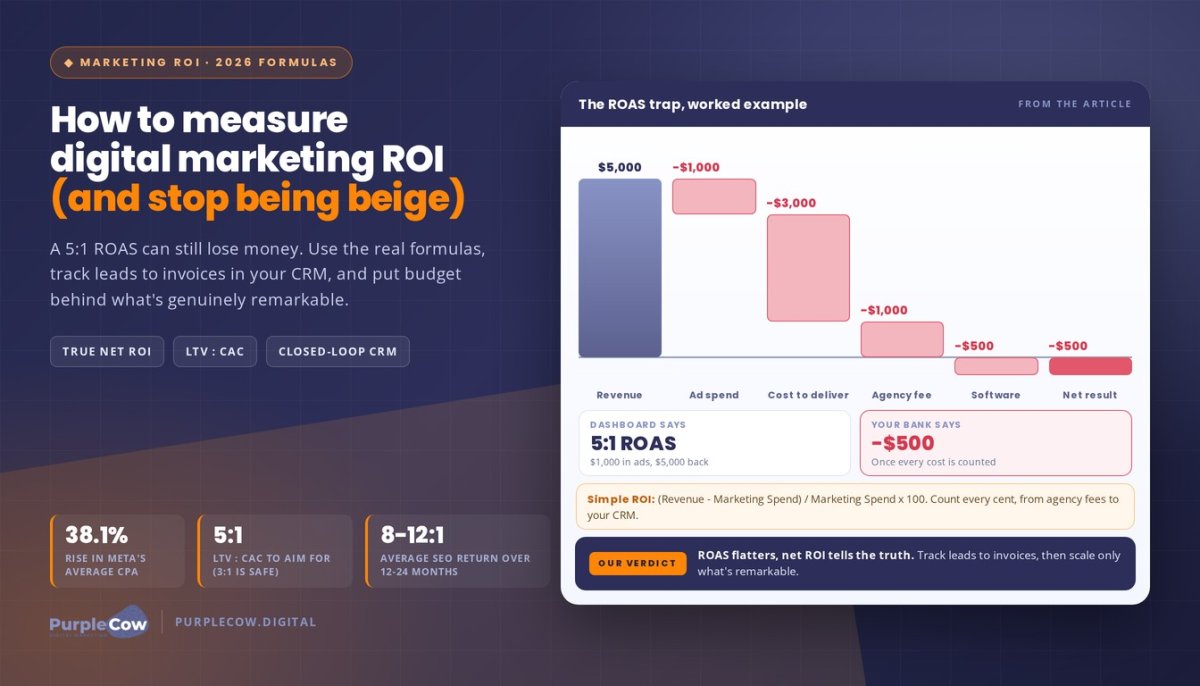
The Simple ROI formula is your quick health check: (Revenue – Marketing Spend) / Marketing Spend x 100. It’s the baseline. However, ROAS can be a trap if it doesn’t account for your overheads. If you spend $1,000 on ads and make $5,000, you have a 5:1 ROAS. That looks great on a dashboard. But if your product costs $3,000 to deliver, your agency fee is $1,000, and your software costs $500, you’ve actually lost money. Your true net ROI must include every cent spent, from agency fees to your CRM subscription. Don’t let a high ROAS mask a dying business. For those playing to win, the Campaign Attributable ROI model is far more accurate. It accounts for the messy reality of multi-channel journeys where a lead might see a Meta ad, read a blog post, and finally convert through an email.
LTV and CAC: The Real Profit Drivers
Mastering how to measure digital marketing roi requires you to be a strategist, not just a spender. This means understanding the relationship between Customer Acquisition Cost (CAC) and Customer Lifetime Value (LTV). If your CAC is $100 and your average customer spends $300, you have a 3:1 ratio. This is the “safe” zone. It keeps the lights on. But if you want to be remarkable, you need to push for a 5:1 ratio. This requires more than just better ads; it requires better marketing strategies for small business that increase retention and maximize upsell opportunities. Calculating LTV allows you to justify a higher initial spend because you know the long-term value of that client is worth the investment. Stop playing house with your data and start building a model that accounts for the entire customer lifecycle.
For service providers, the Marketing Contribution model is a game changer. This measures the percentage of total sales that originated from marketing touchpoints. It prevents “attribution theft” where sales teams take all the credit for leads that marketing nurtured for months. When you align your math with your business goals, you stop guessing and start growing. The middle ground is a graveyard; use these formulas to stay on the winning side of the fence.
Vanity Metrics vs. Remarkable Metrics: What Actually Matters?
Likes are the junk food of the digital world. They feel good for a second, but they don’t nourish your bank account. Vanity metrics are data points that look impressive in an agency report but fail to pay the bills. If you’re bragging about your reach while your revenue is flat, you’re just screaming into an empty room. Learning how to measure digital marketing roi means distinguishing between mere activity and actual achievement. You must shift your gaze to Downstream Metrics; those specific numbers that correlate directly with your bottom line.
Many marketing strategies for small business fail because they chase the wrong KPIs. They focus on being seen rather than being chosen. If you want to master how to measure digital marketing roi, you need a hierarchy that prioritizes profit over popularity. This is the difference between a business that survives and one that dominates. Consider this hierarchy as your roadmap to success:
- Awareness: Reach and impressions. This is the shallow end of the pool.
- Consideration: CTR and engagement. You’ve caught their eye, but you haven’t won their heart.
- Conversion: Sales and leads. This is the payoff that fuels your growth.
- Retention: Repeat business. The profit multiplier that reduces your reliance on new ads.
- Advocacy: Referrals. The ultimate mark of a remarkable, “Purple Cow” brand.
The “Like” Button is Not a Business Strategy
High engagement doesn’t always mean high profit. In fact, it often masks a deeper problem. “Beige” traffic is the enemy of growth; it’s a flood of clicks from people who have zero intention of buying. You might have a million views, but if your web funnel has “leaky buckets,” you’re just pouring money down the drain. You need to identify where people are dropping off. Is it the landing page? The checkout? Stop celebrating the clicks and start fixing the leaks that are draining your budget.
Metrics That Move the Needle
Conversion Rate is the ultimate test of any digital marketing services. It tells you if your message actually resonates with your audience. If your conversion rate is low, your creative is likely too safe or your offer is uninspiring. Next, look at your Lead-to-Close Ratio. This measures the quality of the leads you generate. A thousand leads are worthless if none of them have the budget or intent to buy. Finally, focus on Average Order Value (AOV). Increasing your AOV by even 10% can have a massive impact on your net profit without spending an extra cent on ad platforms. These are the metrics that actually move the needle. Everything else is just noise designed to make average agencies look busy.
Building Your Source of Truth: Tools and Implementation
Data is the new oil, but most businesses are still using a rusty bucket to collect it. If you want to know how to measure digital marketing roi with surgical precision, you need a tech stack that doesn’t leak. Standard browser-based tracking is effectively dead. As of 2026, 20 U.S. states have enacted comprehensive privacy laws. New regulations in Indiana, Kentucky, and Rhode Island have made first-party data strategies a legal requirement, not just a suggestion. You can’t rely on “beige” spreadsheets and gut feelings anymore. You need a system that captures every heartbeat of your customer’s journey.
Step 1 is implementing server-side tracking. This bypasses browser restrictions and ensures you own your data. Step 2 requires connecting your website to a robust CRM like GoHighLevel. This acts as your central brain, housing every interaction. Step 3 is setting up closed-loop reporting. This is the holy grail. It allows you to track a lead from the first click on a Meta ad all the way to the final cash payment in your bank account. Finally, Step 4 involves using AI-driven dashboards for real-time decision making. Since June 2026, GA4 has been automatically classifying traffic from chatbots like ChatGPT and Gemini into a new “AI Assistant” channel group. If you aren’t seeing this data, you’re flying blind.
Why GA4 is Only Half the Story
GA4 is a powerful tool, but it’s not a crystal ball. It often misses the offline impact of your local SEO efforts. To bridge this gap, you must use UTM parameters for every campaign source. Without them, your traffic is just a “beige” blob labeled “Direct” or “Unassigned.” Remarkable brands don’t settle for “Unassigned.” They track every touchpoint to understand the true path to purchase, especially as Google’s cross-channel budget planning tool now allows for much tighter modeling directly within the platform.
CRM: The Heart of ROI Measurement
You cannot measure ROI accurately without a CRM. Period. Standard analytics tell you about sessions; a CRM tells you about sales. By connecting your website to GoHighLevel, you automate the feedback loop between marketing spend and revenue. This allows you to track “Attributed Revenue” instead of just “Potential Revenue.” You’ll see which campaigns are actually closing, not just which ones are generating noise. It’s time to stop guessing and start scaling based on hard evidence. Ready to build a system that actually converts? Explore our digital marketing services to get started.
Scaling the Remarkable: How to Optimise Your ROI
Scaling a business is not about throwing more money at the same tired tactics. It is about identifying your “Purple Cow” and doubling down with aggressive intent. If you have mastered how to measure digital marketing roi, you now have the clarity to see which campaigns are actually remarkable and which are just expensive noise. Most businesses waste a significant portion of their budget on “beige” channels that provide zero incremental value. Optimization is the process of ruthlessly cutting that waste to fuel your winners.
A/B testing is your primary weapon in this fight. It is the difference between a stagnant 2% ROI and a market-dominating 10% return. By constantly challenging your headlines, offers, and creative assets, you force your marketing to evolve. You don’t just “set and forget” a campaign in 2026. You iterate until it becomes undeniable. This is especially true for long-term growth. While paid ads provide immediate feedback, continuous seo services offer the highest long-term ROI. Verified industry data indicates an average return of 8:1 to 12:1 over a 12 to 24 month period. It is the low-cost foundation that supports your high-cost experiments.
Pruning the Garden: Cutting Low-Performers
You must have the courage to kill a campaign that isn’t remarkable. Many brands suffer from “channel cannibalization,” where multiple ads fight for the same lead and drive up costs. If a channel isn’t meeting your target CAC, stop feeding it. Reallocate that spend to high-intent assets that actually convert. The middle ground is a dangerous place to be; if a strategy is just “okay,” it is actually a liability. Focus your resources on the 20% of activities that drive 80% of your profit.
Your Next Move: From Data to Action
Your journey in how to measure digital marketing roi doesn’t end with a report. It begins with action. Set quarterly benchmarks that challenge your team to move beyond the industry average. A “set and forget” mentality is the death of digital growth. The market moves too fast for passive management. You need to be agile, data-driven, and boldly intelligent. Stop settling for invisible results. The risk of being unremarkable is far greater than the risk of being different. Ready to stop being boring? Let’s build a remarkable digital strategy together and turn your data into a competitive weapon.
Own Your Data and Outshine the Beige
The middle of the market is a crowded, expensive graveyard. You’ve learned that “beige” results are a choice, one made by ignoring the hard math of your business. Mastering how to measure digital marketing roi isn’t just about balancing a spreadsheet; it’s about gaining the strategic clarity to outmaneuver your competition. By shifting your focus from vanity metrics to closed-loop reporting and implementing a robust CRM, you transform your marketing from a cost center into a profit engine.
As results-driven WordPress experts with a national Australian reach, we specialize in helping SMEs find their unique edge and scale it aggressively. Don’t let your growth be limited by broken tracking or uninspired creative. It’s time to demand more from your digital presence and turn your data into a definitive competitive advantage. Your business deserves to be remarkable, not just visible.
Stop being beige. Get a remarkable digital strategy that actually converts.
The market is waiting for someone to stop being boring. Take the leap, implement these frameworks, and watch your brand become the most formidable player in the room. You have the data; now go win.
Frequently Asked Questions
What is a good ROI for digital marketing in 2026?
A good ROI depends on your specific channel, but aiming for a 5:1 ratio is the benchmark for a remarkable business. While the average for Google Ads often sits between 2:1 and 4:1, email marketing remains the powerhouse with a staggering 36:1 return. If your results are hovering at the industry average, you aren’t winning; you’re just blending into the beige background of the market.
How long does it take to see a positive ROI from SEO?
SEO is a long-term power play that typically yields its best results over a 12 to 24 month period. During this time, you can expect an average return of 8:1 to 12:1. It’s the ultimate strategy for building a moat around your brand, providing a low-cost lead source that eventually outpaces the volatile costs of paid advertising.
Can I measure ROI for brand awareness campaigns?
Yes, but you have to stop looking at direct sales and start tracking assisted conversions and branded search lift. Awareness campaigns are designed to lower your long-term Customer Acquisition Cost. Remarkable brands measure how top-of-funnel visibility reduces the friction in the final sale, even if that sale happens weeks after the initial impression.
What is the difference between ROI and ROAS?
ROAS measures gross revenue generated for every dollar spent on ads, while ROI measures your total net profit after all expenses. ROAS is often a “beige” metric because it ignores your agency fees, software costs, and overhead. To truly master how to measure digital marketing roi, you must account for every cent that leaves your business, not just your ad spend.
Why is my agency reporting high results but my sales are flat?
Your agency is likely hiding behind vanity metrics like reach, impressions, or clicks that don’t correlate with cash. They might be using outdated attribution models that count passive engagements as “wins.” If your bank account doesn’t reflect their “record-breaking” reports, you have a data integrity problem or a lead quality issue that needs immediate surgery.
How do I calculate ROI if I have a long sales cycle?
You must use a CRM to track lead-to-close ratios and project revenue based on Customer Lifetime Value (LTV). Waiting six months to see if a campaign worked is a recipe for failure. Track micro-conversions at every stage of the funnel and use closed-loop reporting to attribute the eventual sale back to the original marketing touchpoint.
What are the best tools for tracking marketing ROI for small businesses?
A combination of GA4 and a CRM like GoHighLevel is the only way to build a reliable source of truth. Since June 2026, GA4 has been classifying AI chatbot traffic into a specific “AI Assistant” group. You need these tools to talk to each other so you can see exactly which click turned into a confirmed invoice.
How does website design impact my digital marketing ROI?
Your website is the foundation of your entire conversion engine; if it’s beige and boring, your ROI will suffer. High-quality design, like the web development services offered by Evolve Media, ensures your “leaky bucket” is sealed and your traffic actually converts into leads. A template-based site with poor UX can make even the most brilliant ad campaign unprofitable by killing the user’s intent at the final hurdle.

Article by
Angie Neal
Angie Neal is the founder and CEO of PurpleCow Digital, a full-service digital marketing agency based on Queensland's Redcliffe Peninsula. With deep expertise in SEO and web design, as well as a certification as a GoHighLevel Admin. Angie helps small-to-medium businesses build scalable growth systems through AI-powered automations, CRM workflows, and smart digital strategy. She's also passionate about building a community of like-minded agency owners at the After Party — sharing insights, solving real problems, and helping others grow. Whether it's search visibility, lead management, or end-to-end automation — Angie's focus is always on helping businesses scale sustainably.
Disclaimer
This page may contain affiliate links. If you sign up for software through our links, we may earn a commission at no extra cost to you. We only recommend tools we use and trust – software that is the backbone of our agency.