


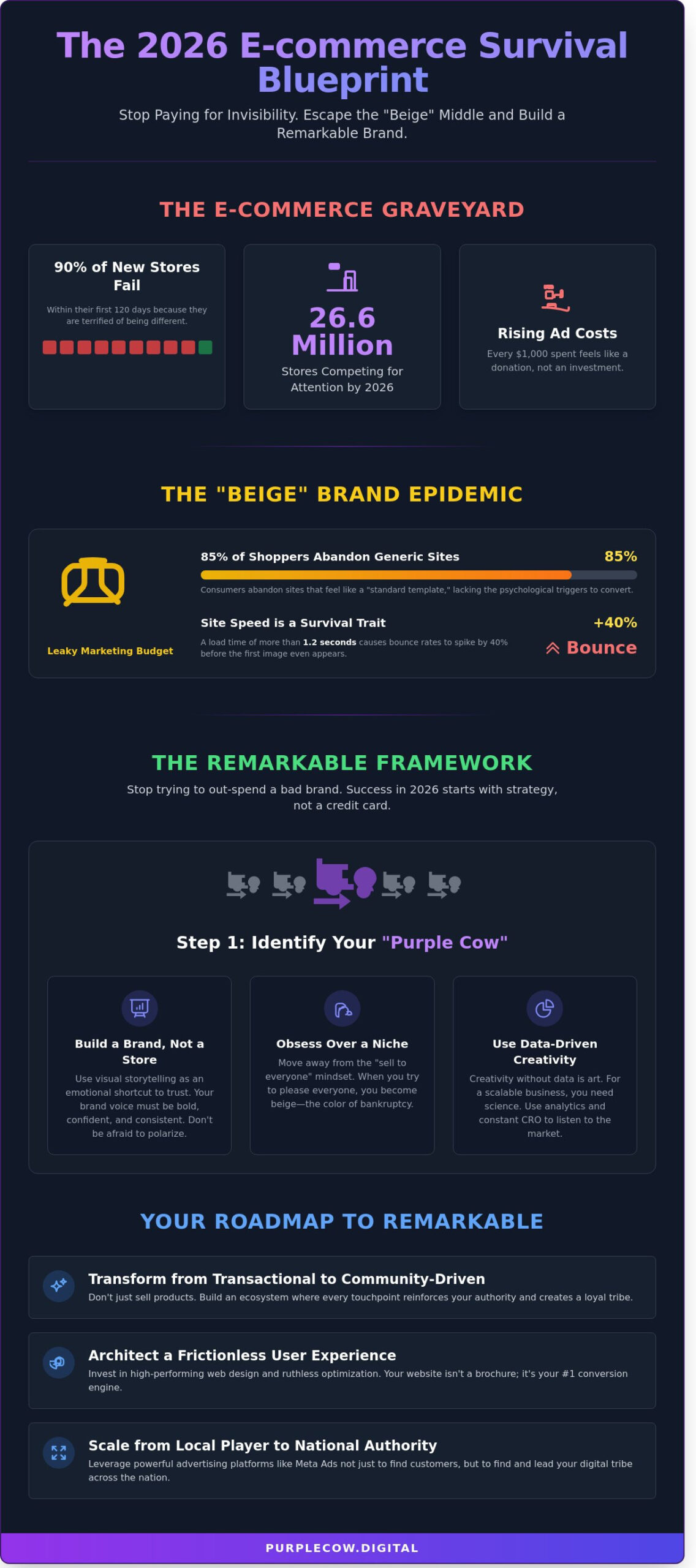
The most dangerous place for your e commerce business isn’t a crowded market; it’s the safe, beige middle where no one notices you exist. By 2026, the digital space will house over 26.6 million stores, and 90% of them will fail within their first 120 days because they’re terrified of being different. You’ve likely felt the crushing weight of rising customer acquisition costs, where every $1,000 spent on ads feels more like a donation to a platform than an investment in your own future. It’s time to stop paying for invisibility.
We agree that the era of generic templates and “me-too” branding is over. This article gives you the strategic blueprint to stop being another forgettable store and start building a remarkable brand that dominates the national market. You’ll learn how to navigate the technical noise and high costs to create a sustainable, scalable revenue engine. We’re diving into the exact roadmap you need to move from an initial concept to a high-conversion launch that people actually talk about.
Key Takeaways
- Discover why the era of ‘beige’ online shops is over and how to transform a transactional website into a community-driven, remarkable brand.
- Master the strategic framework to build a remarkable e commerce business by identifying your ‘Purple Cow’—the unique factor that stops the scroll.
- Evaluate the high-margin control of Direct-to-Consumer (DTC) models against the massive, untapped opportunities within B2B digital wholesaling.
- Learn to architect a frictionless user experience using high-performing web design strategies that convert visitors into loyal customers.
- Develop a roadmap to scale from a local player to a national authority by leveraging Meta Ads to find and lead your digital tribe.
What is an E-commerce Business in 2026?
By 2026, if you’re simply listing products online, you’re already losing the game. A modern e commerce business isn’t a digital catalog; it’s a living, breathing brand ecosystem. To understand the foundation, we can look at What is e-commerce? in its traditional sense, but the fundamental rules have evolved. The “beige” era of generic dropshipping, where sellers hid behind a screen to ship unbranded goods, officially died in 2024. Today, trust is the only currency that doesn’t devalue, and authority is built through consistent, remarkable storytelling that connects with a specific community.
To better understand how this landscape has shifted, watch this breakdown of the modern model:
The Core Components of Online Success
Your Unique Value Proposition (UVP) must do more than offer “fast shipping.” It has to make your competition irrelevant by solving a specific emotional or functional problem. You aren’t building a shop; you’re building a digital ecosystem where every touchpoint, from social proof to post-purchase emails, reinforces your authority. In this environment, your e commerce business acts as a strategic brand vehicle designed to dominate a niche through remarkable experiences, not just a software tool for processing payments. If your branding doesn’t provoke an immediate reaction, you’re just background noise.
Why ‘Average’ is Your Biggest Risk
Being average is now more expensive than being premium. By 2026, consumer data shows that 85% of shoppers abandon a site if it feels like a “standard template.” These generic sites are leaky buckets. They bleed your marketing budget because they lack the psychological triggers needed to convert high-intent traffic. Speed is no longer a luxury; it’s a survival trait. If your site takes longer than 1.2 seconds to load, your bounce rate will spike by 40% before the first image even appears. You can’t hide in the middle of the pack anymore. Choosing a generic website is a guaranteed way to stay invisible in a national marketplace that only rewards the bold and the unique.
The Remarkable E-commerce Framework
Stop trying to out-spend a bad brand identity. It’s a losing game. Most founders believe more ad spend fixes a stagnant e commerce business, but they’re wrong. If your brand is invisible, your budget is just a donation to Silicon Valley. Success in 2026 starts with strategy, not a credit card. You need to identify your “Purple Cow,” that singular, remarkable trait that forces a thumb to stop scrolling mid-feed. It’s the difference between being a choice and being the only option.
The secret lies at the intersection of creative rebellion and cold, hard data. You don’t win by being slightly better; you win by being different. This means moving away from the “sell to everyone” mindset. Instead, you must obsess over a specific “someone.” When you try to please everyone, you become beige. In a world of infinite choice, beige is the color of bankruptcy. You have to be willing to stand for something, even if it means some people won’t like you.
Building a Brand That Isn’t Beige
Digital noise has increased by 300% since 2020. To survive, your professional branding and identity must act as an emotional shortcut to trust. Visual storytelling isn’t just about pretty colors; it’s about signaling authority instantly. Your brand voice shouldn’t whisper. It needs to be bold, confident, and consistent across every touchpoint. If your messaging feels safe, it’s probably boring. Don’t be afraid to polarize. The right customers will love you for it while the wrong ones move on.
Data-Driven Decision Making
Creativity without data is just art. For a scalable e commerce business, you need science. Use analytics to pinpoint exactly which parts of your offer are truly remarkable. Conversion rate optimization (CRO) isn’t a one-time task; it’s a constant cycle of listening to what the market tells you through their clicks. If 68% of your traffic bounces on the landing page, your “remarkable” idea isn’t landing. Citing resources on building a successful online brand can help you align your strategy with proven financial models. It’s time to stop guessing and start measuring. Ready to leave the average behind? See how our digital marketing services can amplify your unique edge.
Choosing Your E-commerce Business Model
Stop blending in. Your e commerce business model determines whether you’re a commodity or a category of one. In 2026, the “grey” middle ground is a death trap. You must decide where you’ll plant your flag. Direct-to-Consumer (DTC) is the ultimate play for brand purists. It gives you 100% control over the customer journey and data. By 2026, DTC sales are projected to exceed $212 billion in the US alone; that’s power you can’t ignore.
B2B e-commerce is the sleeping giant finally waking up. Gartner predicts that 80% of B2B sales interactions will happen digitally by 2025. This isn’t just about bulk orders; it’s about creating a frictionless, consumer-grade experience for wholesale buyers. Accessing official e-commerce business resources helps you navigate international trade laws and tax compliance before you scale these operations globally.
Marketplaces like Amazon or eBay shouldn’t be your “home,” but they’re excellent tactical entry points. Use them to siphon off traffic and test product-market fit. Once you have the data, migrate those customers to your own ecosystem where you own the margins. If you aren’t thinking about recurring revenue through digital products or subscriptions, you’re leaving money on the table. High-margin digital assets can turn a struggling e commerce business into a cash-flow machine without the headache of warehouse logistics.
Inventory Management vs. Digital Assets
Holding physical stock in 2026 is a calculated risk. It offers quality control but ties up your capital. Smart brands now hybridize. They sell a physical “Purple Cow” product and pair it with a high-margin digital community or exclusive content subscription. This mix stabilizes your cash flow during supply chain hiccups. Use sophisticated marketing strategies for small business to sell the value of the digital asset alongside the physical one. It’s about maximizing the Lifetime Value (LTV) of every single click.
Selecting the Right Platform
Cheap, “all-in-one” website builders are a trap for the mediocre. They’re easy to start but impossible to scale. If your tech stack can’t handle a 400% traffic surge during a viral moment, it’s garbage. Shopify offers speed, but a custom WordPress and WooCommerce setup provides total ownership and zero monthly “success taxes.” Scalability is the only metric that matters here. Our team’s approach to web design focuses on building high-performance engines, not just pretty digital brochures. Don’t let a “free” builder become the ceiling that caps your growth.
Building the Store: Design, SEO, and Conversion
Most online stores are invisible. They belong to the gray, boring herd of templates that fail to trigger a single emotion. If you want a remarkable e commerce business in 2026, you can’t just “launch a site.” You must architect an experience that demands attention. High-performing brands don’t just sell products; they remove every ounce of friction between a desire and a purchase.
- Step 1: Remove friction. A 0.1-second improvement in mobile load speed can increase conversion rates by 8.4%, according to Deloitte data. Every unnecessary click is a leak in your revenue bucket.
- Step 2: Implement a high-performing web design strategy. Your store should look like a leader, not a follower.
- Step 3: Dominate search with a comprehensive SEO plan. If you aren’t on page one, you don’t exist.
- Step 4: Write for transformation. Stop listing technical specs; tell the customer how their life improves after the click. Sell the “after” state.
- Step 5: Protect your assets. Security and speed aren’t optional. Set up a robust website care plan to ensure your store stays online and lightning fast.
SEO: The Long-Term Growth Engine
Cheap SEO is the most expensive mistake you’ll ever make. Choosing “affordable SEO” often leads to 0% growth and massive lost opportunity costs. Your e commerce business needs a technical foundation that search engines actually trust. This means clean code, logical site architecture, and a content strategy that answers real human intent. SEO is a monthly investment in your business’s future equity. It builds a moat around your brand that competitors can’t simply buy their way over with ads.
Conversion: Turning Visitors into Fans
The Baymard Institute reports that 70.19% of digital shopping carts are abandoned. That is a staggering amount of money left on the table because of poor psychology. To win, you must deploy social proof and trust badges that actually mean something. Use “remarkability” to stand out. Don’t just send a generic receipt; send an email that makes them smile. Email marketing remains a powerhouse, delivering an average $36 ROI for every $1 spent when used to increase customer lifetime value through personalized storytelling.
Stop being another gray cow in a field of average stores. Scale your brand with our digital marketing services and start dominating your market today.
Scaling Your E-commerce Business Nationally
Safe is risky. If your e commerce business remains a local secret, you’re leaving 90% of your potential revenue on the table. Moving from a local player to a national authority requires more than just a bigger budget; it requires a radical shift in how you find your tribe. Meta Ads in 2026 aren’t just about reach. They’re about surgical precision. You’re looking for the 1% of the population that resonates with your specific brand of rebellion. Use social media to build a community, not just a customer list.
Content marketing is your defensible moat. While competitors waste money on fleeting clicks, you should invest in assets that grow in value. Original data, provocative storytelling, and deep authority pieces build trust that no discount code can replicate. A 2025 study showed that brands with original content saw 45% higher customer retention than those relying solely on paid search. To move faster, partner with a digital marketing agency that understands the difference between fine and remarkable.
From Launch to Dominance
Success isn’t accidental. Set hard KPIs for your first 12 months: aim for a 3:1 LTV-to-CAC ratio and a customer retention rate above 22%. If your conversion rate stays below 1.8% after 10,000 unique sessions, pivot your messaging immediately. Data doesn’t lie; your ego does. Being a Purple Cow means being the only logical choice in a sea of grey, boring options. If your product doesn’t make people talk, your marketing will always be an uphill battle.
The PurpleCow Digital Advantage
We don’t build average websites. We create custom WordPress ecosystems designed to attract high-paying clients who value quality over cost. Our results-driven approach ignores vanity metrics and focuses on the only number that matters: your bottom line. We use data-backed strategies to ensure your e commerce business doesn’t just survive but dominates. Stop being boring. Stop blending in. Contact PurpleCow Digital today to build something truly remarkable.
Stop Blending In and Start Dominating the 2026 Market
The digital landscape is projected to host over 26 million online stores by 2026. If your strategy is simply to exist, you’ve already lost. Success in this hyper-competitive era demands more than just a functional site; it requires a remarkable brand identity design that forces customers to stop scrolling. You’ve learned that a high-performance e commerce business relies on the backbone of custom WordPress experts and data-driven SEO strategies to capture the 45% of shoppers who now start their journey on search engines. Average is the most expensive mistake you can make. It’s time to ditch the gray, safe tactics that keep your brand invisible. By focusing on the Remarkable Framework, you aren’t just building a shop; you’re engineering a market leader. The numbers don’t lie. Brands that prioritize unique positioning see 3x more organic growth than those following the herd. Choose to be the purple cow in a field of monochrome competitors. Your future revenue depends on your courage to be different today.
Ready to build a remarkable e-commerce business? Let’s talk strategy.
Frequently Asked Questions
Is starting an e-commerce business still profitable in 2026?
Profitability is higher than ever for the bold, with global e-commerce sales hitting $8.1 trillion in 2026. You can’t survive by being average anymore. 85% of shoppers now ignore generic retailers. To build a profitable e commerce business, you must dominate a niche and offer a “Purple Cow” experience that makes price comparisons irrelevant. Success isn’t about volume; it’s about being the only choice for your tribe.
How much does it cost to start a professional e-commerce business?
Budget $5,000 to $15,000 for a professional launch that actually converts. Cheap setups are a waste of time. Spend $3,000 on high-converting UX design and $4,000 on a data-driven launch campaign. The remaining capital covers inventory and legal fees. If you start with less, you’re just paying to be invisible. Real brands invest in visibility and strategic positioning from day one.
Do I need technical skills to run an online store?
You don’t need to be a coder to win, but you must be a strategist. Modern platforms handle 95% of the technical heavy lifting. Focus your energy on conversion optimization and customer psychology instead. A $200 technical audit once a quarter is more effective than spending weeks learning Python. Your job is to lead the brand, not to fix broken HTML tags.
What is the best platform for a new e-commerce business?
Shopify is the 2026 market leader for 72% of scaling brands due to its 99.9% uptime. It’s the best platform because it removes technical friction. If you need total creative freedom, look at headless commerce options like BigCommerce. Don’t pick a platform because it’s cheap. Pick the one that lets you scale to $1 million in revenue without breaking your site.
How long does it take for an e-commerce site to rank on Google?
It takes 4 to 9 months to see significant organic traffic from Google. Speed depends on your “remarkable” content strategy. Sites that publish three data-backed case studies per week rank 55% faster than those using AI-generated fluff. SEO is a long-term asset, not a quick fix. You’re building a digital empire, and empires aren’t built in a weekend.
What are the legal requirements for selling online in Australia?
You need an Australian Business Number (ABN) and must register for GST once your turnover exceeds $75,000. Compliance with the Australian Consumer Law (ACL) is mandatory for every store. This includes clear refund policies and data protection under the Privacy Act 1988. Don’t cut corners here. 90% of local shoppers abandon carts if they don’t see clear, legally compliant trust signals.
How do I choose between SEO and paid ads for my online store?
Start with an 80/20 split in favor of paid ads to generate immediate data. Use Facebook and Google Ads to find what converts. Simultaneously, invest that 20% into SEO to lower your long-term acquisition costs. By month 12, your e commerce business should get 35% of its sales from organic search. Ads buy you speed, but SEO buys you freedom from the algorithm.
What makes an e-commerce brand ‘remarkable’?
A brand is remarkable when it’s impossible to ignore. It’s the “Purple Cow” in a sea of gray, boring competitors. Remarkable brands focus on the 15% of the market that truly cares about their mission. They don’t try to please everyone. This strategy leads to a 40% increase in customer retention. If your brand doesn’t provoke a reaction, it’s effectively invisible.