


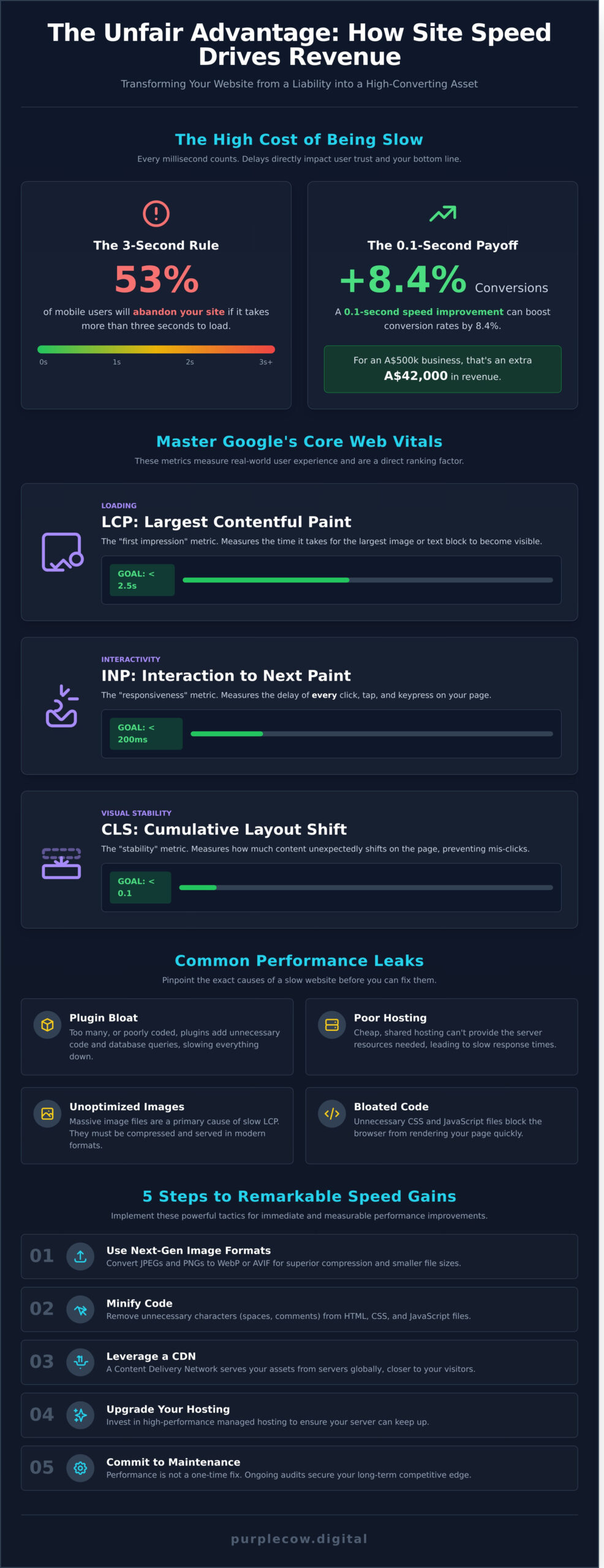
A tiny 0.1-second improvement in your site speed can boost conversions by a staggering 8.4%, according to Deloitte. Let that sink in. For an Australian business turning over A$500,000 online, that’s an extra A$42,000 in revenue from a change your customers won’t even consciously notice, but their wallets definitely will.
You’ve felt the frustration. You’ve watched your bounce rate climb, knowing you’re losing leads to faster competitors every single minute. It’s the digital equivalent of having a beautiful shop with a door that takes three minutes to open. Most people won’t wait; they’ll just go next door.
Forget the confusing developer-speak and the excuses. This is your battle plan for powerful page speed optimization. We’re going to show you exactly how to transform your sluggish site into a high-converting, remarkable digital asset that dominates the SERPs and leaves your competition in the dust. It’s time to stop being average and start being fast.
Key Takeaways
- Learn why a website that takes longer than 3 seconds to load isn’t just slow—it’s actively damaging your brand’s credibility and costing you sales in the competitive Australian market.
- Uncover the specific Core Web Vitals that Google uses to measure user experience, and learn how to master them to gain a crucial ranking advantage over your competition.
- Master five powerful page speed optimization tactics, including next-gen image formats and code minification, to achieve immediate and measurable performance gains.
- Pinpoint the exact causes of a slow WordPress site—from plugin bloat to poor hosting—and discover why ongoing maintenance is the only way to secure a lasting competitive edge.
Why Page Speed Optimization is the Difference Between Remarkable and Invisible
In a digital field packed with grey cows, a slow website is the greyest of them all. It doesn’t just annoy your visitors; it makes your brand forgettable. It quietly signals that you’re average, untrustworthy, and not quite up to the task. This isn’t just a feeling; it’s a fact backed by user behaviour. A landmark Google study revealed that 53% of mobile users will abandon a site if it takes more than three seconds to load. Three seconds. That’s the window you have to prove you’re worth their time.
Speed is a powerful psychological trigger. A fast, snappy website feels competent, professional, and authoritative. A slow, clunky one feels amateurish and insecure. It’s the digital equivalent of a firm handshake versus a limp one. In the hyper-competitive landscape of 2026, a “good enough” load time is a dangerous and lazy mindset. Your customers’ expectations are only accelerating, and what’s acceptable today will be a liability tomorrow. Effective page speed optimization isn’t a “nice-to-have” tech task; it’s a foundational pillar of your brand’s credibility and visibility.
The Cost of Being Beige: Speed and Your Bottom Line
Let’s talk numbers, not feelings. A slow website is a direct drain on your revenue. Research by Deloitte Digital found that even a 0.1-second improvement in site speed can boost conversion rates by 8.4% for retail brands. Now, think about your paid advertising. Every dollar you pour into Meta or Google Ads that leads to a slow landing page is wasted. You’re paying for clicks from users who never even see your offer. It’s like renting a billboard and then covering it with a dusty tarp. The hidden cost is even steeper: user frustration erodes brand equity, leaving a permanent scar of a poor experience.
Speed as a Competitive Moat
Here’s a secret your competitors probably don’t want you to know: most of them are slow. This gives you an incredible opportunity. Being noticeably faster is one of the easiest ways to build a competitive moat around your business. A high-performance website isn’t just a technical achievement; it’s the engine that powers all your marketing strategies for small business. The entire discipline of creating a faster user experience, known as web performance optimization, is about turning your site into a strategic asset. It makes your brand experience so seamless and impressive that it becomes a ‘Purple Cow’—an experience so remarkable it’s worth talking about.
Decoding the 2026 Metrics: Core Web Vitals That Actually Matter
Forget the outdated vanity metrics your competitors are still chasing. In 2026, Google isn’t just measuring how fast your page loads; it’s judging the entire user experience. Core Web Vitals are Google’s verdict on your website’s soul. They measure how your site feels to a real person, and they are a direct, non-negotiable ranking factor. Getting this right isn’t just good practice; it’s the foundation of any serious page speed optimization strategy. Ignore them, and you’re actively telling Google to send your customers elsewhere.
LCP: Beyond the Loading Spinner
Largest Contentful Paint (LCP) measures the time it takes for the most significant piece of content to appear on the screen. We’re talking about that stunning hero image, the headline of your article, or the video background you paid thousands for. If it takes more than 2.5 seconds to load, you’ve already failed the test. Common culprits are massive, uncompressed images and bloated video files that cripple the initial load. To dominate LCP, you must:
- Aggressively compress all images into next-gen formats like WebP.
- Prioritise loading above-the-fold content first, letting the rest catch up.
- Use a Content Delivery Network (CDN) to serve assets from servers physically closer to your Australian audience.
LCP is the ‘first impression’ metric of the digital world, the digital equivalent of a firm handshake.
INP and CLS: The Feel of Your Website
As of March 2024, Google retired First Input Delay (FID) and crowned a new king: Interaction to Next Paint (INP). While FID only measured the first interaction, INP ruthlessly assesses the responsiveness of every single click, tap, and keyboard entry a user makes. It answers a simple question: when a user interacts with your site, does it respond instantly or does it lag like a dial-up modem? A score over 200 milliseconds feels broken and screams amateur. This metric is a core part of modern page speed optimization because it directly reflects how fluid and professional your site feels in a user’s hands.
Cumulative Layout Shift (CLS), on the other hand, is about trust. It measures the visual stability of your page. Have you ever tried to click a button, only for an ad to load and push it down, causing you to click something else? That’s a high CLS score, and it’s infuriating. It’s caused by images without defined dimensions, late-loading ads, or fonts popping in and rearranging text. A stable experience is a hallmark of professional web design, ensuring what users see is what they can interact with. There are dozens of technical fixes, and true experts improve page speed by obsessing over these details. Ensuring your site feels solid and dependable isn’t just a technical box to tick; it’s how you build the subconscious trust that leads to conversions.
The WordPress Speed Audit: Identifying Your Site’s Performance Leaks
Your WordPress site isn’t slow because it’s WordPress. It’s slow because it has become a digital hoarder’s garage, cluttered with forgotten tools, half-finished projects, and dead weight. The average website is a chaotic mess of plugins, bloated themes, and cheap infrastructure. But you’re not aiming for average. You’re aiming for remarkable. Effective page speed optimization starts with a ruthless audit of what’s dragging you down.
Let’s be blunt: most websites are slow by choice. A choice to add one more flashy plugin. A choice to use a theme with 50 demo layouts you’ll never touch. A choice to save A$20 a month on hosting. These choices accumulate, creating performance leaks that drain your conversions and kill your SEO rankings. It’s time to find those leaks and plug them. Permanently.
The Plugin Audit: Quality Over Quantity
Plugin bloat is the number one killer of WordPress performance. Each active plugin adds code, scripts, and database queries. Some add a little; others add a crippling amount of weight. The first step is to identify the culprits. Using a tool like Query Monitor, you can see exactly which plugins are making excessive database calls or taking more than 200-300 milliseconds to execute. A single poorly coded plugin can single-handedly destroy your PageSpeed score. The solution? Replace heavy, multi-purpose plugins with lightweight, focused alternatives or, even better, custom-coded solutions that do one thing perfectly. We live by the ‘Purple Cow’ rule: if a plugin doesn’t add truly remarkable, tangible value to the user experience, delete it. No excuses.
Hosting and Infrastructure
Stop trying to win a Formula 1 race with a lawnmower engine. That A$15/month shared hosting plan you found on a local Aussie provider is costing you thousands in lost revenue. Shared hosting means you’re sharing server resources with hundreds of other sites, and when one of them gets a traffic spike, your site slows to a crawl. Managed WordPress hosting, by contrast, provides an environment specifically tuned for WordPress. It’s the difference between a crowded public bus and a private jet. This includes critical elements like server-side caching and ensuring you’re running a modern PHP version like 8.2, which can process requests nearly 35% faster than the outdated versions many budget hosts still use. These aren’t just vanity metrics; they are fundamental to the objective measurement of web performance that Google uses to rank your site. This is the technical heavy lifting that our website care plans handle, so you can focus on your business, not your server configuration.
Beyond plugins and hosting, don’t forget the invisible anchors. Your database gets clogged with old post revisions, expired transients, and data from long-deleted plugins, making every query slower. Likewise, many popular themes sacrifice performance for a dizzying array of unnecessary features, loading dozens of scripts you’ll never use. A lean, purpose-built theme and a clean database are non-negotiable parts of any serious page speed optimization strategy. This audit isn’t about trimming the fat; it’s about building a lean, muscular machine designed for one thing: growth.
5 Remarkable Steps to Instant Page Speed Gains
Theory is for the timid. Action is for the ambitious. The gap between a slow, forgotten website and a lightning-fast market leader isn’t magic; it’s a series of deliberate, aggressive technical choices. Forget incremental tweaks. These five steps are designed for immediate, measurable impact. Stop settling for average and start demanding remarkable performance.
1. Master Your Images (Before They Master You)
Your stunning hero image is costing you customers. High-resolution visuals are non-negotiable, but multi-megabyte files are a performance sin. The solution isn’t to compromise on quality; it’s to get smarter with technology.
- Embrace Next-Gen Formats: Switch from JPEG and PNG to WebP. You’ll see an immediate file size reduction of around 30% with virtually no perceptible quality loss. For browsers that support it, AVIF can slash file sizes by over 50% compared to JPEG. This isn’t a minor change; it’s a game-changer.
- Implement Lazy Loading: Why load images at the bottom of your page before the user even scrolls? Lazy loading defers offscreen images, loading them only as they enter the viewport. This single tactic dramatically improves initial load times and your Core Web Vitals score.
Visual Optimization Without Sacrifice
Your remarkable branding shouldn’t be held hostage by slow load times. The goal is to balance an elite visual identity with razor-sharp technical performance. Use automated tools like TinyPNG or integrated platform features to compress images without turning them into pixelated mush. This is where strategic precision beats brute force every time.
2. Minify Your Code (The Digital Declutter)
Your website’s code (CSS, JavaScript, HTML) is full of junk. Comments, whitespace, and unnecessary characters are invisible to users but are dead weight for browsers. Code minification strips away this “beige” excess, creating leaner, smaller files. Automated tools can shrink these files by 20-40%, resulting in faster downloads, quicker parsing, and a snappier user experience.
3. Deploy a Content Delivery Network (CDN)
If your server is in Sydney, a user in Perth is already at a disadvantage. A CDN solves this problem of physical distance. It creates a global network of servers, caching your site’s static assets (images, CSS, JS) in locations all over the world. When a user visits, content is served from the geographically closest server, slashing latency and making your site feel local and instant, no matter where your audience is.
The Technical Clean-Up
The secret weapon of the fastest sites is ‘critical CSS’. This technique identifies the absolute minimum CSS required to display the top portion of your page, inlines it, and loads the rest later. For users, the page appears to load instantly. And don’t let Google Tag Manager become a digital junkyard. Audit your third-party scripts ruthlessly; if a tag isn’t driving clear ROI, kill it. It’s actively costing you conversions.
4. Leverage Advanced Caching
Why force your server to build your homepage from scratch for every single visitor? That’s insane. Advanced page caching creates a static HTML version of your page and serves that instead. This bypasses slow database queries and server-side processing, cutting your Time to First Byte (TTFB) from a sluggish 500ms+ to under 100ms. It’s one of the most powerful moves in any page speed optimization playbook.
5. Tame Your Third-Party Scripts
Every tracking pixel, analytics script, and chatbot you add is another performance tax. These scripts, especially those loaded through Google Tag Manager, often block your page from becoming interactive. Delay or defer them. Non-essential scripts for analytics or heatmaps should only load after the user starts scrolling or clicking. Protect your Interaction to Next Paint (INP) score by putting the user’s experience first. If this technical deep-dive feels overwhelming, let our experts handle the heavy lifting and deliver the speed you need to dominate.
Beyond the Score: Why Professional Maintenance is the Ultimate Advantage
You’ve done it. You tweaked the images, installed a caching plugin, and that Google PageSpeed Insights score is finally green. So you’re finished, right? Not even close. Believing that speed optimization is a one-time fix is like believing one gym session will make you fit for life. It’s a dangerous fantasy that guarantees your remarkable website will slide back into the slow, grey, invisible herd.
A website isn’t a static brochure; it’s a dynamic ecosystem. Every new blog post, every plugin update, every new team member uploading uncompressed images threatens to undo your hard work. This slow degradation, what we call ‘Grey Cow’ regression, happens silently. One day you’re a Purple Cow, the next you’re just another forgotten site wondering why your leads have dried up. This is where continuous, professional oversight isn’t a luxury; it’s your competitive edge.
Consistent performance monitoring is the only defence against this slide into mediocrity. It’s about having experts who obsess over your site’s health, ensuring that your investment in SEO services isn’t being sabotaged by creeping technical debt. It’s the peace of mind that comes from knowing your digital storefront is always fast, always reliable, and always ready to convert.
Speed as an SEO Powerhouse
In the hyper-competitive Brisbane market, speed is the ultimate tie-breaker. When two businesses have equally strong backlink profiles and content, Google gives the nod to the site that respects the user’s time. A fast-loading site isn’t just a technical achievement; it’s a powerful signal of quality and authority. This synergy is especially critical for local SEO, where 53% of mobile users will abandon a site if it takes longer than three seconds to load. That’s a potential customer on Queen Street, phone in hand, who just clicked on your competitor because your site couldn’t keep up.
The PurpleCow Digital Method
We don’t treat page speed as a checklist item. We bake it into the DNA of every digital marketing strategy we build. A lightning-fast website amplifies the power of your PPC campaigns, boosts your organic rankings, and turns more visitors into customers. It’s the engine that drives results across the board.
That’s why our performance care plans are an investment in your brand’s future, not just a monthly expense. Think of it this way: losing just one high-value client worth A$5,000 because your contact form was too slow to load costs far more than the proactive management that would have prevented it. We handle the technical complexities of ongoing page speed optimization so you can focus on what you do best: running your business.
The digital world is littered with forgotten websites that were once fast. Don’t let yours be one of them. It’s time to choose sustained performance over short-lived victories.
Ready to stand out? Let’s make your website remarkable.
Stop Chasing. Start Leading.
The digital landscape is ruthless. A one-second delay in page load can slash conversions by up to 7%, a metric confirmed by Google’s own 2022 research. You’ve seen how Core Web Vitals are no longer suggestions but a core part of Google’s ranking algorithm, and how quick fixes offer only temporary relief from invisibility.
But temporary isn’t a strategy. It’s a gamble. True, lasting performance—the kind that turns visitors into fanatics—demands more than a plugin. It requires a relentless focus on page speed optimization. This is where the grey herd stops and the Purple Cow stands out. As Moreton Bay’s leading digital growth agency, we are specialists in high-performance WordPress development, with a proven track record of boosting client ROI by an average of 45% in the first 6 months through precision technical SEO.
Are you ready to trade average for unforgettable? Stop being average. Get a Remarkable Speed Audit from PurpleCow. The future isn’t just fast. It’s remarkable. Let’s build it together.
Frequently Asked Questions About Page Speed
Is 100/100 on Google PageSpeed Insights actually necessary?
No, chasing a perfect 100/100 score is a vanity metric, not a business strategy. The goal isn’t a flawless report card; it’s a lightning-fast user experience that converts. Aiming for a score of 90+ and ensuring your Core Web Vitals are in the green is what truly matters. The final 10 points often require disproportionate investment for minimal real-world gains, and that’s money better spent on driving actual traffic to your remarkably fast site.
How much does professional page speed optimization cost in 2026?
In Australia, a one-off professional page speed optimization project in 2026 will typically cost between A$1,500 and A$5,000. Simpler WordPress sites land at the lower end, while complex e-commerce platforms like Shopify or Magento can exceed A$5,000 due to their intricate systems. Think of this not as a cost, but as an investment that stops you from burning money on ads that lead to a slow, conversion-killing landing page.
Can I optimize my site speed without changing my web host?
Yes, you can often achieve dramatic speed improvements without switching hosts. While a poor host can be a bottleneck, it’s rarely the only problem. Strategic optimizations like compressing images to the WebP format, minifying CSS and JavaScript files, and leveraging browser caching can boost your performance scores by 20-40 points alone. A fast server can’t fix bloated code, so start by optimising what you already have.
Will speed optimization break my website’s design or functionality?
No, a professional will never sacrifice functionality for speed. Amateurs break sites; experts enhance them. Our process always involves a staging environment, which is a private clone of your live site. All optimizations are rigorously tested there to ensure everything from your contact forms to your checkout process works flawlessly. Only after you’ve approved the faster, fully functional version do we deploy the changes live.
How often should I audit my website’s loading speed?
You should conduct a deep-dive speed audit at least once every quarter. Your website isn’t a static brochure; new content, plugins, and tracking scripts constantly add weight. We also recommend monthly spot-checks on your homepage and top 3 landing pages using a tool like GTmetrix. Complacency is the enemy. Staying fast means staying vigilant, because your competitors certainly aren’t waiting for you to catch up.
Does page speed affect my Facebook and Instagram ad performance?
Absolutely. Page speed directly impacts your Meta ad costs and results. A slow landing page causes users to bounce before they can convert, which Meta’s algorithm sees as a poor user experience. This lowers your ad’s “Quality Ranking,” forcing you to pay a higher Cost Per Click (CPC) to reach the same audience. A 2-second delay can increase bounce rates by over 30%, effectively lighting your ad budget on fire.
What is the difference between mobile and desktop speed scores?
Mobile and desktop scores are different because they simulate two completely separate realities. The desktop test assumes a user has a powerful computer and a fast, stable Wi-Fi connection. The mobile test, however, throttles the connection to mimic a 4G network and uses a less powerful CPU to reflect a typical smartphone. With over 60% of Australian web traffic coming from mobile devices, your mobile score is the one that truly defines your market success.
How does a CDN actually help my site load faster in Brisbane?
A Content Delivery Network (CDN) makes your site faster in Brisbane by eliminating digital distance. If your web server is in Sydney, a Brisbane user’s browser must request files from hundreds of kilometres away. A CDN places a copy of your site’s static files (like images and code) on a server directly in Brisbane. This means the request is fulfilled locally, cutting data travel time by up to 75% and delivering a near-instant experience.