

Another email sent. Another deafening silence. You’re pouring hours into crafting messages, only to see them vanish into the digital abyss, unopened and unloved. You stare at your tiny subscriber list, terrified of being flagged as a spammer under Aussie law, and wonder if you should just dump all your energy into the unpredictable world of social media instead. Is this really worth the effort?
While the platform provides the tools, the strategy behind how you use them is what truly drives success. This is often where partnering with a digital marketing agency can be a game-changer. For example, a full-service agency like Ozment Media helps businesses not only select the right tech stack but also build the overarching strategy to ensure every campaign contributes to growth.
Let’s cut through the noise. The problem isn’t the channel; it’s the refusal to be remarkable. Most businesses send grey, forgettable updates. You’re about to do the opposite. This is your ultimate guide to transforming your email marketing from a dreaded chore into your most powerful, direct line for business growth. Forget just sending emails. We’re going to show you how to build a loyal audience that actually looks forward to hearing from you, generate consistent leads, and create campaigns that don’t just get opened-they get results.
Key Takeaways
- Your email list is the one marketing channel you truly own. Learn how to turn this asset into your most powerful engine for growth, free from the chaos of social media algorithms.
- A small, engaged list of true fans will always outperform a massive, bought list of strangers. Discover the strategy to attract subscribers who actually want to hear from you.
- Successful email marketing is about delivering remarkable value, not just blasting sales pitches. We’ll show you how to shift from vanity metrics to measuring real business impact.
- Stop using your standard inbox for campaigns. Pinpoint the essential features you need in an email platform to automate, analyse, and scale your efforts effectively.
Why Email Marketing is Your Most Powerful Asset (Not a Relic)
Let’s cut through the noise. Anyone who tells you email marketing is dead is either lazy or trying to sell you something far less effective. Dead? No. Boring email marketing? Absolutely. The generic, mass-blasted newsletters of the past are relics. But strategic, data-driven email communication is not just surviving; it’s the engine room for local businesses that want to dominate, not just compete. Despite a long history of email marketing, its core principles of direct connection are more potent today than ever before.
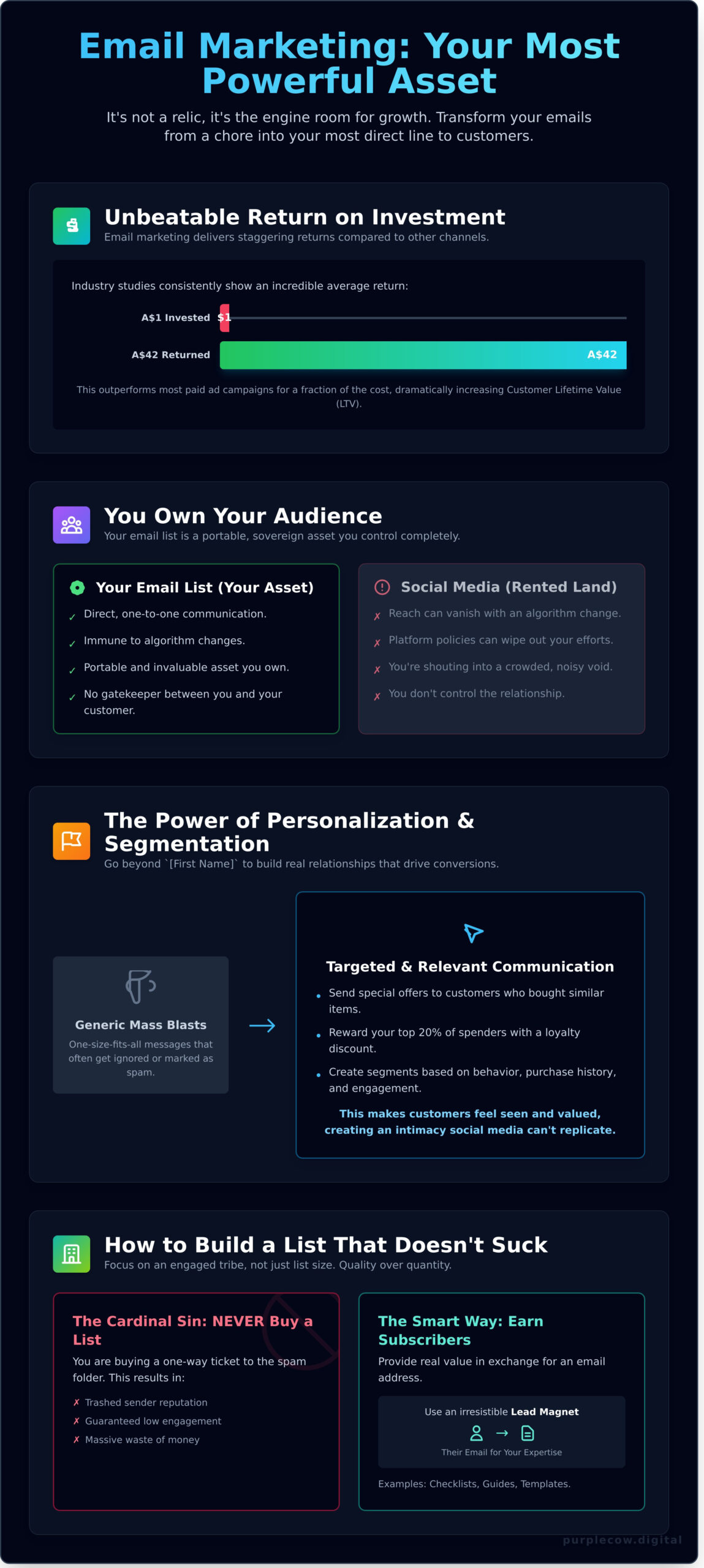
While everyone else is shouting into the void of social media algorithms, you could be having a direct, one-to-one conversation with your best customers. This isn’t just about sending promotions; it’s about building a tribe, fostering loyalty, and driving predictable, repeatable revenue. The numbers don’t lie: industry studies consistently show a staggering return of around A$42 for every A$1 invested. Show us a paid ad campaign that can promise that.
You Own Your Audience
Think of your social media following as rented land. A sudden algorithm change or platform policy shift can wipe out your reach overnight. Your email list, however, is your sovereign territory. It’s a portable, invaluable asset that you control completely. No gatekeeper can prevent your message from landing in your subscribers’ inboxes, giving you a direct line of communication that is immune to the whims of Silicon Valley.
Unbeatable Return on Investment
The maths is simple and brutal. The cost of a professional email platform is a drop in the ocean compared to the ever-rising cost of pay-per-click advertising in Australia. Instead of paying to acquire the same customer repeatedly, email allows you to nurture relationships and dramatically increase Customer Lifetime Value (LTV). A targeted email to a segmented list will always outperform a generic ad, driving higher conversion rates for a fraction of the cost.
The Power of Personalization
Personalization is more than just dropping a `[First Name]` into the subject line. True power comes from segmentation. Imagine sending a special offer for a new product only to customers who bought a similar item before. Or a loyalty discount to your top 20% of spenders. This is the kind of relevant, timely communication that builds real relationships and makes customers feel seen-a level of intimacy that a crowded social media feed can never replicate.
The Foundations: How to Build an Email List That Doesn’t Suck
Let’s get one thing straight. The size of your email list is a vanity metric. What truly matters is engagement. A list of 500 raving fans who open every email is infinitely more valuable than 10,000 strangers who mark you as spam. Your goal isn’t to collect contacts; it’s to build a tribe that trusts your local business.
This brings us to the cardinal rule of email marketing. Rule #1 is simple and non-negotiable: Never, ever buy an email list. You’re not just buying dead-end addresses; you’re buying a one-way ticket to the spam folder, a trashed sender reputation, and a massive waste of money. Real growth comes from a value exchange: their email address for your expertise.
Create an Irresistible Lead Magnet
A lead magnet is your ethical bribe. It’s a high-value piece of content you give away for free in exchange for an email. Forget generic newsletters. You need to solve one specific, urgent problem for your ideal customer. Think:
- A local cafe offering a “Home Barista’s Checklist for the Perfect Flat White.”
- A plumber providing a guide on “5 DIY Checks to Prevent a A$5,000 Water Damage Bill.”
- A financial advisor sharing a “Template for a Simple Family Budget.”
Deliver on your promise, and you’ve just earned trust, not just a contact.
Optimise Your Website for Sign-ups
Don’t hide your subscription form like a state secret. Make it impossible to miss. Place clear, compelling sign-up opportunities in high-traffic areas of your website: the header, the footer, at the end of blog posts, and even as a polite exit-intent pop-up to catch visitors before they leave. Ditch boring CTAs like “Subscribe.” Instead, use action-oriented language that highlights the value: “Get My Free Guide Now!” or “Unlock the Checklist.” Keep the process frictionless-just ask for an email.
Of course, all these optimizations depend on a strong website foundation. For a better understanding of how a professional online presence can drive your marketing efforts, you can discover AHS Digital.
List Hygiene: Keeping Your Audience Engaged
This is where the brave get rewarded. Regularly cleaning your email list by removing inactive subscribers feels counterintuitive, but it’s a power move. A bloated list of unengaged contacts drags down your performance. By pruning it, you signal to email providers like Gmail that your content is high-quality, which boosts your deliverability. Before removing someone, try a re-engagement campaign. But if they don’t bite, let them go. A clean list dramatically improves all the crucial email marketing metrics that actually drive revenue.
Crafting Emails People Actually Want to Open and Read
Let’s be brutally honest. The average inbox is a graveyard of good intentions and bad marketing. Most emails from local businesses are predictable, boring, and instantly deleted. Why? Because they’re focused on selling, not helping. The secret to powerful email marketing isn’t a bigger discount; it’s being the one email people actually look forward to. It’s about being remarkable.
To do this, you must stop thinking like a marketer and start thinking like a helpful expert. Every email should either solve a problem, provide a unique insight, or make your subscriber’s day a little better. This philosophy shifts you from being an interruption to being a welcome guest in their inbox.
The Art of the Subject Line
Your subject line is the gatekeeper. If it doesn’t earn the click, the rest of your email is irrelevant. Ditch the generic “July Newsletter” and create intrigue. Use curiosity (“Our biggest mistake last year…”), specific benefits (“5 ways to winter-proof your garden”), or personalised questions (“Jessica, are you making this common coffee mistake?”). A well-placed emoji can add personality, but avoid spammy trigger words like “FREE” or “ACT NOW” that send you straight to the junk folder.
Writing Compelling Email Copy
Once they’re in, you have seconds to hold their attention. Write like you talk-ditch the corporate jargon. Use short sentences, punchy paragraphs, and plenty of white space to make your content scannable, especially on mobile. Every email should have one primary goal and one crystal-clear call-to-action (CTA). Instead of just listing features, tell a story. A short anecdote about how a customer solved a problem with your product connects on an emotional level that a feature list never will. For more foundational tips, the SBA’s guide to email marketing basics is a great resource that reinforces the importance of clarity and building trust.
Types of Email Campaigns to Send
Not all emails are created equal. A smart strategy uses different campaigns for different goals:
- Welcome Series: These are your most-opened emails. Use them to make an unforgettable first impression and set expectations.
- Newsletters: Build a community by consistently delivering value, not just sales pitches. Share tips, behind-the-scenes content, or local news.
- Promotional Campaigns: Frame your offers as exclusive opportunities or thank-yous for subscribers, not just another discount.
- Automated Nurture Sequences: Systematically guide new leads from initial awareness to becoming loyal customers without lifting a finger.
Remember, most of your audience is reading this on a phone while waiting for a flat white. If your email isn’t designed for a small screen, it’s already failed. Mobile-first design isn’t a feature; it’s a requirement.
Feeling overwhelmed? Tired of sending emails that get ignored? If you’re ready to stop broadcasting and start connecting, we can help. Need help crafting remarkable emails? We can make you stand out.
Choosing Your Tech: Email Marketing Platforms for SMEs
Thinking of using your Gmail or Outlook account for mass emails? Stop. Right now. That’s the fastest way to get your domain blacklisted and look like an amateur. It’s the digital equivalent of shouting your specials through a rolled-up newspaper. Professional email marketing isn’t about hitting ‘Bcc’ on a hundred contacts. It’s about strategy, data, and a platform built to deliver results, not just messages.
A dedicated platform is your command centre. It’s where you manage your audience (list management), design emails that demand attention (campaign builder), set up automated sequences that nurture leads 24/7 (automation), and track every open, click, and sale (analytics). It’s the difference between shouting into the void and having a strategic conversation that drives revenue.
Key Features That Actually Matter
Don’t get distracted by a million flashy features you’ll never use. Focus on the core engine that will power your growth:
- User-friendly editor: A drag-and-drop builder is non-negotiable. You need to create visually stunning, on-brand emails without needing a developer on speed dial.
- Segmentation & tagging: Stop blasting everyone with the same message. This is crucial for sending targeted, relevant content that makes your subscribers feel seen, not spammed.
- Reliable automation: This is where you make money while you sleep. Build welcome series, abandoned cart reminders, and follow-ups that run on autopilot.
- Clear analytics: Ditch the guesswork. You need a dashboard that clearly shows what’s working, who’s engaged, and what’s driving revenue. Data, not drama.
Understanding the Price Tag
Most platforms charge based on your number of subscribers or the volume of emails you send. ‘Free’ plans are great for dipping your toes in, but they come with strict limits and will plaster the provider’s branding all over your emails. As you grow, watch for pricing tiers that jump sharply. Your success shouldn’t be penalised. Think of it as an investment in a revenue-generating asset, not a monthly cost.
Top Platforms for Australian Businesses
While there are dozens of options, a few consistently stand out for Australian SMEs:
- Mailchimp: The classic go-to for beginners. Simple, clean, and gets the job done when you’re just starting out.
- Campaign Monitor: A powerful, Aussie-born platform with fantastic local support and robust features for growing businesses.
- Klaviyo: The undisputed champion for e-commerce. Its deep integration with Shopify and other platforms is a game-changer for online stores.
- ActiveCampaign: The beast of automation. Perfect for service-based businesses that need sophisticated funnels and CRM capabilities.
The right tool is a force multiplier. It automates the mundane so you can focus on building relationships and creating remarkable experiences. If you’re ready to build an email strategy that drives real growth, let’s talk.
Measuring What Matters: How to Know if Your Email Marketing is Working
Stop obsessing over open rates. Seriously. In the world of mediocre marketing, open rates are a feel-good vanity metric that does nothing to pay your bills. Remarkable businesses don’t measure activity; they measure impact. The only question you should be asking is: “Is my email marketing driving real, tangible results for my business?”
If you can’t connect your email campaigns directly to leads, bookings, or sales, you’re just making noise. It’s time to stop guessing and start measuring what truly moves the needle. Data isn’t scary; it’s your roadmap to dominating the inbox and your local market.
The 4 Essential Metrics to Track
Forget the fluff. These are the four metrics that tell the real story of your campaign’s performance, from inbox to bank account.
- Deliverability Rate: Are your emails even reaching the inbox? A low rate means you’re talking to a brick wall. This is your foundation.
- Open Rate: A useful-but-limited gauge of your subject line’s power. It gets them in the door, but it doesn’t mean they’re buying.
- Click-Through Rate (CTR): This shows intent. Someone was interested enough to take the next step. This is where engagement truly begins.
- Conversion Rate: The king of all metrics. How many people completed the desired action-made a purchase, booked a consult, or filled out a form? This is your ROI, plain and simple.
While these metrics are key for email, understanding your overall Return On Ad Spend (ROAS) is vital if you use other paid channels. For a comprehensive guide on calculating this crucial figure, you can visit CGT Marketing.
The Power of A/B Testing
The difference between an average campaign and a high-performing one isn’t luck; it’s relentless testing. A/B testing (or split testing) is simple: you create two versions of one email, changing a single element, and see which one performs better. It’s the engine of continuous improvement.
Not sure where to start? Test these:
- Subject Lines: “20% Off Today” vs. “Your Exclusive Offer Inside”
- Calls-to-Action (CTAs): “Shop Now” vs. “Explore the Collection”
- Send Times: Tuesday at 9 AM vs. Thursday at 7 PM
Run the test, analyse the data, implement the winner, and then test something new. This is how you evolve from sending emails to building a powerful, data-driven sales machine. Ready to turn your data into dollars? That’s where remarkable marketing begins.
Don’t Just Send Emails. Own the Inbox.
So, let’s kill the myth once and for all: email isn’t dead, but boring, self-serving email certainly is. As this guide has shown, true inbox dominance isn’t about shouting the loudest. It’s about earning attention with a quality list of engaged subscribers, crafting content so valuable it becomes a welcome arrival, and measuring what actually matters to drive growth. This is the new standard for effective email marketing, transforming a simple tool into your most profitable asset.
Most businesses settle for the grey, predictable approach and get lost in the noise. But you’re not here to be average. At PurpleCow Digital Marketing, we are a results-driven digital marketing agency obsessed with creating remarkable brand experiences. We don’t just send emails; we build relationships and turn average businesses into unforgettable Purple Cows that command their market.
Ready to build an email strategy that isn’t boring? Talk to us.
The field is full of grey cows. It’s time to be the purple one.
Email Marketing FAQs: No Fluff, Just Answers
What is a good open rate for email marketing?
Forget chasing generic industry averages-that’s for the herd. While Australian benchmarks hover around 20-30%, a truly engaged list for a local business should aim higher. The only number that matters is your own. A good open rate is one that’s better than your last campaign. Focus on providing remarkable value that makes your subscribers *want* to open your emails. That’s how you move from average to exceptional and dominate the inbox.
How often should I send marketing emails to my list?
The right frequency isn’t about a magic number; it’s about the value you deliver. If you have a compelling offer, an unmissable update, or genuinely useful content, send it. For a local cafe, that might be a weekly special. For a B2B consultant, it might be a monthly insights-packed newsletter. The golden rule: send as often as you have something remarkable to say. Let your engagement data and unsubscribe rate be your ruthless guide.
What’s the difference between single opt-in and double opt-in?
Single opt-in adds a subscriber to your list the moment they hit “submit.” It’s fast but messy, attracting lower-quality leads and spambots. Double opt-in requires users to confirm their subscription via a link in a follow-up email. It’s a crucial extra step that builds a highly engaged, clean list and ensures you have explicit consent. Don’t chase vanity metrics with single opt-in; build a real asset with double opt-in. Quality always trumps quantity.
Can I use my personal Gmail or Outlook for email marketing?
In a word: no. Using a personal inbox for mass emails is the fastest way to get your domain blacklisted and look unprofessional. Professional email marketing platforms are built for deliverability, provide essential analytics, and handle unsubscribes automatically to comply with Australia’s Spam Act 2003. Trying to run a serious campaign from Gmail is like trying to win a Grand Prix in a go-kart. Invest in the right tools for the job.
How do I make sure my emails don’t end up in the spam folder?
Landing in the inbox isn’t luck; it’s strategy. First, use a reputable email provider and authenticate your domain (SPF & DKIM). Second, build a quality list with double opt-in and keep it clean by removing inactive subscribers. Third, write compelling, non-spammy subject lines-no ALL CAPS or desperate tricks. Ultimately, the best way to avoid the spam folder is to create content so valuable that your audience would be disappointed to miss it.
What is the best day and time to send marketing emails?
Anyone who gives you a generic “best time to send” is selling you yesterday’s news. The only right answer is buried in *your* data. The best time for a local restaurant to send a lunch special is different from a B2B firm sending a whitepaper. Stop guessing and start testing. Send campaigns on different days and at different times, then analyse your open and click-through rates. Let your audience’s behaviour tell you when they’re ready to listen.
How does email marketing support my SEO strategy?
Email marketing is a direct-injection of fuel for your SEO. When you email your list a link to your latest blog post or landing page, you drive a surge of high-intent traffic to your site. This activity signals to Google that your content is valuable and engaging. It also fosters repeat visits and builds brand authority-both are powerful ranking factors. It transforms your SEO from a passive waiting game into an active, audience-driven strategy.

Article by
Angie Neal